


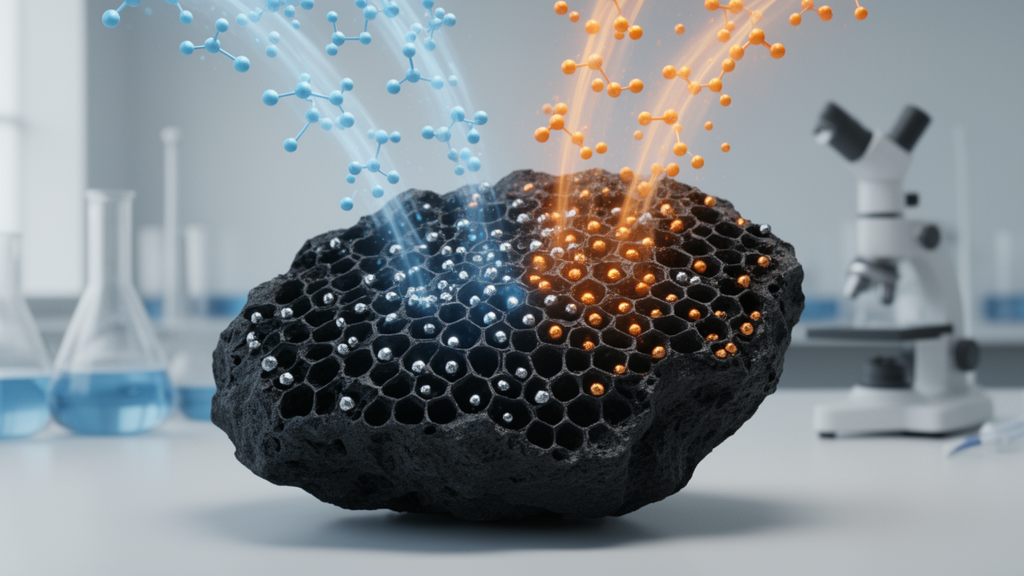
Chemists in the United Kingdom and Spain have turned agricultural waste almond shells into a catalyst that converts carbon dioxide into carbon monoxide with remarkable precision, achieving up to 87 percent CO2 conversion and essentially perfect selectivity for the desired product at 750 degrees Celsius. The catalysts, described in a study published in Frontiers in Chemistry, pair iron with biochar, a porous carbon material made by heating biomass in the absence of oxygen, and they managed to suppress the formation of methane, the troublesome by-product that usually plagues this chemistry even when the hydrogen supply is abundant. Carbon monoxide produced this way is a valuable feedstock: it can be fed into Fischer-Tropsch synthesis to make liquid hydrocarbon fuels, or routed into methanol synthesis units such as the CAMERE process, which chains RWGS and methanol production together as a direct route from CO2 to value-added chemicals.
What has been missing, the researchers argue, is a systematic understanding of how iron behaves when supported on biochar, whose texture and surface chemistry can be tuned by thermal and chemical treatments. Most previous RWGS studies have used conventional supports such as inert alumina or reducible oxides like ceria, and while biochar-based catalysts have been proposed for related reactions, including platinum catalysts for the water-gas shift and its reverse, only a handful of studies have examined biochar supports specifically for RWGS. The team, led by Maryanne Mosonik and Roberto Volpe of Queen Mary University of London together with Tomas Ramirez Reina of the University of Surrey and the University of Seville-CSIC, began with almond shells from southern Italy.
The shells were milled and sieved to particles below 125 micrometres, dried for 48 hours at 105 degrees Celsius and stored under argon to prevent ageing. Pyrolysis in a tubular furnace at 500 degrees Celsius for one hour under a flowing argon atmosphere converted the biomass into biochar, yielding roughly 30 percent of the starting mass. The char was washed with methanol, filtered and dried before iron was introduced.
Iron loading was achieved by wet impregnation with iron(II) acetate dissolved in methanol, targeting either 20 or 40 percent iron by weight. The impregnated biochar was then pyrolysed again, either at 700 degrees Celsius, labelled low heat, or at 1000 degrees Celsius, labelled high heat, with holding times of either one or three hours. This matrix of conditions produced five distinct catalysts, and the actual iron contents measured by inductively coupled plasma optical emission spectroscopy came out at 19.5 and 38.9 percent, closely matching the nominal targets.
X-ray diffraction revealed that metallic iron, in its body-centred cubic alpha form, dominated every sample. Iron carbide, Fe3C, appeared in catalysts synthesised at high temperature or with longer residence times, with one telling exception: the 20 percent iron sample treated at 1000 degrees Celsius for three hours showed almost no carbide, which the authors attribute to carbide decomposition under prolonged high-temperature treatment in argon, a process known to begin above roughly 527 degrees Celsius. The lowest-temperature, shortest-duration sample, 20 percent LHS, retained traces of magnetite, Fe3O4, suggesting its reduction to metallic iron was incomplete.
Transmission electron microscopy showed iron particles wrapped in carbon shells, consistent with a dissolution-precipitation model in which carbon atoms dissolve into gamma-iron at 1000 degrees Celsius and precipitate out on cooling, encapsulating the metal. Perhaps surprisingly, the synthesis conditions barely changed the physical texture of the catalysts. BET surface areas ranged only from 122 to 147 square metres per gram, with similar pore volumes near 0.1 cubic centimetres per gram and pore diameters around 4 nanometres across all five samples.
This uniformity allowed the team to attribute differences in catalytic behaviour to the iron phases and their interaction with the carbon support rather than to textural variation, and it set the stage for clean performance comparisons. Catalytic testing took place in a vertical fixed-bed quartz reactor loaded with 0.25 grams of catalyst, fed with a hydrogen-to-CO2 ratio of 4 to 1 at a space velocity of 12,000 millilitres per gram per hour, with products monitored continuously by an online gas analyser from 350 to 750 degrees Celsius. Every catalyst was active across the whole range, and at 750 degrees Celsius CO2 conversions spanned 74 to 87 percent with CO selectivities between 82 and 100 percent.
Four of the five catalysts exceeded 80 percent conversion with approximately 100 percent CO selectivity, and the best performers, 20 percent HHL and 40 percent HHS, approached the calculated thermodynamic equilibrium conversion in the 550 to 750 degrees Celsius window. Strikingly, no methane was detected at any temperature, despite the hydrogen-rich feed that would normally favour Sabatier methanation. When the researchers normalised CO2 consumption rates by the actual iron content of each catalyst, differences between samples persisted, proving that performance cannot be explained by iron loading alone and pointing to a genuine role for the metal-support interface.
At 750 degrees Celsius the leading catalysts reached consumption rates of about 0.32 grams of CO2 per gram of active phase per minute, figures that compare competitively with published iron-based RWGS systems, many of which rely on ceria supports. The authors suggest that carbon monoxide binds weakly at the iron-biochar interface and therefore desorbs before it can be further hydrogenated to methane, a selectivity mechanism consistent with earlier work showing that stabilising an adsorbed CO intermediate tips selectivity toward methanation while weak binding releases CO. Post-reaction X-ray diffraction added a final twist: after exposure to the hydrogen-rich reaction stream at high temperature, all iron oxide and iron carbide peaks vanished, leaving metallic iron as the dominant crystalline phase, since both H2 and CO can reduce these species under the reaction conditions.
Because metallic iron is the main active phase, this in-situ reduction actually benefits the reaction. The authors are careful to note the limits of the study: selectivity occasionally fell below 100 percent, and while methane was absent, other carbon-containing products such as C2+ hydrocarbons from Fischer-Tropsch-type pathways could not be excluded because a complete carbon balance was not established. Even so, the work stands as a proof of concept that biomass-derived supports can carry transition metals into demanding CO2 conversion chemistry, offering structural, thermal and mechanical advantages for real-world applications such as integrated RWGS-Fischer-Tropsch schemes and CAMERE-style methanol production.
Subject of Research: Biochar-supported iron catalysts for the reverse water-gas shift conversion of CO2 to CO
Article Title: Efficient eco-friendly biochar-based catalyst design for CO2 conversion via the reverse water-gas shift reaction
Article References: Mosonik, M., Zhang, Q., Villora-Pico, J. J., Reina, T. R., & Volpe, R. (2026). Efficient eco-friendly biochar-based catalyst design for CO2 conversion via the reverse water-gas shift reaction. Frontiers in Chemistry, 14, 1953213. https://doi.org/10.3389/fchem.2026.1953213
Image Credits: AI Generated
DOI: 10.3389/fchem.2026.1953213
Keywords: biochar, iron catalyst, reverse water-gas shift, CO2 conversion, carbon monoxide, methane suppression, pyrolysis, almond shells, Fischer-Tropsch, green chemistry, heterogeneous catalysis, carbon utilisation
Cite Scienmag News
Bethany Barker. (October 27, 2026). Almond-Shell Biochar Turns Iron Into a Near-Perfect CO2-to-CO Catalyst. Scienmag. https://scienmag.com/almond-shell-biochar-turns-iron-into-a-near-perfect-co2-to-co-catalyst/
Bethany Barker. "Almond-Shell Biochar Turns Iron Into a Near-Perfect CO2-to-CO Catalyst." Scienmag, 27 October 2026, https://scienmag.com/almond-shell-biochar-turns-iron-into-a-near-perfect-co2-to-co-catalyst/. Accessed 27 October 2026.
Bethany Barker. "Almond-Shell Biochar Turns Iron Into a Near-Perfect CO2-to-CO Catalyst." Scienmag. October 27, 2026. https://scienmag.com/almond-shell-biochar-turns-iron-into-a-near-perfect-co2-to-co-catalyst/


