


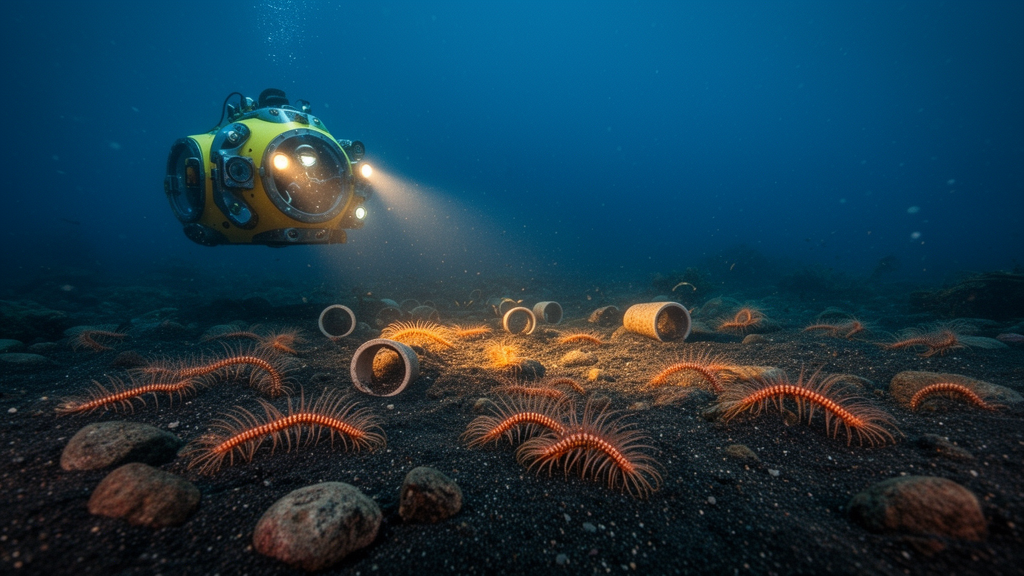
A newly published data paper in the Biodiversity Data Journal introduces a curated global checklist of polychaetes from these chemosynthetic and reducing habitats, bringing together decades of scattered taxonomic records into a single, standardised and publicly available dataset.
Polychaetes, a species-rich group within the phylum Annelida, are among the most important benthic faunal components in deep-sea chemosynthetic and reducing ecosystems. Records of these worms have accumulated over decades, but they have been dispersed across species descriptions, regional surveys, ecological investigations, handbooks and reviews, each adopting inconsistent taxonomic frameworks, habitat terminology and levels of record detail.
That fragmentation has practical consequences. Some historical names have undergone synonymisation or generic re-assignment, and certain habitat associations were only recognised in later studies. These discrepancies hamper direct comparison and reuse of global datasets. The new dataset, compiled by Yu Li and Xuwen Wu, addresses the problem by harmonising scientific names against the World Register of Marine Species (WoRMS), attaching AphiaIDs, LSIDs and taxonomic status to every entry, and linking each record to its original literature source.
The dataset, version 1.0.1, is archived on Zenodo under a Creative Commons Attribution 4.0 International licence and contains 368 checklist-level taxonomic records, of which 363 are included in core statistics according to the ‘includeInCoreStatistics’ field. The main table holds 364 WoRMS accepted records, two taxon inquirendum, one alternative representation and one unaccepted record retained for taxonomic tracking. Of the 363 core records, 360 are core records and three are provisional core records; the remaining five are excluded because of taxonomic or habitat evidence issues.
Each row in the main file, ‘taxon_checklist.csv’, represents a taxon rather than an individual station, sampling event or occurrence record. The dataset provides taxonomic hierarchies, WoRMS identifiers, standardised and raw habitat descriptions, locality information, source references and taxonomic and ecological notes. Supplementary files include a reference table, a habitat controlled vocabulary, a field dictionary, taxonomic notes, a README, a CITATION file, a licence and a version history, with an Excel workbook offering a human-readable version of the CSV data.
Habitat associations are captured through a controlled vocabulary of ten standardised categories: hydrothermal vent, cold seep, methane seep, whale fall, wood fall, cow fall, organic fall, experimental substrate, reducing sediment and uncertain. For summary purposes these are grouped into six broad categories. Among all 368 records, the numbers of taxon records associated with individual habitat types are hydrothermal vent 189, cold seep 89, whale fall 69, wood fall 21, methane seep 15, cow fall seven, organic fall four, reducing sediment four, experimental substrate two and uncertain one. Because a single taxon may be associated with multiple habitats, the sum across categories exceeds the total number of main-table records, and these figures represent taxon-habitat associations rather than occurrence frequencies or abundances.
The compilation rests on 161 unique published references spanning 1957 to 2026, drawn from original taxonomic descriptions, revisions, regional faunal surveys, ecological studies, monographs, handbooks and reviews. Literature searches were conducted primarily in Web of Science, supplemented by Google Scholar, the Biodiversity Heritage Library, publisher websites and backward citation tracking. The final search and dataset update were completed on 19 August 2026. All records were initially compiled by Yu Li and reviewed by Xuwen Wu for taxonomy and habitat assignment, with disagreements resolved by re-examining the original literature.
The historical sweep of the source literature is itself revealing. Before the 1980s, taxonomic research on polychaetes in these habitats was limited in scope, and the dataset contains eight references from that period, including Hartman’s 1957 review of four families and early descriptions of siboglinid tubeworms. Following the discovery of hydrothermal vents in 1977, research expanded markedly: the dataset includes 28 references from 1980 to 1999, among them Pettibone’s descriptions of new Polynoidae from the Galápagos vents, the establishment of the family Alvinellidae by Desbruyères and Laubier in 1986, and the description of the methane hydrate-dwelling Hesiocaeca methanicola in the Gulf of Mexico. Most references, however, were published between 2000 and 2026, a period in which molecular phylogenetic methods became increasingly common alongside traditional morphology.
Geographically, the dataset covers major deep-sea chemosynthetic and reducing habitats worldwide, spanning the Pacific, Atlantic and Indian Oceans, the Southern Ocean and associated marginal seas. Location fields retain original geographic descriptions, from specific habitat areas and ridges to broader regional names, without speculative geolocation for historical records that provide only regional information. The authors emphasise that the dataset is suitable for global-scale taxonomic and biogeographic data integration, but it is not an occurrence-level geographic database.
The authors are explicit about the dataset’s limitations and intended uses. It supports taxonomic syntheses, global or regional biodiversity overviews, broad-scale habitat-association analyses and the compilation of occurrence-level data, and its AphiaIDs, LSIDs and reference links facilitate connections to WoRMS, OBIS, GBIF and institutional specimen databases. It is not suitable for fine-scale species distribution modelling, station-level community analyses or sampling-effort-corrected richness estimation, because it lacks systematic coordinates, sampling dates, depths, specimen numbers and abundance information. Completeness is also constrained by search coverage, the digitisation of historical literature and language accessibility, so version 1.0.1 represents the best available information at the time of release rather than an exhaustive global checklist. Taxonomic status will continue to change with new evidence, and widespread species, provisional cf. records and twelve flagged suspected additional taxa, indicating possible undescribed or cryptic species, require cautious interpretation. The dataset is maintained with versioned updates, with future revisions expected to add new species and records, reflect changes in WoRMS taxonomy and potentially expand to occurrence-level data, laying a foundation for deeper synthesis of life in the ocean’s chemical-powered depths.
Subject of Research: A curated global checklist dataset of polychaetes from deep-sea chemosynthetic and reducing habitats
Article Title: A curated global checklist of polychaetes ( Annelida ) from deep‑sea chemosynthetic and reducing habitats
Article References: Li, Y., Chen, Y., & Wu, X. (2026). A curated global checklist of polychaetes (Annelida) from deep‑sea chemosynthetic and reducing habitats. Biodiversity Data Journal, 14, Article e212692. https://doi.org/10.3897/BDJ.14.e212692
Image Credits: AI Generated
Keywords: polychaetes, deep sea, hydrothermal vents, cold seeps, whale falls, wood falls, chemosynthesis, WoRMS, biodiversity dataset, taxonomy, Annelida, Zenodo
Cite Scienmag News
Drew Townsend. (October 27, 2026). Global checklist brings order to deep-sea polychaete diversity. Scienmag. https://scienmag.com/global-checklist-brings-order-to-deep-sea-polychaete-diversity/
Drew Townsend. "Global checklist brings order to deep-sea polychaete diversity." Scienmag, 27 October 2026, https://scienmag.com/global-checklist-brings-order-to-deep-sea-polychaete-diversity/. Accessed 27 October 2026.
Drew Townsend. "Global checklist brings order to deep-sea polychaete diversity." Scienmag. October 27, 2026. https://scienmag.com/global-checklist-brings-order-to-deep-sea-polychaete-diversity/


