


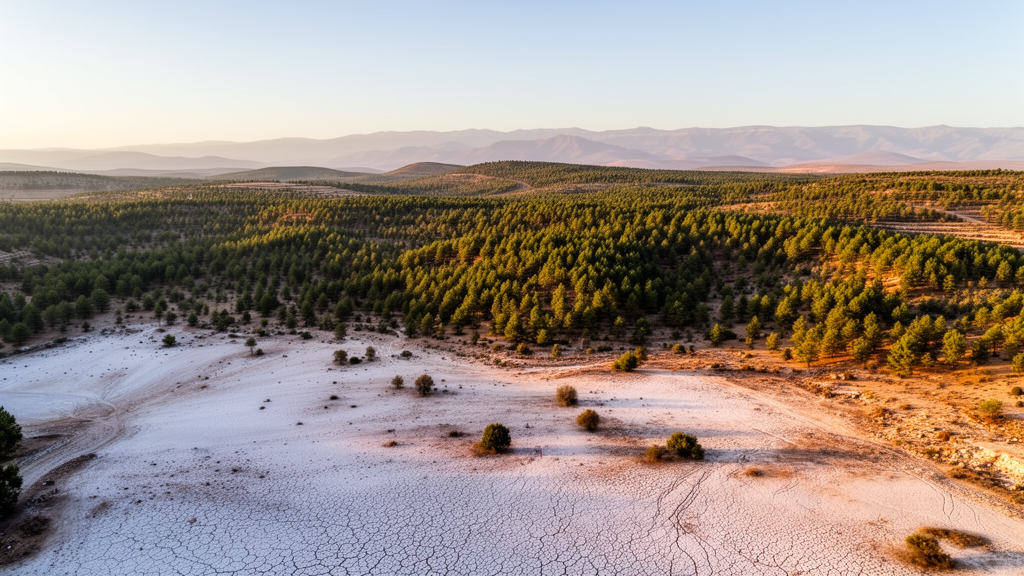
Khenifra National Park, a protected landscape in Morocco’s Middle Atlas mountains, has undergone a marked reorganization of its vegetation over the past three decades, according to a new satellite-based analysis published in Theoretical and Applied Climatology. Between 1995 and 2024, every vegetation density class in the park shrank while bare ground expanded by nearly half, a shift the researchers link to rising temperatures, declining rainfall and shrinking surface water, with possible additional pressure from human activities.
The study, led by Salwa Mokrane and colleagues, relied primarily on the Normalized Difference Vegetation Index, or NDVI, a satellite-derived measure of the greenness and density of vegetation at the land surface. The team combined this index with the Modified Normalized Difference Water Index, which tracks surface water, and with climate records from Morocco’s General Directorate of Meteorology, including mean annual maximum temperature, mean annual minimum temperature and cumulative annual precipitation. Together, these datasets allowed the researchers to map how vegetation density classes changed across the park and to test whether those changes tracked climatic conditions over the same period.
The numbers reveal a consistent downward redistribution. Low vegetation, the sparsest of the vegetated classes, fell from 17,690.96 hectares to 14,082.71 hectares, a loss of 3,608.25 hectares, or 20.40 percent. Moderate vegetation declined by 3,284.23 hectares, equivalent to 12.11 percent. Dense vegetation decreased from 20,465.52 hectares to 18,589.30 hectares, a reduction of 1,876.22 hectares or 9.17 percent. Meanwhile, bare soil expanded dramatically, from 18,827.76 hectares to 27,697.50 hectares, an increase of 47.11 percent. A transition matrix confirmed the pattern: land moved predominantly from higher-density vegetation classes toward lower-density ones rather than in the reverse direction.
The timing of these changes is notable. The authors report that the reorganization of vegetation formations was particularly pronounced after 2018, and that annual cumulative precipitation declined markedly after that same year. Temperature, by contrast, rose across the whole record: mean annual maximum temperature increased by approximately 2.2 degrees Celsius between 1995 and 2024. The hydrological signal is equally stark. Analysis based on the Modified Normalized Difference Water Index showed that surface water area within the park collapsed from roughly 400 hectares in 2010 to just 120 hectares in 2024, a loss of about seventy percent of the open water visible to the satellite sensor in that fourteen-year window.
When the researchers examined the statistical relationship between vegetation density and the climatic variables, the picture was more nuanced. Some negative associations emerged between vegetation density and temperature, particularly for dense vegetation, meaning that hotter years tended to coincide with lower values of the densest vegetation class. However, after applying the Benjamini-Hochberg false discovery rate correction, a statistical procedure that guards against spurious findings when many correlations are tested simultaneously, most of these vegetation-climate relationships were no longer statistically significant. The authors therefore treat the climatic linkage as suggestive rather than proven for individual classes, even as the overall pattern of warming, drying and vegetation loss points toward increasing stress on the ecosystem.
A complementary spatial trend analysis of the full NDVI time series adds an important qualification to the headline losses. Across the park’s vegetated areas, 88.64 percent showed no statistically significant NDVI trend over the study period. Where significant trends did occur, increases covered 8.43 percent of vegetated land, more than the 2.93 percent showing significant decreases. This spatial pattern indicates that vegetation decline was not generalized across the entire park; instead, degradation appears concentrated in particular zones while other areas remained stable or even greened. The authors suggest that this uneven spatial distribution of degradation may be influenced by anthropogenic pressures, implying that human activities could contribute to where vegetation thins, alongside the broader climatic drivers.
The authors are careful to frame their findings as indicative rather than definitive. The results, they write, may indicate increasing vegetation stress under concurrent warming and hydrological stress, and the spatial pattern of degradation may be influenced by anthropogenic pressures. The statistical non-significance of most vegetation-climate correlations after correction, and the predominance of stable NDVI trends across the park, both caution against a simple narrative of uniform climate-driven collapse. What the data do establish firmly is the magnitude of the land-cover change itself: the hectare-level losses in all three vegetation classes, the 47.11 percent expansion of bare soil, the 2.2 degree Celsius rise in maximum temperature, the post-2018 decline in precipitation, and the shrinkage of surface water from about 400 hectares to 120 hectares.
Looking forward, the authors argue that the findings highlight the need for sustainable management strategies tailored to the park’s specific pressures. Among the measures they identify are cedar regeneration, reforestation in priority areas, and grazing control, to be implemented while taking into account both climatic and anthropogenic pressures. Because the degradation is spatially uneven, such targeted interventions could in principle be directed at the zones where vegetation loss is concentrated rather than applied uniformly. The study, published on 27 October 2026 in Volume 157 of Theoretical and Applied Climatology as article number 758, provides a three-decade quantitative record of vegetation, water and climate for a single protected area against which the success or failure of those strategies can eventually be measured.
Subject of Research: Satellite-based analysis of vegetation cover change in Khenifra National Park, Morocco, from 1995 to 2024 in relation to climate and human pressures
Article Title: Vegetation cover dynamics in Khenifra National Park, Middle Atlas, Morocco (1995–2024): Effects of climate change and potential anthropogenic pressures
Article References: Mokrane, S., Gharnit, Y., Aabdousse, J., El Jarmouni, M., Khaffou, M., El Harti, A., & Boulli, A. (2026). Vegetation cover dynamics in Khenifra National Park, Middle Atlas, Morocco (1995–2024): Effects of climate change and potential anthropogenic pressures. Theoretical and Applied Climatology, 157(11), Article 758. https://doi.org/10.1007/s00704-026-06685-y
Image Credits: AI Generated
DOI: 10.1007/s00704-026-06685-y
Keywords: Khenifra National Park, Middle Atlas, Morocco, NDVI, vegetation cover, bare soil expansion, climate change, MNDWI, surface water, remote sensing, anthropogenic pressure, Theoretical and Applied Climatology
Cite Scienmag News
Violet Maxwell. (October 27, 2026). Morocco’s Khenifra National Park Loses Vegetation as Bare Soil Expands. Scienmag. https://scienmag.com/moroccos-khenifra-national-park-loses-vegetation-as-bare-soil-expands/
Violet Maxwell. "Morocco’s Khenifra National Park Loses Vegetation as Bare Soil Expands." Scienmag, 27 October 2026, https://scienmag.com/moroccos-khenifra-national-park-loses-vegetation-as-bare-soil-expands/. Accessed 27 October 2026.
Violet Maxwell. "Morocco’s Khenifra National Park Loses Vegetation as Bare Soil Expands." Scienmag. October 27, 2026. https://scienmag.com/moroccos-khenifra-national-park-loses-vegetation-as-bare-soil-expands/


