


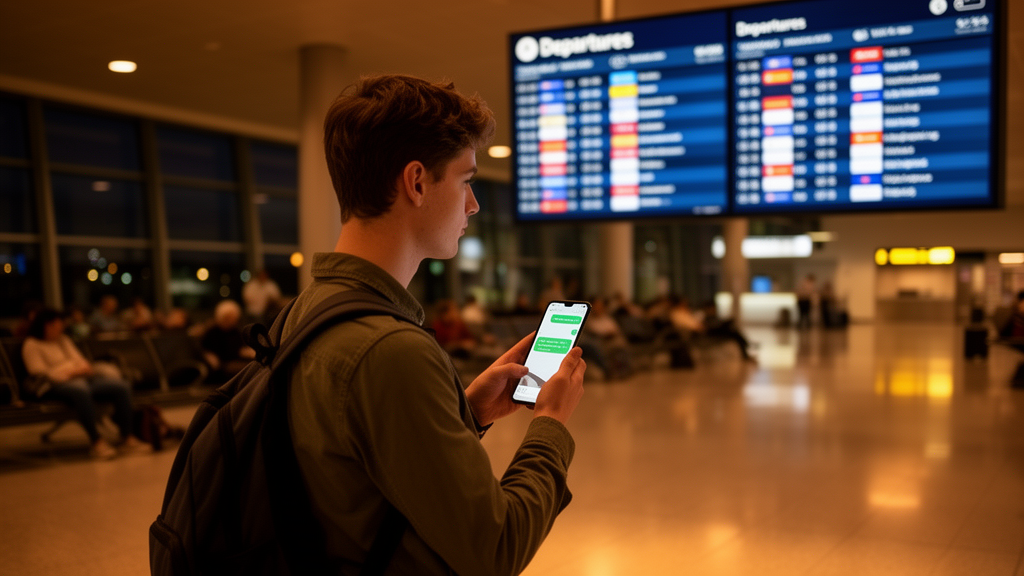
Tourism accounts for roughly five percent of global carbon emissions, and air transport is responsible for about 43 percent of that footprint. In wealthy countries, flying has become the default mode of long-distance holiday travel, made ever more accessible by low-cost airlines. Because carbon pricing, fuel taxes and cleaner aircraft face political and economic constraints, researchers are increasingly testing whether behavioral interventions can act on the margins that conventional policy does not reach: the salience of emissions at the moment of trip planning, the perceived social normality of flying, and the visibility of lower-carbon alternatives.
A new randomized controlled trial conducted in Lugano, Switzerland, put one such intervention to the test. The tool, called Treeps, is a multi-component digital nudging app that combines a generative AI chatbot built on GPT-3.5, peer-generated content shared through the app and a linked Instagram account, carbon feedback, and gamified rewards. The short-term results, published in Frontiers in Sustainable Cities, are sobering but nuanced: the intervention produced no detectable average effect across all participants, yet the most engaged users showed measurably lower intentions to fly for holidays.
The study is rooted in the Model of Action Phases, a psychological framework that describes behavior change as a progression through four stages. In the pre-decision phase, personal and social norms help habitual flyers begin to set a goal for change. In the pre-action phase, positive attitudes toward low-carbon holidays and greater perceived behavioral control support intention formation. The action and post-action phases then involve implementing sufficient holidays and sustaining them through rewards and social support. The Treeps app was designed to activate each of these levers: the chatbot suggested lower-impact destinations and reported the carbon saved compared with flying, the community section displayed other users’ experiences with injunctive norm messages, and a points system rewarded those who shared their own trips.
The trial was pre-registered and approved by an ethics committee. Starting in March 2025, participants were recruited through the newsletter of Lugano Living Lab, the municipality’s innovation lab, which reaches more than 10,000 subscribers. The recruitment message explicitly targeted people who love traveling. Of 364 applicants, 294 were deemed eligible, and 204 completed the baseline questionnaire in April 2025 and were randomly assigned in equal numbers to treatment and control groups. The treatment group received access to Treeps for three months, from May to August 2025, while the control group received nothing. A follow-up survey immediately after the intervention left 146 participants in the analytical sample: 84 controls and 62 treated participants.
The sample was deliberately skewed toward frequent flyers. Both groups averaged 0.7 leisure flights in the three months before the trial, far above the Swiss national average of 0.68 leisure flights per person per year recorded in the 2015 Mobility and Transport Micro Census. Participants were mainly working-age adults with high education levels, and most began the study in the pre-decision phase of behavior change, meaning they were habitual flyers who had not yet formed an intention to change.
The primary analysis used an intention-to-treat framework with individual fixed-effects panel models, algebraically equivalent to a difference-in-differences regression with two time points. This approach counts every assigned participant as treated regardless of actual app use, providing an objective estimate of real-world effectiveness. The outcomes included psychological antecedents such as personal norms, descriptive and injunctive social norms, perceived behavioral control, and attitudes toward planes and trains, plus the stated intention to fly for holidays in the following three months. After correcting for multiple testing using the Benjamini-Hochberg procedure within theoretical families of outcomes, no statistically significant average treatment effects emerged on any outcome.
The authors emphasize that this null result should be read as an absence of evidence rather than evidence of absence. The trial was powered a priori for a longer-term behavioral outcome, the number of flights per person per year, requiring between 140 and 280 participants depending on the targeted effect size, but not for the short-term psychological and intention outcomes examined here. A post-hoc calculation suggests that roughly 194 participants would have been needed to detect the observed effect on descriptive social norms with 80 percent power. The final analytical sample was substantially smaller, leaving the study underpowered for small-to-moderate psychological shifts.
Attrition posed a further challenge. Dropout reached 39 percent in the treatment group versus 18 percent in the control group, and a logistic regression confirmed that treatment assignment significantly predicted dropout, alongside a negative association with age. The researchers applied inverse probability weighting, assigning each retained participant a weight based on the estimated probability of remaining in the study given treatment status and baseline characteristics such as age, gender, education, employment, prior flights and behavior-change phase. Balance tests showed no significant differences between the retained treatment and control groups on observed characteristics, but the authors caution that bias from unobserved factors, such as motivation or available time, cannot be ruled out.
Engagement with the tool itself was highly uneven. Of the 102 treated participants, 67 used the app at least once, but 18 never activated an account. The chatbot handled 472 exchanges and suggested 196 destinations, yet only 67 of those were unique, a repetition problem the authors identify as a likely driver of disengagement. Just 21 participants shared holiday experiences, and the three most active users accounted for 50 of the 89 posts. To capture this variation, the team built a standardized Engagement Index from app accesses, chatbot messages and shared posts, and used it in an exploratory interaction analysis that was explicitly associational rather than causal, since engagement was not randomized.
The engagement analysis yielded two striking patterns. First, each one-unit increase in the Engagement Index was associated with a 0.107 decrease in the intention to fly for holidays, a statistically significant association that survived multiple-testing correction. At the 90th percentile of engagement, the model estimated a difference of 0.334 intended flights per capita between treatment and control participants, though confidence intervals included zero across much of the observed range. Second, higher engagement was linked to a smaller reduction in perceived descriptive norms: the most active users came to believe that a larger share of the Swiss population flies on holiday, the opposite of the intended shift. A post-hoc analysis offered a possible explanation. Participants without Instagram accounts, only 18 percent of treated respondents, engaged far more with the app and showed a larger increase in perceived holiday flying, whereas Instagram users, who could see Treeps posts almost daily in their feeds, showed a marginally significant decrease in the perceived prevalence of flying. The authors speculate that highly active contributors may have come to see themselves as exceptions rather than part of a broader trend, though this interpretation remains hypothesis-generating.
Because holiday air travel is planned and booked well in advance, the three-month window was too short to capture actual behavior change, and the study measured only psychological antecedents and stated intentions, leaving the well-documented attitude-behavior gap untested. The sample was also self-selected and highly educated, limiting generalizability, and the skewed engagement distribution means the most active users drove most of the observed variation. The authors recommend that future interventions invest heavily in chatbot performance, unlock all destination content from the start, supplement scarce user-generated posts with clearly labeled researcher-provided examples to protect descriptive norms, and explore ways to engage less active users. Longer follow-up waves of the trial will reveal whether the psychological shifts observed among engaged users ultimately translate into fewer flights, and whether tools combining generative AI, gamification and peer content can genuinely help steer holiday travel toward lower-carbon choices.
Subject of Research: A randomized controlled trial testing a GenAI and peer-based digital nudging app to reduce holiday air travel demand in Switzerland
Article Title: Toward less air travel: evidence from a multi-component field experiment combining GenAI and peer-based digital nudges
Article References: Ventimiglia, L., Cellina, F., Soma, L., Granato, P., & Tavoni, A. (2026). Toward less air travel: evidence from a multi-component field experiment combining GenAI and peer-based digital nudges. Frontiers in Sustainable Cities, 8, 1960238. https://doi.org/10.3389/frsc.2026.1960238
Image Credits: AI Generated
DOI: 10.3389/frsc.2026.1960238
Keywords: digital nudging, generative AI, holiday air travel, randomized controlled trial, social norms, behavior change, carbon emissions, sustainable tourism, gamification, Switzerland, chatbot, flight intentions
Cite Scienmag News
Sloane Callahan. (October 27, 2026). AI Chatbot and Peer Nudges Show Hints of Curbing Holiday Flying Intentions. Scienmag. https://scienmag.com/ai-chatbot-and-peer-nudges-show-hints-of-curbing-holiday-flying-intentions/
Sloane Callahan. "AI Chatbot and Peer Nudges Show Hints of Curbing Holiday Flying Intentions." Scienmag, 27 October 2026, https://scienmag.com/ai-chatbot-and-peer-nudges-show-hints-of-curbing-holiday-flying-intentions/. Accessed 27 October 2026.
Sloane Callahan. "AI Chatbot and Peer Nudges Show Hints of Curbing Holiday Flying Intentions." Scienmag. October 27, 2026. https://scienmag.com/ai-chatbot-and-peer-nudges-show-hints-of-curbing-holiday-flying-intentions/


