


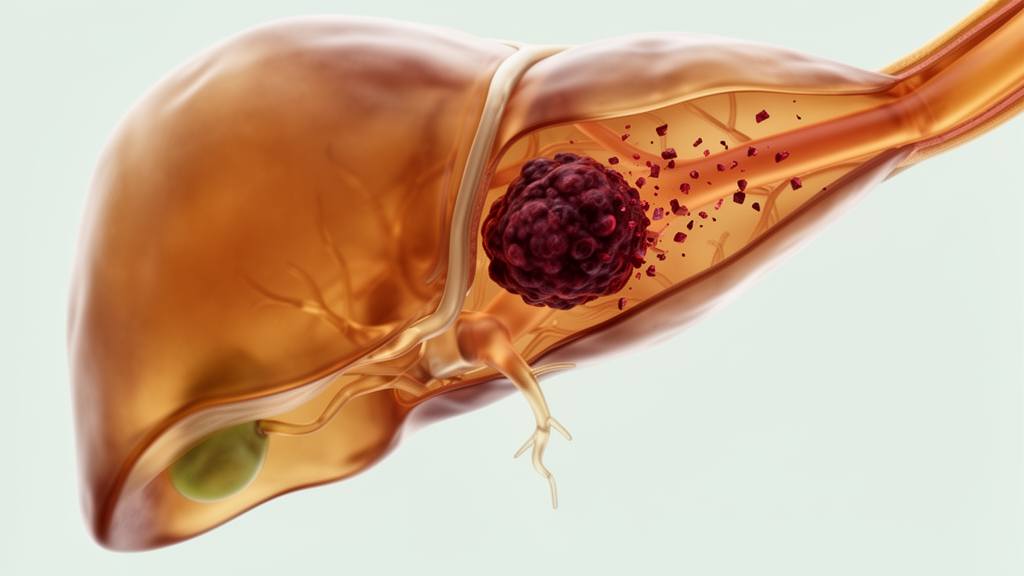
A 63-year-old man in China with a giant, inoperable liver cancer that had invaded one of the body’s largest blood vessels is still alive more than four years after the mass was first detected, according to a case report published in Frontiers in Oncology. The most striking element of his course is not simply survival beyond the few months typically expected when hepatocellular carcinoma reaches the inferior vena cava, but the complete, sustained disappearance of the tumor thrombus inside that vessel after a sequence of two very different systemic therapies, one of them delivered at a reduced, non-standard dose.
Hepatocellular carcinoma is the sixth most common malignancy worldwide and the fourth leading cause of cancer death, with the burden concentrated in East Asia where chronic hepatitis B infection is widespread. Roughly 70 to 80 percent of patients are diagnosed at an advanced stage, when curative resection or local ablation is no longer possible. Major vascular invasion, meaning tumor thrombus growing into the portal vein or the inferior vena cava, occurs in 10 to 40 percent of advanced cases, and without systemic treatment median overall survival in such patients is only 2.7 to 4.0 months. An inferior vena cava thrombus is especially dangerous because it can trigger Budd-Chiari syndrome, pulmonary embolism, and rapid hemodynamic collapse.
The patient first came to medical attention in October 2022 with a liver mass found incidentally ten months earlier. Imaging showed a bulky liver with multiple lesions, the two largest measuring 13.51 and 6.67 centimeters, for a combined target-lesion diameter of 20.18 centimeters. Laboratory tests pointed to hepatitis B-related disease: hepatitis B surface antigen was strongly positive, albumin was severely depleted at 24.6 grams per liter, and the baseline Child-Pugh score of 7 placed him in class B, with an albumin-bilirubin grade of 3. Tumor markers were only modestly elevated at that point, with alpha-fetoprotein at 23.4 nanograms per milliliter and PIVKA-II at 77.8. A multidisciplinary team judged surgical resection infeasible, and the patient declined both surgery and interventional procedures, requesting systemic therapy instead.
He began first-line treatment on 22 October 2022 with sintilimab, a PD-1 immune checkpoint inhibitor, plus IBI305, a bevacizumab biosimilar, mirroring the combination validated in the phase 2-3 ORIENT-32 trial. For financial reasons, however, the infusions were spaced every four weeks rather than the standard three. By January 2023, after roughly three months, the target lesions had shrunk 12.2 percent, tumor markers had fallen, albumin had recovered, and liver function had returned to Child-Pugh class A. But the scan also revealed something new: a filling defect in the inferior vena cava. Under RECIST 1.1 criteria, a new lesion defines progressive disease, so the assessment was formally recorded as progression. The multidisciplinary team, noting the simultaneous shrinkage of intrahepatic tumors, falling markers, and the patient’s preserved performance status, judged it more likely that improved imaging had unmasked a previously occult thrombus than that the disease was truly advancing, and treatment continued.
He completed twelve cycles by late August 2023, by which time the target-lesion sum had fallen a further 23.5 percent from baseline and the thrombus remained stable. Then came a critical turning point. The patient stopped therapy on his own, again citing financial constraints, and turned to oral traditional Chinese medicine. Ten and a half months after his last infusion, in December 2023, he was readmitted with massive ascites and bilateral leg swelling. Liver function had slipped back to Child-Pugh class B and his performance status had deteriorated. When immunotherapy was eventually reinitiated in mid-2024, imaging showed the target lesions had grown to 20.77 centimeters, a 34.5 percent increase from their lowest point, and PIVKA-II had exploded to 16,934.56 nanograms per milliliter, signaling aggressive tumor evolution during the treatment-free interval.
With the disease now progressing despite re-exposure to the first-line regimen, the team switched to regorafenib, a multi-kinase inhibitor targeting VEGFR, TIE2, KIT, RET, RAF-1, BRAF, and FGFR. Regorafenib is approved as a second-line option after sorafenib failure or intolerance, so its use here, after immune checkpoint inhibitor and anti-VEGF therapy, was explicitly non-standard and individualized. Financial constraints again shaped the plan: instead of the approved 160 milligrams daily, the patient started at 80 milligrams per day, later reduced to 80 milligrams every other day after a grade 2 hand-foot skin reaction developed. He adhered closely to the adjusted schedule.
The response was remarkable. By April 2025 the target-lesion sum had fallen 29.3 percent from baseline, just short of the partial-response threshold, and the inferior vena cava tumor thrombus had regressed completely. Alpha-fetoprotein had normalized to 5.0 nanograms per milliliter. Scans in January and June 2026 showed continued shrinkage, with the sum of diameters reaching 10.32 centimeters, a 48.9 percent reduction from the original baseline and a formal partial response under RECIST 1.1. The thrombus had vanished, liver function remained class A, and the patient was still taking regorafenib with manageable toxicity and good performance status as of June 2026, more than four years after the liver mass was first detected.
The authors of the report argue that the depth and durability of this response challenge the conventional view that second-line tyrosine kinase inhibitors merely delay progression rather than producing meaningful tumor regression. They suggest several possible mechanisms, while stressing that none were demonstrated in this patient because no serial biopsies or immune profiling were performed. Regorafenib’s broad kinase inhibition may have starved the thrombus vasculature through potent anti-angiogenic effects. Tyrosine kinase inhibitors can also reshape the tumor immune microenvironment, reducing regulatory T cells and promoting immune-cell activation, potentially priming residual disease for immune surveillance after prior checkpoint blockade. More speculative pathways involving ferroptosis, a form of iron-dependent cell death that regorafenib can induce in other cancers, are raised only as hypotheses consistent with the broader biology of hepatocellular carcinoma.
The case also carries sobering lessons about treatment continuity and safety gaps in real-world practice. The interruption led to rapid decompensation, and the authors note that the tumor microenvironment may shift toward an immunosuppressive state when therapeutic pressure lapses. Equally important are the limitations they candidly acknowledge: the diagnosis rested on imaging and tumor markers rather than histopathology; baseline HBV DNA was never measured and serial viral-load monitoring was never done despite the concrete risk of hepatitis B reactivation during immunotherapy in a surface-antigen-positive patient who declined antiviral treatment; blood pressure was not regularly monitored or treated during bevacizumab-containing therapy despite emerging hypertension; and the vascular thrombus was assessed qualitatively rather than by caliper measurement. The authors frame these as reflections of real-world adherence barriers rather than a model of care, and they caution that a single favorable outcome may owe much to patient-specific factors such as preserved performance status and restored adherence. Still, the report adds to growing evidence that durable survival is achievable even in traditionally poor-prognosis subgroups of advanced liver cancer, and it underscores how individualized dose adjustment, careful toxicity management, and sequential use of immune and targeted therapies can, in exceptional cases, push the disease back from the great vessels entirely.
Subject of Research: Sequential systemic therapy for unresectable hepatocellular carcinoma with inferior vena cava tumor thrombus
Article Title: Dramatic and sustained regression of an inferior vena cava tumor thrombus in a patient with unresectable giant hepatocellular carcinoma following sequential systemic therapy: a case report and literature review
Article References: Hou, J., & Wu, K. L. (2026). Dramatic and sustained regression of an inferior vena cava tumor thrombus in a patient with unresectable giant hepatocellular carcinoma following sequential systemic therapy: a case report and literature review. Frontiers in Oncology, 16, 1930045. https://doi.org/10.3389/fonc.2026.1930045
Image Credits: AI Generated
DOI: 10.3389/fonc.2026.1930045
Keywords: hepatocellular carcinoma, inferior vena cava tumor thrombus, sintilimab, bevacizumab biosimilar, regorafenib, immune checkpoint inhibitor, case report, RECIST 1.1, hepatitis B, vascular invasion, second-line therapy, Child-Pugh class
Cite Scienmag News
Nathaniel Bowman. (October 27, 2026). Shrinking the Untreatable: Blood-Vessel Tumor Thrombus Vanishes in Advanced Liver Cancer Case. Scienmag. https://scienmag.com/shrinking-the-untreatable-blood-vessel-tumor-thrombus-vanishes-in-advanced-liver-cancer-case/
Nathaniel Bowman. "Shrinking the Untreatable: Blood-Vessel Tumor Thrombus Vanishes in Advanced Liver Cancer Case." Scienmag, 27 October 2026, https://scienmag.com/shrinking-the-untreatable-blood-vessel-tumor-thrombus-vanishes-in-advanced-liver-cancer-case/. Accessed 27 October 2026.
Nathaniel Bowman. "Shrinking the Untreatable: Blood-Vessel Tumor Thrombus Vanishes in Advanced Liver Cancer Case." Scienmag. October 27, 2026. https://scienmag.com/shrinking-the-untreatable-blood-vessel-tumor-thrombus-vanishes-in-advanced-liver-cancer-case/


