


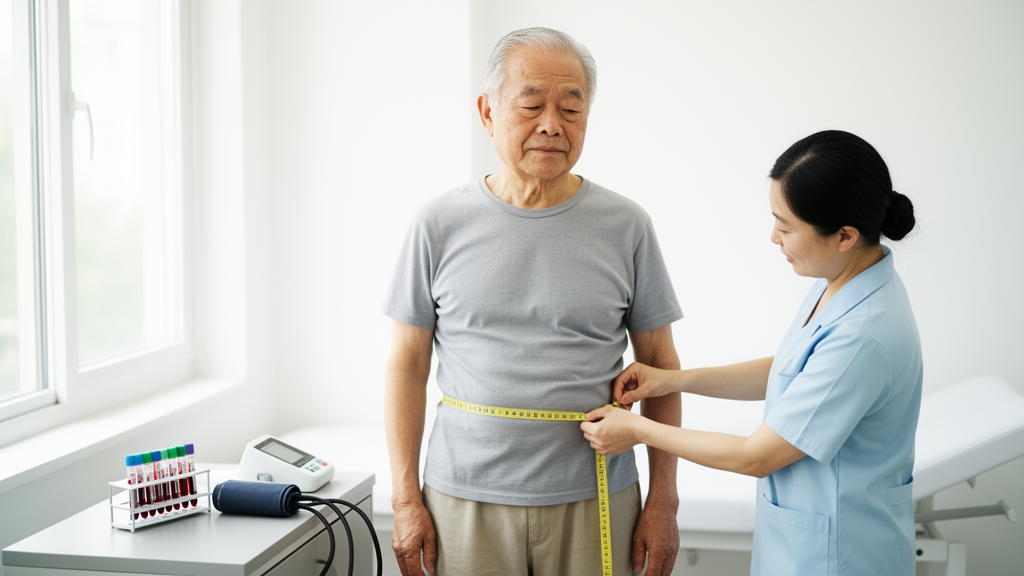
A large cross-sectional study of nearly 20,000 older adults in Nanjing, China, has found that both waist circumference and body mass index are independently linked to hypertriglyceridemia, a condition in which fasting triglyceride levels in the blood rise above healthy thresholds. The research, conducted by a team from Xuzhou Medical University, the Nanjing Municipal Center for Disease Control and Prevention, Nanjing Medical University and Jiangsu Province Official Hospital, examined community-dwelling residents aged 60 and older who were not living with diabetes and were not taking lipid-lowering medications. The study, published in the journal Frontiers in Nutrition, randomly sampled 19,668 participants from Nanjing municipality in 2023.
Hypertriglyceridemia was defined strictly on the basis of fasting triglyceride concentration, and body weight status was assessed in two separate ways: waist circumference, which captures central or abdominal fat accumulation, and body mass index, the familiar ratio of weight to height used to classify people as normal weight, overweight or obese. Overall, 29.3 percent of participants met the criteria for hypertriglyceridemia. That headline figure, however, concealed a striking gradient across body size categories.
Among people whose waist circumference fell within the normal range, the prevalence was 25.3 percent, while those classified as obese by waist circumference showed a prevalence of 32.3 percent. The gradient was even steeper when body mass index was used: 22.6 percent of participants with normal BMI had elevated triglycerides, rising to 33.1 percent among those who were overweight and 39.9 percent among those with obesity. To move beyond simple prevalence counts, the researchers turned to mixed-effects logistic regression, a statistical framework that can account for clustering in the sampling design while adjusting for potential confounding factors.
Compared with counterparts of normal weight, participants with waist-circumference-based obesity had 37 percent higher odds of hypertriglyceridemia, with an odds ratio of 1.37 and a 95 percent confidence interval of 1.28 to 1.44. Those classified as overweight by BMI had an odds ratio of 1.66 (95 percent CI 1.55 to 1.78), and those with BMI-based obesity had an odds ratio of 2.14 (95 percent CI 1.95 to 2.35), meaning their odds of elevated triglycerides were more than double those of normal-weight peers. The analysis also explored what happens when the two measures are considered together rather than separately.
Combining waist-circumference and BMI categories revealed positive associations between body weight status and hypertriglyceridemia across most joint groupings, with one notable exception: participants who had waist-circumference-based obesity but a normal BMI-based weight did not show a statistically significant elevation in odds. The researchers therefore stratified their analyses, and the patterns held. The relationships between body weight status and hypertriglyceridemia among age- and sex-stratified subgroups were similar to those observed in the overall sample, lending weight to the consistency of the association across demographic slices of the population.
The technical distinction between the two anthropometric measures matters for interpreting the results. In this study, BMI-based categories showed steeper odds ratios than waist-circumference-based categories, and the combined analysis suggests that each measure captures overlapping but not identical information about metabolic risk. Because the study is cross-sectional, measuring body weight and triglycerides at a single point in time, it can establish association but not causation.
It cannot determine whether higher body weight raises triglyceride levels, whether metabolic changes drive weight gain, or whether unmeasured factors influence both. The restriction to non-diabetic adults not taking lipid-lowering medications is a strength in that it removes two major sources of distortion, but it also means the findings may not generalize to older adults with diabetes or those already on statins or fibrates. The sampling was confined to one Chinese municipality, so regional generalizability is likewise limited.
The authors argue that their findings carry practical implications: specific waist-circumference-based or BMI-based weight statuses, or combinations of the two, should be considered in clinical practice and in public health campaigns aimed at managing triglyceride levels at the population level. For a study of this scale, the consistency of the gradient across both measures, the stability of the associations across age and sex strata, and the adjustment for confounders make a reasonably strong case that body weight status and hypertriglyceridemia travel together in this population. What remains open is the causal direction and the mechanistic pathway, questions that only longitudinal designs and metabolic studies can answer.
In the meantime, the data from Nanjing add to the evidence that in adults aged 60 and above, both the tape measure and the scale tell part of the same metabolic story.
Subject of Research: The association of body weight status measured by waist circumference and BMI with hypertriglyceridemia among community-dwelling older adults in Nanjing, China
Article Title: The association of body weight status with hypertriglyceridemia among community-dwelling older adults in regional China
Article References: Lu, S., Lu, Y., Ao, G., Yang, L., Ji, Y., Xu, T., Tang, W., & Xu, F. (2026). The association of body weight status with hypertriglyceridemia among community-dwelling older adults in regional China. Frontiers in Nutrition, 13, 1985854. https://doi.org/10.3389/fnut.2026.1985854
Image Credits: AI Generated
DOI: 10.3389/fnut.2026.1985854
Keywords: hypertriglyceridemia, obesity, overweight, body mass index, waist circumference, older adults, triglycerides, cross-sectional study, China, public health, clinical nutrition, logistic regression
Cite Scienmag News
Daisy Hatcher. (October 27, 2026). Bigger Waistlines and Higher BMI Both Track With Elevated Triglycerides in Older Chinese Adults. Scienmag. https://scienmag.com/bigger-waistlines-and-higher-bmi-both-track-with-elevated-triglycerides-in-older-chinese-adults/
Daisy Hatcher. "Bigger Waistlines and Higher BMI Both Track With Elevated Triglycerides in Older Chinese Adults." Scienmag, 27 October 2026, https://scienmag.com/bigger-waistlines-and-higher-bmi-both-track-with-elevated-triglycerides-in-older-chinese-adults/. Accessed 27 October 2026.
Daisy Hatcher. "Bigger Waistlines and Higher BMI Both Track With Elevated Triglycerides in Older Chinese Adults." Scienmag. October 27, 2026. https://scienmag.com/bigger-waistlines-and-higher-bmi-both-track-with-elevated-triglycerides-in-older-chinese-adults/


