


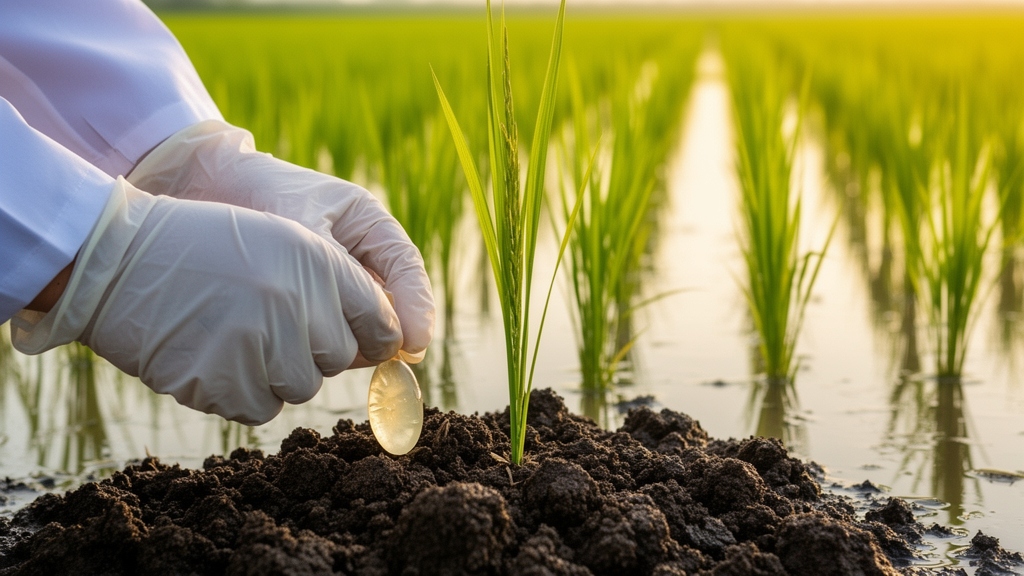
Researchers at Tamil Nadu Agricultural University in India have developed a biodegradable gelatin capsule that places herbicide powder directly into the flooded soil of transplanted rice fields, and a new field trial shows the approach can outperform conventional spraying for one widely used herbicide combination. In the study, published in Frontiers in Sustainable Food Systems, capsules filled with the recommended rate of bensulfuron methyl plus pretilachlor increased cumulative weed control by 16.9 percent and cut cumulative weed biomass by 28.7 percent over a 45-day assessment period compared with spraying the same formulation. The capsule treatment also lifted grain yield by 14.9 percent, from 4,755 to 5,463 kilograms per hectare, and delivered the highest benefit-to-cost ratio of any treatment tested.
The technology is deliberately simple. Each capsule measures roughly two centimeters across and holds about 1.5 grams of powdered or granular herbicide. The shell is made only of gelatin and water.
Workers place the capsules into the paddy three days after transplanting, and when the gelatin contacts moist soil it progressively disintegrates, releasing the active ingredient at the placement site rather than dispersing it through a spray cloud. The physical design is registered with the Indian Patent Office as Design No. 432328-001, and the delivery method is disclosed in Indian Patent Application No. 20241103293 A. The motivation lies in the well-documented weaknesses of spray application.
Herbicide droplets can drift away from the target zone or move downward through the soil profile, reducing application efficiency, exposing non-target organisms and raising the risk of environmental contamination. Poorly matched nozzles and spray volumes can further undermine delivery in rice. Because rice is a staple for roughly 60 percent of the global population, and India alone cultivates about 47 million hectares and produces around 132 million tonnes annually while accounting for more than 40 percent of world exports, even modest gains in input-use efficiency carry substantial weight.
The research proceeded in two phases. In a preliminary pot experiment, the team screened four herbicide formulations, pyrazosulfuron ethyl, butachlor, bensulfuron methyl plus pretilachlor, and triafamone plus ethoxysulfuron, each at 50, 75, 100 and 150 percent of the recommended rate, using twelve-day-old CO 55 rice seedlings and naturally emerging weeds from field soil. Weed control efficiency ranged from 72.2 to 100 percent across treatments.
Nine top-performing capsule treatments, selected through percent-rank analysis, advanced to a randomized complete block field experiment with 14 treatments and three replications at the Wetland Farm in Coimbatore from March to June 2024. To capture performance over time rather than at single dates, the researchers calculated the area under the weed control efficiency curve (AUWCEC) and the area under the weed dry weight curve (AUWDWC) by trapezoidal integration of observations at 15, 30 and 45 days after transplanting. The results were strikingly formulation-specific.
For bensulfuron methyl plus pretilachlor, the 100 percent capsule treatment recorded an AUWCEC of 2,194.50 percent-day against 1,878.00 percent-day for conventional spraying, and an AUWDWC of 725.32 versus 1,016.78 grams per square meter per day. For pyrazosulfuron ethyl and triafamone plus ethoxysulfuron, however, capsule delivery performed worse than conventional application, demonstrating that the benefit depends on the particular herbicide-delivery pairing rather than on capsules being universally superior. The crop response tracked the weed suppression closely.
The 100 and 150 percent bensulfuron methyl plus pretilachlor capsule treatments produced plant heights of 115 and 117 centimeters at harvest, tiller densities of 646 and 648 per square meter, and dry matter of 15,200 and 15,300 kilograms per hectare, all statistically comparable with the weed-free check, which reached 120 centimeters, 651 tillers and 15,650 kilograms. The weedy check, by contrast, managed only 86 centimeters, 546 tillers and 3,020 kilograms of dry matter. Grain yield followed the same gradient: 5,710 kilograms per hectare at the 150 percent capsule rate, 5,463 at 100 percent, 4,755 under conventional spraying of the same herbicide, and 2,061 in the weedy check, with the weed-free check at 5,998.
Notably, raising the capsule loading from 100 to 150 percent added little. The difference in yield between the two rates, 247 kilograms per hectare, fell well below the critical difference of 705.16, and the temporal weed metrics differed only marginally, with AUWCEC rising from 2,194.50 to 2,204.25 percent-day. This suggests that most of the weed-suppression benefit was already achieved at the recommended formulation rate, positioning the capsule system as a tool for optimizing herbicide placement and use efficiency rather than a justification for applying more chemical.
The economics reinforced that conclusion. Although the 150 percent treatment generated the highest gross return, 123,070 rupees per hectare, and net return, 71,821 rupees per hectare, the 100 percent treatment achieved the highest benefit-to-cost ratio at 2.42, compared with 2.40 for the higher rate and 2.25 for conventional spraying. Economic-threshold analysis using the Stone and Pedigo and Uygur and Mennan approaches estimated that the capsule treatments could tolerate greater weed infestation before losses exceeded control costs, with thresholds of 9.71 and 4.23 respectively at the 100 percent rate.
The authors caution that thresholds should be read alongside treatment cost and realized profitability rather than as stand-alone indicators of superiority. The team also examined what happens to soil life when a gelatin capsule degrades. Placing an empty capsule in soil was followed by increases in culturable bacterial, fungal and actinomycete populations over seven days, with bacteria rising from 5.0 million to 11.0 million colony-forming units per gram and fungi from 21,300 to 29,300.
The researchers suggest the increase may partly reflect microbes consuming organic substrates released during gelatin decomposition, though degradation and nutrient release were not directly measured. They emphasize that plate counts capture only the cultivable fraction of the soil microbiome, so the results indicate preliminary carrier compatibility, not evidence of improved overall soil health. The authors are equally careful about environmental claims.
The study did not measure spray drift, volatilization, runoff, leaching, residues or off-target transport, so reduced environmental exposure remains a potential advantage requiring direct validation rather than a demonstrated outcome. Within those boundaries, the findings support a formulation-specific case for gelatin capsule-mediated delivery: paired with bensulfuron methyl plus pretilachlor at the recommended rate, the capsules combined sustained weed suppression, near weed-free productivity and the best economic return of the trial. Future work, the researchers say, should characterize capsule degradation and herbicide release kinetics, residue dynamics, runoff and leaching, and longer-term soil biological responses across multiple environments, including direct-seeded rice, to determine whether the demonstrated gains in delivery efficiency can translate into verifiable environmental benefits at production scale.
Subject of Research: Biodegradable gelatin capsule-based herbicide delivery for weed management in transplanted rice
Article Title: A novel biodegradable gelatin capsule platform for input-efficient herbicide delivery in transplanted rice
Article References: Sabarivasan, R., Arthanari, P. M., Djanaguiraman, M., Fanish, S. A., & Sellamuthu, K. M. (2026). A novel biodegradable gelatin capsule platform for input-efficient herbicide delivery in transplanted rice. Frontiers in Sustainable Food Systems, 10, Article 1967832. https://doi.org/10.3389/fsufs.2026.1967832
Image Credits: AI Generated
DOI: 10.3389/fsufs.2026.1967832
Keywords: gelatin capsules, herbicide delivery, transplanted rice, weed management, bensulfuron methyl, pretilachlor, input-use efficiency, biodegradable carrier, economic threshold, soil microbiome, sustainable agriculture, India
Cite Scienmag News
Alan Morgan. (October 27, 2026). Research report: A novel biodegradable gelatin capsule platform for input-efficient herbicide delivery in transplanted rice. Scienmag. https://scienmag.com/research-report-a-novel-biodegradable-gelatin-capsule-platform-for-input-efficient-herbicide-delivery-in-transplanted-rice/
Alan Morgan. "Research report: A novel biodegradable gelatin capsule platform for input-efficient herbicide delivery in transplanted rice." Scienmag, 27 October 2026, https://scienmag.com/research-report-a-novel-biodegradable-gelatin-capsule-platform-for-input-efficient-herbicide-delivery-in-transplanted-rice/. Accessed 27 October 2026.
Alan Morgan. "Research report: A novel biodegradable gelatin capsule platform for input-efficient herbicide delivery in transplanted rice." Scienmag. October 27, 2026. https://scienmag.com/research-report-a-novel-biodegradable-gelatin-capsule-platform-for-input-efficient-herbicide-delivery-in-transplanted-rice/


