


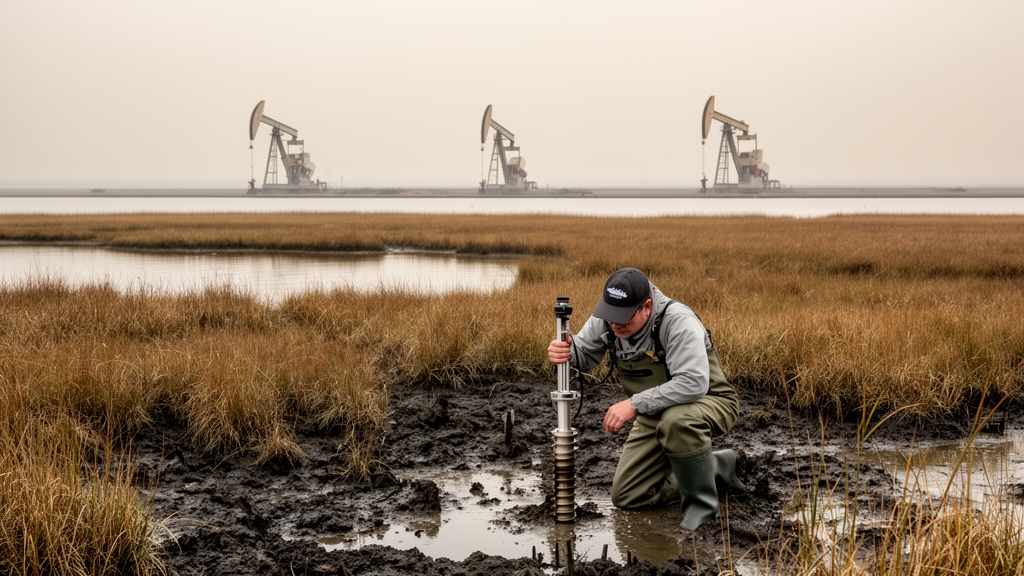
Retiring an oil well may end production, but it does not immediately erase the petroleum that production left behind in the ground. A soil survey from the Liao River estuary wetlands in northeastern China, published in Frontiers in Marine Science, compared active oil-well sites, retired oil-well sites and natural reference wetlands and found a clear gradient of residual contamination. Mean total petroleum hydrocarbon concentrations were 35.71 grams per kilogram of soil at active plots, 12.95 grams per kilogram at retired plots and just 1.20 grams per kilogram at reference plots, a difference that was statistically robust across the survey.
The study drew on a September 2022 soil survey covering five active oil-well plots, five retired oil-well plots and three reference wetland plots. At each plot, three separately collected surface soil samples were averaged, yielding 13 independent analytical units. The researchers measured basic soil properties, total petroleum hydrocarbons and five trace metals, then compared the three well-status groups statistically.
Total organic carbon followed the same ordering as the hydrocarbons, averaging 43.15 grams per kilogram at active plots, 29.76 grams per kilogram at retired plots and 18.99 grams per kilogram at reference plots, again with P below 0.001 and q below 0.001. Across the 13 plots, total organic carbon and total petroleum hydrocarbons were positively associated, with a Spearman rank correlation of 0.76 and a P value of 0.003. That coupling is consistent with the idea that petroleum-derived carbon contributes substantially to the organic carbon pool in soils near oil infrastructure, although the survey design shows association rather than proving the direction of the relationship.
The trace metal results were more nuanced. After correction for multiple comparisons, the study detected no overall group difference among active, retired and reference plots for arsenic, cadmium, chromium, copper or lead. However, one active plot showed locally elevated benchmark ratios for arsenic, cadmium and chromium, indicating that metal enrichment can occur at specific sites even when it does not emerge as a group-level pattern.
The authors therefore suggest that monitoring after oil-well retirement should include targeted assessment of local metal enrichment alongside the broader hydrocarbon picture. The most consequential finding for wetland management concerns the retired plots. Their mean hydrocarbon concentration was lower than that of active plots, which might suggest partial recovery after production ends.
Yet every retired-plot value exceeded the range observed at the reference wetlands, meaning that none of the retired sites had returned to background conditions within the timeframe captured by the survey. Residual petroleum contamination, in other words, persists after wells are taken out of service, and retirement alone does not restore the soil to reference quality. The measured gradient, from roughly 36 grams per kilogram at active sites to about 13 at retired sites and about 1 at reference sites, quantifies both the footprint of ongoing production and the legacy that remains once it stops.
The authors frame their findings as support for continued monitoring of residual petroleum contamination after oil-well retirement, rather than as evidence that retired sites have recovered. The survey was a single time point with a modest number of plots, so the results describe conditions in September 2022 rather than trends over time, and the metal findings at the group level were negative despite the locally elevated values at one active plot.
Subject of Research: Petroleum hydrocarbon and trace metal contamination in soils of active, retired and reference oil-field wetlands in the Liao River estuary
Article Title: Contrasting petroleum hydrocarbon contamination across active, retired and reference wetlands in the Liao River estuary
Article References: Lu, W., Liu, Y., Wu, D., Song, M., Zhang, Q., Yang, Y., Pang, B., Du, R., Zhang, Y., Zhai, D., Liang, H., & Xie, T. (2026). Contrasting petroleum hydrocarbon contamination across active, retired and reference wetlands in the Liao River estuary. Frontiers in Marine Science, 13, Article 2005218. https://doi.org/10.3389/fmars.2026.2005218
Image Credits: AI Generated
DOI: 10.3389/fmars.2026.2005218
Keywords: coastal wetland, Liao River estuary, oil-well retirement, total petroleum hydrocarbons, soil organic carbon, trace metals, soil contamination, marine pollution, Panjin, wetland monitoring, Contrasting, petroleum
Cite Scienmag News
Violet Maxwell. (October 27, 2026). Research report: Contrasting petroleum hydrocarbon contamination across active, retired and reference wetlands in the Liao River estuary. Scienmag. https://scienmag.com/research-report-contrasting-petroleum-hydrocarbon-contamination-across-active-retired-and-reference-wetlands-in-the-liao-river-estuary/
Violet Maxwell. "Research report: Contrasting petroleum hydrocarbon contamination across active, retired and reference wetlands in the Liao River estuary." Scienmag, 27 October 2026, https://scienmag.com/research-report-contrasting-petroleum-hydrocarbon-contamination-across-active-retired-and-reference-wetlands-in-the-liao-river-estuary/. Accessed 27 October 2026.
Violet Maxwell. "Research report: Contrasting petroleum hydrocarbon contamination across active, retired and reference wetlands in the Liao River estuary." Scienmag. October 27, 2026. https://scienmag.com/research-report-contrasting-petroleum-hydrocarbon-contamination-across-active-retired-and-reference-wetlands-in-the-liao-river-estuary/


