


Four out of every ten acute teleconsultations in a rural German telemedicine network concerned conditions other than suspected stroke, and most of those turned out to be genuine neurological emergencies rather than stroke mimics, according to a retrospective analysis of the ANNOTeM network published in Frontiers in Stroke. The finding, drawn from nearly 4,700 consultations across 12 hospitals in Northeast Germany between January 2023 and December 2024, suggests that telestroke infrastructure built for one disease is already functioning in routine care as a much broader lifeline for neurological expertise in regions where specialists are scarce.
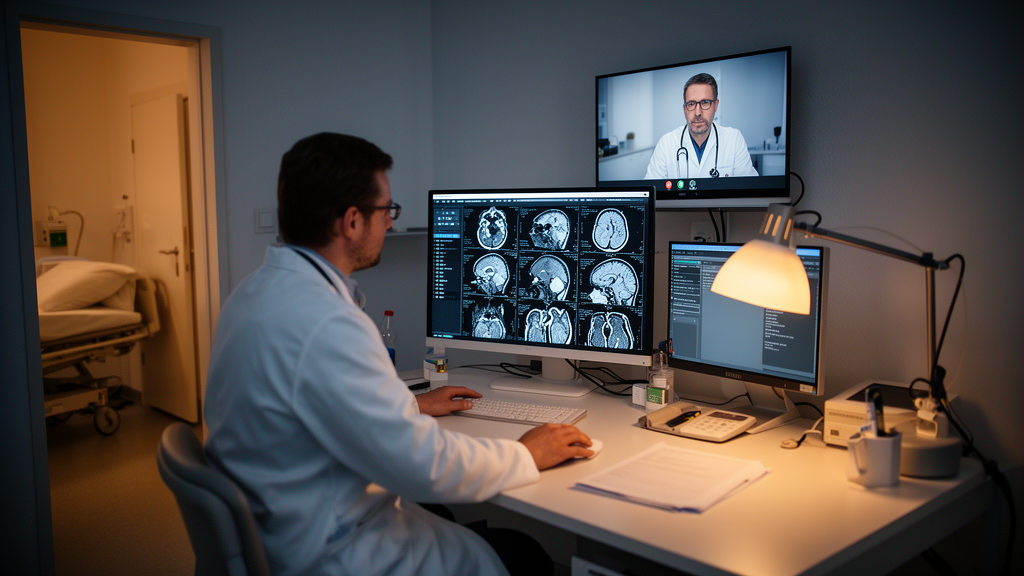
The ANNOTeM network, short for Acute Neurological Care in Northeast Germany with Telemedicine Support, connects three academic neurological hubs in Berlin and Greifswald with rural acute-care hospitals in Saxony-Anhalt, Brandenburg, and Mecklenburg-Western Pomerania. Participating hospitals have round-the-clock access to board-certified neurologists who examine patients by video, review neuroimaging in real time, and issue immediate recommendations on local treatment or transfer for interventions such as thrombectomy or neurosurgery. The regions served are demographically distinctive: population densities in the hospital districts range from 35 to 99 inhabitants per square kilometer, roughly 30 percent of residents are aged 60 to 80, and outpatient physician density is about half that of urban comparator regions such as Berlin and Frankfurt am Main. The density of neurology-related outpatient specialists is roughly one-third lower than in those cities, and a considerably larger share of those specialists are themselves older than 65.
The researchers, led by Maike Kern and Janina Behrens of Charité – Universitätsmedizin Berlin, analyzed all acute teleconsultations involving direct patient assessment at the 12 hospitals that participated continuously during the two-year window. After excluding follow-up visits, telephone-only discussions, and incomplete records, 4,697 consultations remained. Of these, 4,207 could be assigned to exactly one of seven predefined diagnostic categories, forming the primary analysis population, while 427 carried overlapping or competing diagnoses and were analyzed separately. Video communication was used in 95 percent of cases, and the median patient age was 70 years, with a range stretching from 16 to 102.
Suspected stroke dominated the single-category case mix at 60.0 percent, but the remaining 40 percent was far from negligible. Other neurological diagnoses, a category spanning peripheral vestibular disorders, headache, movement disorders, brain tumors, multiple sclerosis, peripheral nerve lesions, facial palsy, functional neurological disorders, and dementia, accounted for 20.3 percent. Non-neurological diagnoses and stroke mimics, including metabolic encephalopathy, delirium, syncope, electrolyte disturbances, hypoglycemia, and medication intoxication, made up 11.6 percent. Epileptic presentations contributed 7.5 percent and traumatic brain injury 0.6 percent. Crucially, more than 70 percent of the non-stroke consultations received another neurological diagnosis rather than a non-neurological one, meaning the network is largely fielding genuine neurological emergencies, not simply sorting out stroke look-alikes.
The workload varied meaningfully from hospital to hospital. The proportion of consultations coded as suspected stroke ranged from 51.7 to 69.2 percent across the 12 centers, while other neurological diagnoses ranged from 15.7 to 25.9 percent. At the hospital with the broadest case mix, non-stroke presentations reached 48.3 percent of single-diagnosis consultations. Most participating departments were internal medicine units without on-site neurology; only one hospital in the network had an independent neurological department. The mean distance from a partner hospital to the nearest hospital with a neurology department was 34.6 kilometers, and the number of neurological hospitals within a 50-kilometer radius ranged from just one to 26, depending largely on whether a hospital sat in a peri-urban pocket adjacent to a major city.
Consultation timing revealed a striking pattern tied to local staffing. Across the whole network, teleconsultations clustered into two peaks, one between 11 a.m. and 1:59 p.m. and another between 4 p.m. and 6:59 p.m. But when the researchers stratified by local neurological services, each group showed a single dominant peak: hospitals without any on-site neurology peaked in the midday window, accounting for 25.6 percent of their consultations, whereas hospitals with some local neurological presence peaked in the late afternoon, with 24.9 percent. The authors interpret this as evidence that teleneurology may be filling temporal as well as geographical gaps, absorbing demand after locally available consultation or core-hour coverage ends in hospitals with partial neurological staffing.
Regression analyses, though explicitly exploratory and univariable, pointed to age as the strongest correlate of what the network was asked to handle. Each additional 10 years of patient age raised the odds of a neurological diagnosis by 9 percent (odds ratio 1.09, 95 percent confidence interval 1.04 to 1.15) and the odds of suspected stroke by 42 percent (OR 1.42, 95 percent CI 1.38 to 1.48). At the regional level, each additional percentage point in the proportion of residents aged 60 to 80 was associated with roughly 4 percent higher odds of a neurological diagnosis (OR 1.04, 95 percent CI 1.00 to 1.07). This matters because nearly 30 percent of residents in the ANNOTeM catchment areas fall within that age band, almost twice the proportion in the urban comparator regions.
Specialist availability also left fingerprints on the case mix. A higher density of neurology-related outpatient specialists was associated with a 6 percent lower relative likelihood of another neurological diagnosis compared with suspected stroke (OR 0.94, 95 percent CI 0.89 to 0.98). One plausible reading, the authors note, is that better outpatient neurological access reduces emergency presentations of non-stroke conditions through earlier recognition and management, whereas stroke prevention is shared across several medical specialties and less directly tied to outpatient neurology. Hospitals with consultation-based or core-hour neurological services did not differ significantly from hospitals with a full neurology department in the likelihood of a neurological diagnosis, while hospitals with no local neurological expertise showed significantly lower odds, a difference that may reflect referral thresholds, patient populations, or other unmeasured hospital factors. Greater distance to the nearest neurological department was paradoxically associated with slightly lower odds of suspected stroke, a counterintuitive result the authors urge readers to interpret cautiously given the narrow distance range and the model’s very low explanatory power.
The study’s limitations are laid out plainly. The diagnostic categories represent consultation-time working diagnoses rather than independently adjudicated discharge diagnoses, and the broad “other neurological” category limits conclusions about individual conditions. Traumatic brain injury, acute spinal cord syndromes, and neuroinfectious diseases were too rare for separate analysis, with the latter two appearing in only five patients and always alongside other diagnoses. Recorded consultation durations were highly variable and included implausible extreme values, so the median of 103 minutes should not be read as active consultation time. The regression models explained little of the variance overall, consultations were clustered within only 12 hospitals, no adjustment for multiple testing was applied, and the analyses covered only patients who actually received a teleconsultation, so the findings cannot be generalized to the full patient population of the participating hospitals. No treatment, transfer, outcome, or cost data were included in this analysis.
Even with those caveats, the case mix carries practical weight. Earlier evaluations of ANNOTeM found that implementing the managed teleneurological system was associated with improved outcomes across a broad spectrum of neurological emergencies without a relevant increase in 90-day costs, although the present study cannot determine whether care beyond stroke contributed to those effects. The authors argue that telestroke networks already supply most of what comprehensive teleneurology requires: continuous specialist availability, secure audiovisual links, rapid imaging access, standardized pathways, and established transfer arrangements. They caution, however, that quality indicators and reimbursement frameworks centered on reperfusion and stroke-unit processes may not capture the broader workload documented here, and that staffing and financing should reflect the actual spectrum of presentations. With 40 percent of single-category consultations involving non-stroke conditions in regions where nearly a third of residents are approaching or past retirement age, the study offers an empirical basis for testing whether extending telestroke into full-service teleneurology can sustain specialist care in low-density regions, with future work needed on patient outcomes, avoidable transfers, and health-economic effects.
Subject of Research: Real-world diagnostic spectrum of acute teleneurology consultations in a rural German telestroke network
Article Title: Extending telestroke to broader teleneurology in sparsely populated regions: real-world experience from a German network
Article References: Kern, M., Braemswig, T. B., Kinze, S., Kotlarz-Böttcher, M., Audebert, H. J., & Behrens, J. R. (2026). Extending telestroke to broader teleneurology in sparsely populated regions: real-world experience from a German network. Frontiers in Stroke, 5, Article 1981787. https://doi.org/10.3389/fstro.2026.1981787
Image Credits: AI Generated
DOI: 10.3389/fstro.2026.1981787
Keywords: teleneurology, telestroke, rural healthcare, ANNOTeM, stroke mimics, epilepsy, telemedicine, Northeast Germany, aging population, neurological emergencies, healthcare access, retrospective study
Cite Scienmag News
Cassandra Pierce. (October 27, 2026). Rural telestroke network in Germany handles far more than stroke, two-year study shows. Scienmag. https://scienmag.com/rural-telestroke-network-in-germany-handles-far-more-than-stroke-two-year-study-shows/
Cassandra Pierce. "Rural telestroke network in Germany handles far more than stroke, two-year study shows." Scienmag, 27 October 2026, https://scienmag.com/rural-telestroke-network-in-germany-handles-far-more-than-stroke-two-year-study-shows/. Accessed 27 October 2026.
Cassandra Pierce. "Rural telestroke network in Germany handles far more than stroke, two-year study shows." Scienmag. October 27, 2026. https://scienmag.com/rural-telestroke-network-in-germany-handles-far-more-than-stroke-two-year-study-shows/


