


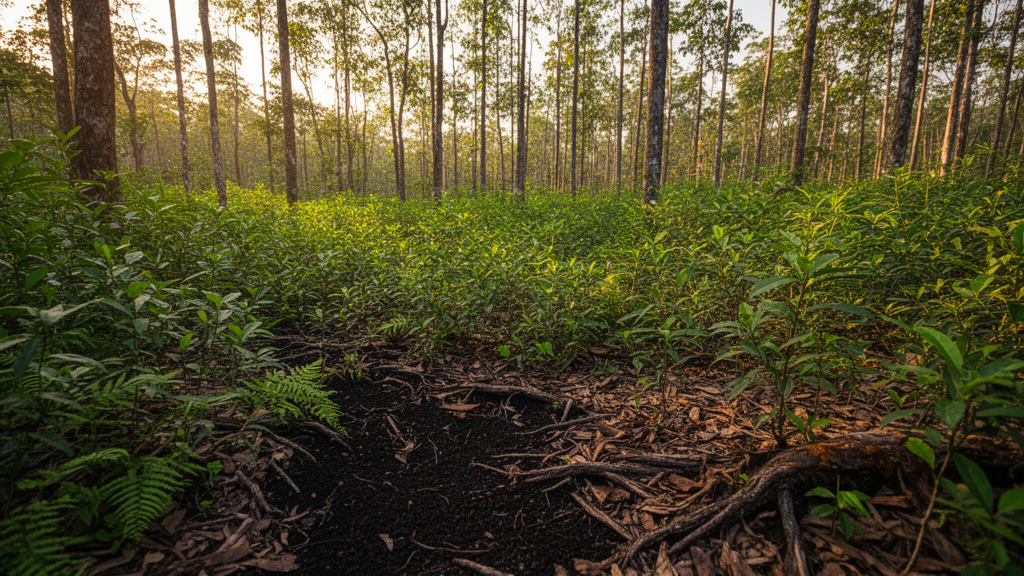
Forests with dense, closed canopies can still lose their soil. A new study from a typical red soil erosion area in southern China shows why: the layers of vegetation closest to the ground, not the leafy crown overhead, do most of the work of holding soil in place. The research, published in Frontiers in Forests and Global Change, introduces a three-dimensional way of measuring forest structure that captures what conventional satellite indices miss.
Traditional indicators such as fractional vegetation cover and the Normalized Difference Vegetation Index record only the horizontal extent of greenery. In a forest whose canopy looks intact from above but whose shrubs, herbs, and litter layers have been stripped away, these indicators suggest healthy soil conservation. The new study set out to quantify this vertical blind spot.
The researchers built their assessment around Stratified Vegetation Volume, defined for each layer as cover multiplied by leaf area index, or, for the litter layer, cover multiplied by litter depth. They measured this quantity separately for the canopy, understory, and litter strata, then linked it to a Soil Erosion Index that grades the severity of erosion at a site. The empirical foundation came from 17 standard runoff plots, where erosion could be measured directly under controlled conditions.
To extend the findings beyond these plots, the team developed a two-variable empirical model based on soil bulk density and gravel content, which allowed them to estimate the Soil Erosion Index at 46 natural forestland sites across the region. This extrapolation model achieved a cumulative grade accuracy of 91.1 percent within plus or minus one erosion grade, meaning that for the vast majority of sites the predicted erosion class fell within a single grade of the true value. With erosion grades in hand for all 46 forest sites, the researchers then regressed the extrapolated Soil Erosion Index against the vegetation volumes of the three vertical layers.
The three-variable regression model performed best, explaining 65 percent of the variance with a root mean square error of 0.104. But the most striking result lay in the relative sizes of the regression coefficients, which revealed a clear hierarchy of protective power. The understory coefficient was −0.186, more than four times larger in magnitude than the litter coefficient of −0.046 and the canopy coefficient of −0.040.
Because all three coefficients are negative, larger vegetation volume in each layer corresponds to lower soil erosion, but the understory contributes roughly 4.6 times more to erosion reduction than the canopy does. In practical terms, a forest can carry a full crown of leaves and still erode badly if its ground layers are gone, while a thinner canopy over a well-developed understory and litter layer can protect the soil far more effectively. This finding carries a warning for remote sensing-based erosion assessment.
The study's stratified approach corrects for this by weighting each layer according to its measured contribution. The researchers also tested whether a simpler model could suffice. A two-indicator version using only understory and litter volumes achieved the same grade classification accuracy, 96.3 percent, as the full three-indicator model.
Since these two layers are the ones that matter most and can be surveyed on the ground with modest effort, the simplified model offers a practical pathway for rapid assessment when time, funding, or data are limited. The broader significance is for restoration planning in degraded subtropical forests. The authors note that the model is empirical and calibrated to a specific red soil erosion region, so its coefficients should not be transferred uncritically to other soil types or climates.
Nevertheless, the study establishes near-surface vegetation as the core functional layer for forest soil conservation and provides land managers with a quantitative tool for identifying which degraded stands need ground-layer restoration most urgently.
Subject of Research: A stratified vegetation volume index for assessing soil erosion in understory-eroded subtropical forestlands
Article Title: Assessing soil erosion in understory-eroded forestlands based on the three-dimensional index of stratified vegetation volume
Article References: He, Y., Gu, Z., Fu, Q., Yue, X., Wu, J., & Liao, G. (2026). Assessing soil erosion in understory-eroded forestlands based on the three-dimensional index of stratified vegetation volume. Frontiers in Forests and Global Change, 9, 1953106. https://doi.org/10.3389/ffgc.2026.1953106
Image Credits: AI Generated
DOI: 10.3389/ffgc.2026.1953106
Keywords: soil erosion, understory vegetation, forest soil conservation, stratified vegetation volume, Soil Erosion Index, red soil region, subtropical forests, remote sensing, runoff plots, regression model, litter layer, restoration prioritization
Cite Scienmag News
Margaret Porter. (October 27, 2026). Understory Vegetation, Not Canopy, Drives Soil Protection in Degraded Forests. Scienmag. https://scienmag.com/understory-vegetation-not-canopy-drives-soil-protection-in-degraded-forests/
Margaret Porter. "Understory Vegetation, Not Canopy, Drives Soil Protection in Degraded Forests." Scienmag, 27 October 2026, https://scienmag.com/understory-vegetation-not-canopy-drives-soil-protection-in-degraded-forests/. Accessed 27 October 2026.
Margaret Porter. "Understory Vegetation, Not Canopy, Drives Soil Protection in Degraded Forests." Scienmag. October 27, 2026. https://scienmag.com/understory-vegetation-not-canopy-drives-soil-protection-in-degraded-forests/


