


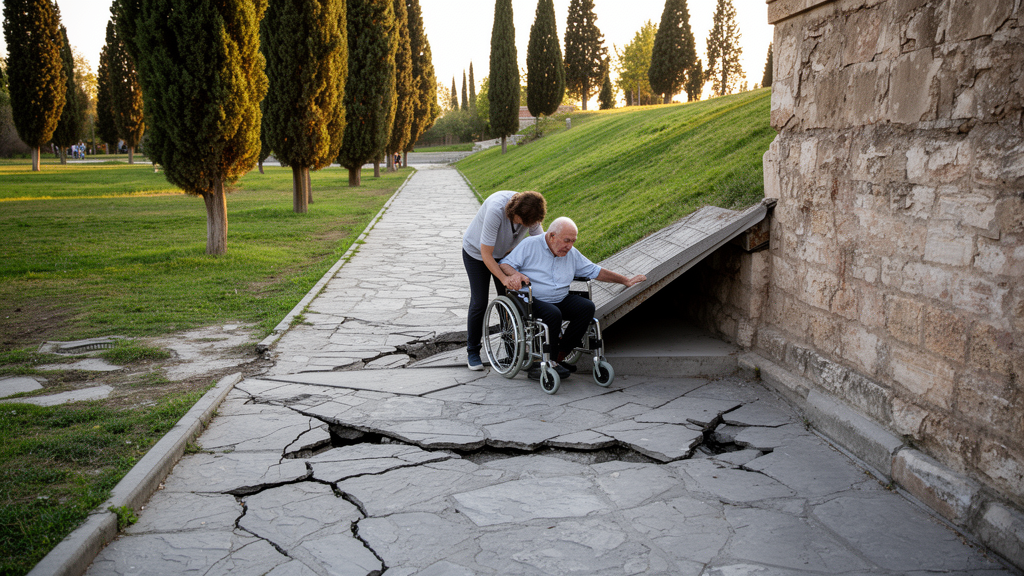
A new case study of Alaeddin Tepesi Park, the landmark hill park at the heart of Konya, Türkiye, finds that despite visible investments in ramps, pathways and street furniture, the park’s accessibility for elderly people, people with disabilities and users with strollers remains partial and unevenly distributed across the site. The research, published in the journal Discover Cities, combined systematic field observation, documentary analysis and interviews with municipal officials and urban professionals, and concluded that the mere presence of accessible-looking facilities does not guarantee that vulnerable groups can actually use the space autonomously, safely and with dignity.
The study was conducted by Benjamin Aganze Marhegane and Ümmügülsüm Dağlıoğlu, who adopted the universal design framework as their analytical lens. Universal design holds that accessibility should be integrated from the earliest design phase so that environments are usable by the greatest number of people, rather than being retrofitted as an afterthought. The authors argue that accessibility in public space is not simply the absence of physical barriers but the effective capacity of all users, regardless of age or physical, sensory or cognitive abilities, to access, use and appropriate a space on equal terms. Their fieldwork set out to test whether that principle holds in practice in a park where steep topography and heritage conservation collide with inclusion goals.
Alaeddin Tepesi was chosen deliberately. The hill is an artificial elevation rising roughly 20 metres above its surroundings, measuring about 450 metres north to south and 350 metres east to west, and it anchors Konya’s historic centre. It takes its name from the Seljuk sultan Alaeddin Keykubad I and hosts the Great Alaeddin Mosque, the remains of the old Seljuk palace and traces of the defensive boundary that once enclosed the site. The park is also heavily frequented: previous studies cited by the authors show that many residents spend significant parts of their day there, walking, resting, playing sport and socialising. That combination of centrality, footfall, user diversity, heritage value and pronounced topography made it an ideal test case for accessibility under real urban conditions.
Methodologically, the researchers observed the park directly and non-participatively between February 2 and March 21, 2026, covering weekdays and weekends and three daily windows: morning from 6:00 to 10:00, daytime from 11:00 to 15:00 and evening from 17:00 to 21:00. Their observation grid, built from universal accessibility principles and the inclusive design literature, recorded the presence and condition of stairs, pavements, ramps and street furniture, as well as actual uses, pathway navigability and the constraints facing vulnerable groups. In parallel, they analysed planning documents, Konya Metropolitan Municipality guidelines and international frameworks including the UN Convention on the Rights of Persons with Disabilities, the 2030 Agenda’s SDG 11, the New Urban Agenda and the WHO Global Age-friendly Cities framework. Finally, they conducted roughly 30-minute semi-structured interviews with 35 urban stakeholders, including institutional actors and professionals with direct knowledge of the park’s design and management.
The observational findings paint a picture of a park that is broadly equipped but structurally incomplete. Access points include stairs on one side and ramps at the south and east entrances, and the interior contains hierarchically organised pathways linking rest areas, promenades, a water fountain, a public toilet, terraces and commercial services. Yet continuity and uniformity vary considerably by zone. Stairs dominate circulation within the park and act as a decisive limiting factor for elderly visitors, wheelchair users and people pushing strollers. The ramps that do exist are localised and do not provide direct, continuous access to the whole site. Slopes, together with insufficient informational, directional and tactile signage, further reduce navigability for new visitors and visually impaired users, producing situations of dependence on assistance.
To interpret these observations systematically, the researchers defined three qualitative levels of accessibility: easy, where users move without major constraints or assistance; moderate, where movement requires extra effort, detours or occasional help; and difficult, where physical constraints substantially limit autonomous mobility or block access to certain areas altogether. Applying these categories revealed starkly differentiated practicability. Able-bodied visitors enjoy near-total freedom of movement across the site, while people with reduced mobility concentrate on the principal pathways that offer more direct access and largely avoid zones with greater constraints. Areas overlooking Zafer Meydanı and Alaeddin Meydanı, and those near bus and tram stops, were especially frequented, whereas harder-to-reach zones saw far less use by people with mobility impairments.
One of the study’s most vivid findings concerns the adaptive practices users invent to cope with these constraints. Observers documented informal pathways and shortcuts carved out to avoid slopes and stairs, circumvention of obstacles, restricted or abandoned use of certain areas, informal occupation of spaces and the misappropriation of urban furniture, with curbs and steps pressed into service as seats. Children aged 10 to 16 were seen using the stairs and slopes of the bike park for unsupervised games, creating potential risk situations and conflicts with other users. The authors read these behaviours not as successes of accessibility but as evidence of its limits: users are improvising workarounds that the formal design failed to provide, and the benefits of such improvisation are not evenly available to all groups.
The interviews exposed a sharp perceptual divide. Urban professionals, 27 of whom rated the perceived accessibility of each vulnerable group on a five-point scale from poor to excellent, judged the park’s accessibility for vulnerable users to be more theoretical than practical. They identified steep slopes, poorly designed or absent ramps, and benches ill-suited to elderly people’s need for rest as the main obstacles, and noted that recent improvements have focused disproportionately on youth and children. They also flagged inadequate night-time lighting and signage that create so-called dead zones, and pointed to prolonged archaeological excavation works that fragment the space and reduce publicly accessible areas. Municipal actors, by contrast, offered a markedly more positive appraisal, citing specific adaptations and the recognition earned by the Directorate of Parks and Gardens under the Engelsiz Mekanlar Projesi, the Project of Accessible Places, and arguing that the site’s facilities allow all users to access the park without major obstacles.
This divergence between institutional discourse, expert assessment and observed reality is central to the study’s argument. The authors contend that accessibility must be understood not as the presence of facilities but through their effective usability, the practices actually observed on site, the constraints imposed by topography and heritage conservation, and the socio-spatial realities of who gets excluded. Because incomplete accessibility falls disproportionately on older people, people with disabilities and stroller users, it becomes a mechanism producing socio-spatial inequality, in tension with the inclusion principles of the New Urban Agenda, Article 9 of the UN disability convention and the age-friendly cities framework. The experts proposed two levers for improvement: modernising the park with technological solutions such as moving walkways, elevators, accessible signage and smart lighting, and establishing multi-stakeholder governance bringing together the municipality, universities and citizens so future interventions respond to real user needs.
The authors are careful about scope. They acknowledge four main limitations: the qualitative design and single-site focus prevent generalisation to all of Konya’s public spaces; observations carry an interpretive, potentially subjective dimension; vulnerable groups themselves were not interviewed, so their lived experiences remain outside the data; and the winter observation window may have underrepresented spring and summer activities and the use of terraces and seating areas. Triangulation across observations, documents and interviews was used to strengthen interpretive robustness. Even so, the study’s core message travels beyond one Anatolian hill: in heritage parks especially, equitable access and conservation must be balanced through targeted, gradual interventions, inclusive signage and genuine attention to user feedback, because a public space that looks accessible on a plan can still quietly exclude the people who most need it.
Subject of Research: Accessibility of open public spaces for vulnerable groups in a heritage park in Konya, Türkiye
Article Title: Accessibility of open public spaces for vulnerable groups in Alaeddin Tepesi Park, Konya, Türkiye
Article References: Marhegane, B. A., & Dağlıoğlu, Ü. (2026). Accessibility of open public spaces for vulnerable groups in Alaeddin Tepesi Park, Konya, Türkiye. Discover Cities, 3(1), Article 209. https://doi.org/10.1007/s44327-026-00393-y
Image Credits: AI Generated
DOI: 10.1007/s44327-026-00393-y
Keywords: accessibility, universal design, public space, Alaeddin Tepesi Park, Konya, vulnerable groups, heritage conservation, urban planning, disability, inclusive design, social inclusion, qualitative research
Cite Scienmag News
Courtney Benton. (October 27, 2026). Historic hill park in Konya falls short on real accessibility for vulnerable users. Scienmag. https://scienmag.com/historic-hill-park-in-konya-falls-short-on-real-accessibility-for-vulnerable-users/
Courtney Benton. "Historic hill park in Konya falls short on real accessibility for vulnerable users." Scienmag, 27 October 2026, https://scienmag.com/historic-hill-park-in-konya-falls-short-on-real-accessibility-for-vulnerable-users/. Accessed 27 October 2026.
Courtney Benton. "Historic hill park in Konya falls short on real accessibility for vulnerable users." Scienmag. October 27, 2026. https://scienmag.com/historic-hill-park-in-konya-falls-short-on-real-accessibility-for-vulnerable-users/


