


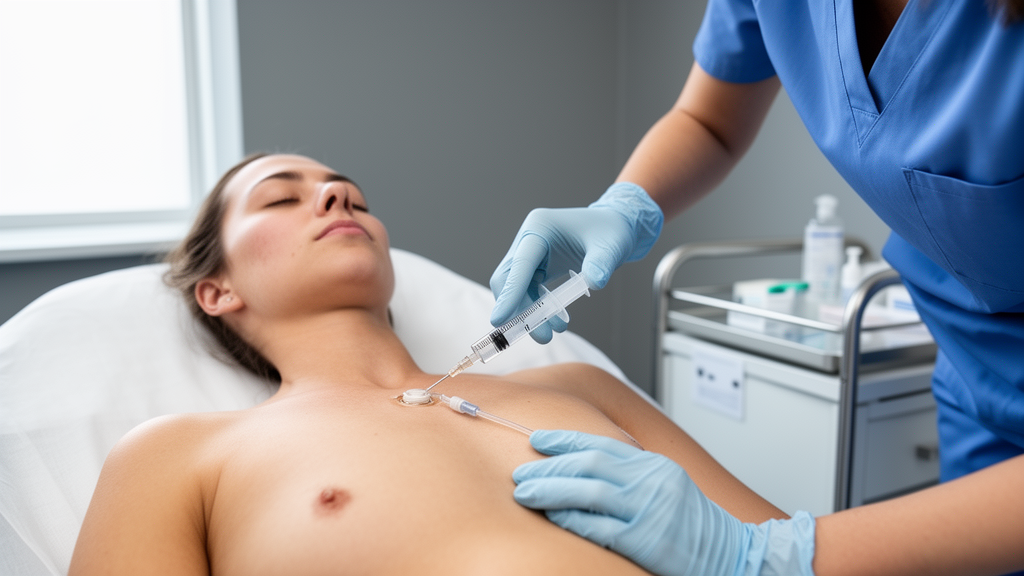
A randomized clinical trial conducted at a regional teaching hospital in northern Taiwan has found that catheter-related complications in hospitalized patients with cancer were remarkably rare regardless of whether implanted venous ports were flushed with heparin or with ordinary salt water. The study, an exploratory three-arm trial involving 192 patients, compared 10 milliliters of normal saline, 20 milliliters of normal saline, and a heparin lock solution containing 1,000 units of heparin diluted in 10 milliliters of saline, each administered after every use of a totally implantable venous access device, commonly known as a port-a-cath. Across all three groups, only a single catheter occlusion occurred during the 30-day surveillance window, and not one catheter-related bloodstream infection was recorded.
Keeping the catheter inside the device free-flowing, a property known as patency, is essential for uninterrupted cancer treatment. When a port becomes occluded, patients may face treatment delays, additional procedures, extra interventions, and in some cases premature removal of the device. Reported occlusion rates in the broader literature range from roughly 1 to 6 percent, a figure that sounds modest but translates into a meaningful burden across large oncology populations. Many of the factors contributing to occlusion, including flushing practices, chemotherapy administration, thrombotic events, and indwelling duration, are strongly associated with nursing care processes, and many of them are modifiable, which means that how catheter care is organized and delivered can substantially affect outcomes.
Heparin lock remained the routine maintenance practice at the study hospital when the trial was initiated, and it was therefore retained as the active comparator. Yet heparin is not without drawbacks. It carries risks of adverse events such as bleeding and thrombocytopenia, adds to the medication burden, and increases health-care costs. Systematic reviews and meta-analyses have repeatedly failed to demonstrate a clear superiority of heparin over normal saline for maintaining catheter patency, though the certainty of that evidence has been limited by heterogeneity in study designs, clinical settings, and catheter care practices. This uncertainty left an important question open: does the flushing solution itself matter, or does the way care is organized and delivered matter more? The researchers designed their trial to address that question within a real-world inpatient oncology setting.
Participants were adults aged 20 or older with a confirmed cancer diagnosis who had a port in place, were receiving intravenous therapy on oncology wards, and were expected to need the device for at least three days during their hospital stay. Patients with a history of catheter occlusion, those receiving continuous infusions such as parenteral nutrition or maintenance fluids, those on anticoagulant or antiplatelet therapy, and those with coagulation disorders, pregnancy, or hormonal contraceptive use were excluded. Using block randomization with sequentially numbered opaque sealed envelopes prepared by an independent researcher, 64 participants were allocated to each of the three flushing arms. The mean age of participants was 58 years, the sex distribution was balanced, and gynaecological cancer was the most common malignancy at 33.3 percent, followed by gastrointestinal, head and neck, and lung cancers.
What distinguished this trial was not the flushing solutions themselves but the standardized, nurse-led, protocol-driven care framework wrapped around them. Every oncology nurse delivering the intervention was trained and certified against institutional vascular access standards before the study began, with protocol education, skills demonstration, supervised practice, and competency assessment using a standardized checklist consistent with international infusion therapy standards. The protocol included skin antisepsis with chlorhexidine, pulsatile flushing technique, positive pressure maintained during the final flush, and adherence monitoring. Refresher briefings were provided during the trial to reinforce adherence, and a trained nurse practitioner screened and enrolled all participants.
Participants and the independent attending physician who adjudicated suspected occlusion events were blinded to group allocation, while nurses delivering care and the statistician could not be blinded because of the nature of the intervention. Adherence was monitored through biweekly observational audits conducted by the head nurse using a structured checklist that assessed the correct execution of key procedural steps, including skin antisepsis, pulsatile flushing technique, and maintenance of positive pressure during the final flushing step. Feedback was provided during routine clinical meetings, and any observed deviations were addressed through reinforcement of the standardized procedure. Occlusion was defined as a persistent inability to aspirate blood or flush saline despite sequential corrective steps, including pulsatile flushing with a 10-milliliter syringe, patient repositioning, and repeat aspiration testing. Catheter-related bloodstream infection was defined according to criteria from the Taiwan Centers for Disease Control, and bleeding complications were recorded when they required additional clinical or nursing intervention such as medication adjustment or compression.
The results were striking in their uniformity. Catheter occlusion occurred in exactly one participant out of 192, an overall rate of 0.5 percent, and that single event fell in the 10-milliliter saline group, corresponding to 1.6 percent within that arm while both the 20-milliliter saline and heparin lock groups recorded zero events. Bleeding was similarly uncommon: three cases of minor localized bruising at the catheter site, two in the 10-milliliter saline group and one in the heparin lock group, for an overall rate of 1.6 percent. No catheter-related bloodstream infections, unplanned catheter removals, or device exchanges occurred in any group. Fisher’s exact tests yielded p values of 1.000 for occlusion and 0.774 for bleeding, but with such sparse event counts these figures carry little comparative weight, and the authors interpret them descriptively rather than as evidence of comparable risk.
Because the study was not powered as a non-inferiority or equivalence trial, the absence of statistically significant differences cannot be interpreted as proof that saline matches heparin. Exploratory analyses of absolute risk differences produced wide confidence intervals, such as a difference of 0.0 percentage points between the 20-milliliter saline and heparin groups with an interval spanning from minus 5.7 to 5.7 percentage points, and 1.6 percentage points between the 10-milliliter saline and heparin groups with an interval from minus 5.4 to 8.3 percentage points, reflecting the imprecision inherent in a single occlusion event. The sample size had been calculated pragmatically using a general analysis-of-variance approach with a moderate effect size to establish a feasible recruitment target, not to provide definitive power for detecting between-group differences in the binary primary outcome. No participants withdrew, no outcome data were missing, and no severe adverse events occurred during the study period.
Several limitations temper the findings. The study was conducted at a single center, and the surveillance approach was changed from the originally registered in-hospital assessment period of up to 12 weeks to a standardized 30-day window after enrollment, a modification made before any between-group analysis and applied uniformly to all randomized participants, with complete outcome data available for all 192. This shorter window may have reduced ascertainment of later complications such as delayed thrombotic occlusion, and post-discharge surveillance through routine outpatient and chemotherapy records may have missed undocumented events. Because the assigned flushing protocol applied only during the index hospitalization, with no study-mandated flushing after discharge, variation in outpatient catheter management during follow-up could also have influenced outcomes. Implementation fidelity, though supported by training and audits, was not quantified with validated instruments, making it difficult to disentangle the contribution of the care framework from that of the flushing solution.
Nevertheless, the central message of the trial is provocative for oncology nursing and for the broader movement toward de-implementation of low-value interventions. Within a consistently delivered, protocol-driven care model, complication rates were uniformly low regardless of the pharmacological flush, suggesting that the quality and consistency of care delivery processes may contribute as much to early catheter outcomes as the choice of solution. The uniformly low event rates are consistent with systematic reviews reporting no clear superiority of heparin over normal saline, and the structured framework of competency-based training, adherence monitoring, and feedback offers a replicable model that other institutions could adapt. If adequately powered multicenter studies confirm these observations, routine heparin use in port maintenance could potentially be reduced, simplifying nursing workflows, lowering medication exposure and costs, and improving medication safety.
For now, the findings stand as hypothesis-generating rather than as support for substituting one flushing strategy for another. The authors emphasize that any de-implementation effort would require robust evidence from non-inferiority or equivalence trials, and that future studies should include broader patient populations, outpatient settings, patients with longer catheter dwell times, formal measures of implementation fidelity, predefined implementation outcomes, and cost-effectiveness analyses. Multicenter designs with longer follow-up will be needed to confirm these observations and to evaluate long-term efficacy, cost-effectiveness, and generalizability across diverse health-care settings. Until then, the trial’s most valuable contribution may be its demonstration that rigorous, standardized nurse-led catheter care can be delivered consistently in a busy inpatient oncology environment, and that the processes surrounding a flushing decision deserve as much scientific scrutiny as the solution itself.
Subject of Research: Flushing strategies for totally implantable venous access devices in nurse-led oncology care
Article Title: Flushing Strategies for Totally Implantable Venous Access Devices in Nurse‐Led Cancer Care: Exploratory Randomized Clinical Trial
Article References: Ho, C.-J., Hsieh, J. C.-H., Xu, H. G., Yen, C.-C., Kuo, H.-C., Chou, C.-T., Chen, L.-C., & Wang, B.-C. (2026). Flushing Strategies for Totally Implantable Venous Access Devices in Nurse‐Led Cancer Care: Exploratory Randomized Clinical Trial. Nursing Open, 13(10), Article e70942. https://doi.org/10.1002/nop2.70942
Image Credits: AI Generated
DOI: 10.1002/nop2.70942
Keywords: totally implantable venous access device, port-a-cath, catheter occlusion, heparin lock, normal saline flush, oncology nursing, randomized controlled trial, catheter-related bloodstream infection, nurse-led care, protocol adherence, de-implementation, Taiwan
Cite Scienmag News
Nathaniel Bowman. (October 27, 2026). Saline May Match Heparin for Implanted Cancer Ports When Nurses Follow One Strict Protocol. Scienmag. https://scienmag.com/saline-may-match-heparin-for-implanted-cancer-ports-when-nurses-follow-one-strict-protocol/
Nathaniel Bowman. "Saline May Match Heparin for Implanted Cancer Ports When Nurses Follow One Strict Protocol." Scienmag, 27 October 2026, https://scienmag.com/saline-may-match-heparin-for-implanted-cancer-ports-when-nurses-follow-one-strict-protocol/. Accessed 27 October 2026.
Nathaniel Bowman. "Saline May Match Heparin for Implanted Cancer Ports When Nurses Follow One Strict Protocol." Scienmag. October 27, 2026. https://scienmag.com/saline-may-match-heparin-for-implanted-cancer-ports-when-nurses-follow-one-strict-protocol/


