


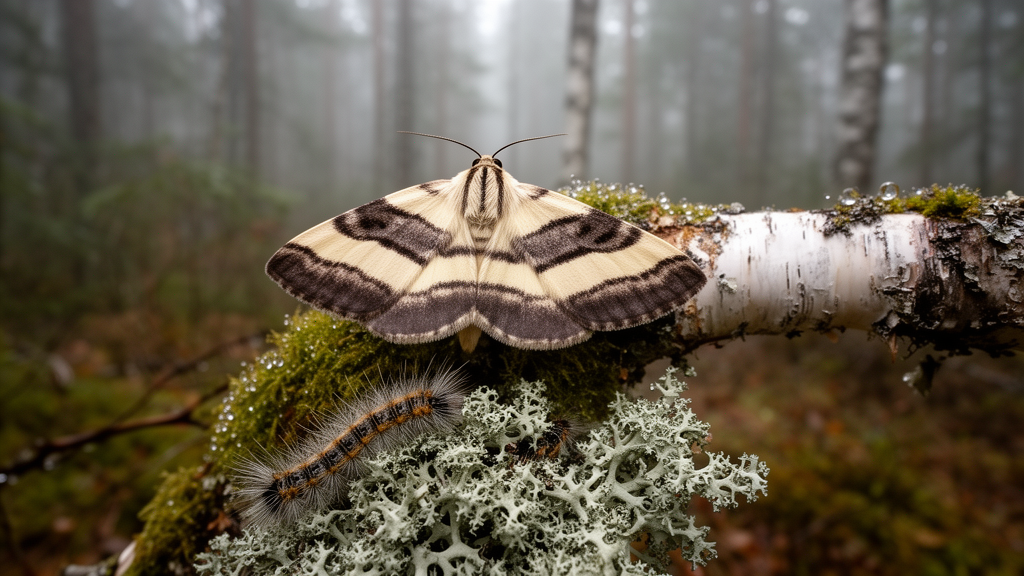
Deep in the Bureinsky Nature Reserve, in the mountains of Russia's Khabarovsk Krai, a single large orange-and-black moth flew low over the ground on a sunny July afternoon in 2018. It was the first Menetries' tiger moth, Arctia menetriesii, recorded in the region in 34 years, and the researcher who caught it had spent 13 field seasons searching its habitat during the flight period before finally encountering one. That single female proved to be a scientific goldmine: she laid 105 eggs in captivity, allowing the first detailed documentation of every stage of this species' development, from egg to adult, along with a startling series of metamorphosis anomalies that may help explain why the species is so vanishingly rare.
Arctia menetriesii is one of the most poorly studied moths of the entire Palaearctic region. Despite its large size and bright colouration, it is known only from sporadic, isolated records scattered across boreal Eurasia, from Finland in the west to Sakhalin Island in the east. Verified populations exist in northern European Russia, the Urals, Siberia, the Russian Far East, Kazakhstan and possibly northern China, but the species is listed as Data Deficient in Finland and Vulnerable in the Russian Federation.
Its holotype came from northeastern Kazakhstan, yet no specimens have been found there since its discovery, underscoring how fragmented and mysterious its distribution remains. The newly described female was collected at 2:30 p.m. on July 1, 2018, in the Dusse-Alin' Mountains at an elevation of 877 metres, flying low above the ground after a short rain shower. The habitat was a mountain larch forest of Larix gmelinii with scattered young spruce and birch, a mossy understorey dominated by lingonberry, arctic raspberry and Ledum, and scattered shrubs of willow, birch, rose and spiraea.
Two days later, in captivity, the female laid 105 dome-shaped, light green eggs about 2 millimetres wide, each with a finely meshed surface sculpture. The eggs hatched in roughly nine days at 23 to 25 degrees Celsius. The larvae passed through seven instars, each described and illustrated in unprecedented detail.
Early instars are whitish with light orange thoracic and rear segments, black shiny heads, and rows of brown warts bearing hairs; distinctive black spots form on the first and seventh abdominal segments from the second instar onward. By the sixth and seventh instars the appearance transforms dramatically: the body becomes black with a bold orange-yellow dorsal stripe, the warts turn large and white with dense tufts of dark hairs, and the final caterpillar reaches up to 45 millimetres before pupating. Instar durations ranged from two to three days in the first instar on dandelion to as long as 21 to 30 days in the seventh.
The rearing experiment also served as a test of long-standing hypotheses about the species' host plants. Most early larvae were fed leaves of the extremely poisonous aconite, Aconitum consanguineum, while others received dandelion; all larvae were switched to dandelion at the third instar. Around twenty sixth- and seventh-instar larvae were then moved onto larch needles, because larch has been suggested as an important natural food plant.
The results were sobering: every larva fed on larch died before pupation, while several last-instar larvae switched back to dandelion in mid-stage successfully pupated. This contradicts the idea that larch is a key host, at least under laboratory conditions. The aconite question is particularly intriguing.
The only reliable record of a natural host plant for the species comes from the Baikal region, where a last-instar larva was found feeding on the toxic Aconitum rubicundum; that larva subsequently died, apparently of starvation when aconite was unavailable and other plants were refused. Norditerpenoid alkaloids in Aconitum are known to have strong insecticidal activity, and other tiger moths, such as Grammia incorrupta, are known to sequester plant alkaloids as a chemical defence against predators. The author suggests that Menetries' tiger moth larvae may likewise feed on aconite to acquire defensive compounds, but that too much of the plant can be lethal.
Notably, no aconite was found in the reserve habitat where the female was captured; the nearest plants grow five kilometres away across a mountain pass, and years of examining those plants revealed no moth larvae or feeding damage. The most striking findings concerned the end of development. Mortality was low to moderate through the first six instars, but roughly 75 percent of larvae that reached the final instar died just before pupation.
Of the fourteen larvae that pupated, every single pupa showed anomalies of varying severity, ranging from abnormal leg, antenna and wing positions to severe malformations. Four specimens became larva-pupa intermediates after disrupted moulting; only one of these, a female, completed metamorphosis, emerging with her head and thorax still covered in larval cuticle. She laid 19 unfertilized eggs.
Of the thirteen pupae that survived to eclosion, only four adults fully or almost fully inflated their wings, and one male had a severely deformed forewing. The entire cycle from egg to adult took 72 to 83 days. Such anomalies are not unknown in laboratory lepidopterology: similar disruptions have been documented in cotton leafworm and beet armyworm larvae reared on food treated with the plant-derived insecticide azadirachtin or the insect growth regulator methoxyfenozide.
This raises the possibility that secondary plant compounds ingested by the caterpillars, whether aconite alkaloids or chemicals in larch needles, interfered with metamorphosis. Importantly, two other arctiine species coexisting with A. menetriesii in the same region, Arctia ornata and Grammia quenselii, were reared on dandelion under identical conditions without any such anomalies, suggesting the problem is specific to this species and its diet rather than to the rearing setup. The low adult yield mirrors earlier attempts.
In Finland in the 1940s, only two moths emerged from 30 eggs, and a later Transbaikalian rearing produced 19 adults from 100 larvae fed on 15 plant species. The new description broadly confirms those observations while revealing differences: the paired spots on the first and seventh abdominal segments are black rather than reddish brown, the dorsal dark lines appear as early as the fourth instar rather than the fifth, and the pupal cremaster bears 14 to 20 setae instead of the 10 reported from Finland. Why does this moth remain so rare?
The adults are notoriously difficult to detect: they are not attracted to light, fly by day or at dusk, and do so reluctantly. The laboratory findings raise the possibility that high mortality during metamorphosis, perhaps linked to diet chemistry, also operates in nature, and parasitoids may add further pressure. In the same reserve, all 23 sixth-instar larvae of the sympatric Arctia ornata collected in July 2017 were parasitized by tachinid flies, and parasitoid infestation is known to sharply reduce adult abundance in other Siberian and Arctic tiger moths.
Subject of Research: Life history and laboratory rearing of the rare boreal tiger moth Arctia menetriesii in the Russian Far East
Article Title: Life history of the rare boreal tiger moth Arctia menetriesii (Eversmann, 1846) ( Lepidoptera , Erebidae , Arctiinae ) in the Russian Far East
Article References: Koshkin, E. S. (2021). Life history of the rare boreal tiger moth Arctia menetriesii (Eversmann, 1846) (Lepidoptera, Erebidae, Arctiinae) in the Russian Far East. Nota Lepidopterologica, 44, 141-151. https://doi.org/10.3897/nl.44.62801
Image Credits: AI Generated
DOI: 10.3897/nl.44.62801
Keywords: Arctia menetriesii, tiger moth, Lepidoptera, boreal ecology, Russian Far East, metamorphosis anomalies, host plants, Aconitum, larch, rare species, conservation, laboratory rearing
Cite Scienmag News
Gavin Prescott. (October 27, 2026). Rarest boreal tiger moth finally reveals its life cycle in the Russian Far East. Scienmag. https://scienmag.com/rarest-boreal-tiger-moth-finally-reveals-its-life-cycle-in-the-russian-far-east/
Gavin Prescott. "Rarest boreal tiger moth finally reveals its life cycle in the Russian Far East." Scienmag, 27 October 2026, https://scienmag.com/rarest-boreal-tiger-moth-finally-reveals-its-life-cycle-in-the-russian-far-east/. Accessed 27 October 2026.
Gavin Prescott. "Rarest boreal tiger moth finally reveals its life cycle in the Russian Far East." Scienmag. October 27, 2026. https://scienmag.com/rarest-boreal-tiger-moth-finally-reveals-its-life-cycle-in-the-russian-far-east/


