


A quarter-century of scientific literature on the bone-eroding side effects of breast cancer drugs has been mapped in unprecedented detail, and the picture that emerges is one of a field in transition. A new bibliometric analysis, published in Frontiers in Nutrition, examined 768 original articles and reviews spanning 2000 to 2025 to chart how researchers have studied aromatase inhibitor-induced bone loss, a common complication of the endocrine therapies taken by millions of postmenopausal women with hormone receptor-positive breast cancer. The findings suggest the field has moved decisively beyond simply measuring bone mineral density toward an integrated strategy that pairs antiresorptive drugs with micronutrients, dietary bioactive compounds, and metabolic management.
The clinical backdrop is significant. Breast cancer is the most frequently diagnosed cancer in women worldwide, and hormone receptor-positive disease accounts for roughly 70 to 80 percent of all cases. Third-generation aromatase inhibitors—anastrozole, letrozole, and exemestane—are the primary adjuvant endocrine therapies for postmenopausal women with early-stage hormone receptor-positive disease, and they have been shown to reduce recurrence and improve long-term survival. But these drugs work by blocking the peripheral conversion of androgen precursors into estrogens, and estrogen plays a central physiological role in restraining osteoclast activity and suppressing bone resorption. The result is accelerated bone turnover: bone mineral density loss rates under aromatase inhibitor therapy run two to four times higher than those seen in natural menopause, with fragility fractures and degraded quality of life as downstream consequences.
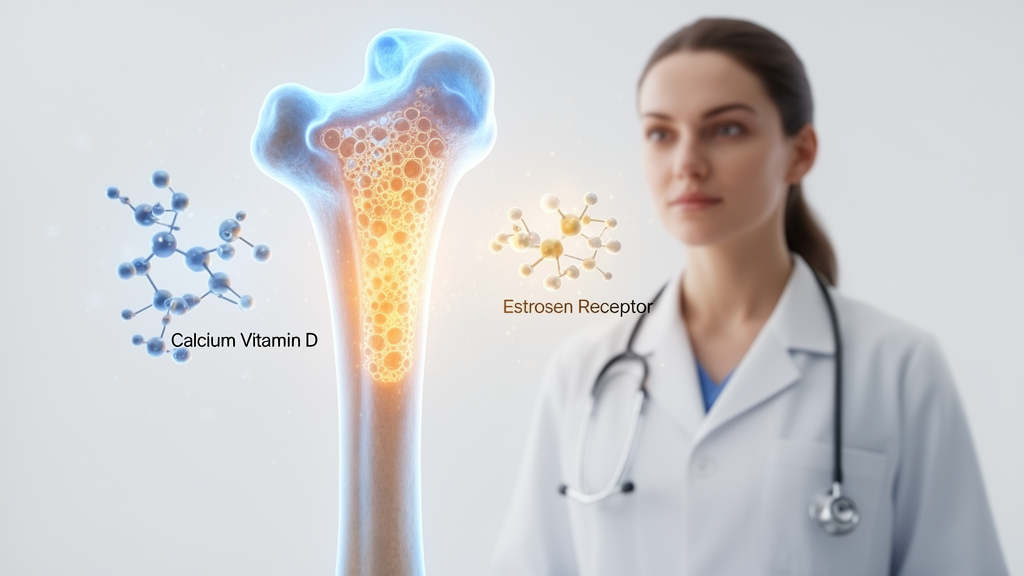
While antiresorptive medications such as bisphosphonates and denosumab are recommended in clinical guidelines for managing this bone loss, their long-term use can be limited by serious adverse events, including atypical femoral fractures, osteonecrosis of the jaw, and severe hypocalcemia. That limitation has fueled growing interest in nutritional and supportive interventions as complementary approaches. Elemental calcium and vitamin D serve as physiological co-therapies for intestinal calcium transport and bone mineralization, while recent research has highlighted how dietary patterns, phytoestrogens, and gut microbiota-derived metabolites may influence the signaling pathways driving osteoclast formation and systemic low-grade inflammation.
To capture how this research landscape evolved, the team, led by Zhenfan Huang, Yuyu Zhang, Qiongyu Wu, and Shaoda Meng of the First People’s Hospital of Yunnan Province in Kunming, China, searched the Web of Science Core Collection and Scopus for publications from January 1, 2000, to December 31, 2025. Their query combined four logical blocks covering aromatase inhibitor therapy, breast cancer, bone metabolism outcomes, and nutritional interventions ranging from vitamin D and calcium to phytoestrogens, probiotics, and polyphenols. Following PRISMA guidelines, they screened 934 records from Web of Science and 1,220 from Scopus, excluded 286 off-target records, and removed 166 duplicates, yielding a final dataset of 768 articles drawn from 366 journals and authored by 3,558 investigators, with an average of 44.89 citations per document.
The temporal pattern of output tells a story of a field that matured quickly and then consolidated. Annual production rose from just two articles in 2000 into a growth phase between 2005 and 2011, peaking at 59 articles in 2011 before settling into a stable plateau of 23 to 41 articles per year through 2025. The authors note that the initial surge coincides with the publication of pivotal randomized controlled trials such as ATAC and BIG 1-98, which established aromatase inhibitors as standard therapy and simultaneously raised awareness of their skeletal consequences. The subsequent plateau, they suggest, reflects the acceptance of basic management principles as clinical consensus, with research attention shifting toward more specialized nutritional and metabolic co-therapies.
Geographically, the field is heavily concentrated in North America and Europe. The United States led all countries with 303 publications, followed by the United Kingdom with 84, Italy with 66, Germany with 42, Canada with 36, and Australia with 34. The country collaboration network was dense, with the United States, United Kingdom, Germany, France, and Italy serving as the most important topological hubs. The United States also recorded the highest number of single-country publications at 243, a pattern the authors attribute to federally funded national cooperative clinical trial groups. European countries and Canada showed proportionally higher rates of internationally co-authored work, likely reflecting multi-center trial cooperation through organizations such as the European Organisation for Research and Treatment of Cancer and the Austrian Breast and Colorectal Cancer Study Group. At the institutional level, the Mayo Clinic led with 28 publications, followed by the University of Sheffield with 20 and the University of Michigan with 19, with transatlantic clusters linking European centers to North American ones.
The keyword and thematic analyses reveal the field’s intellectual architecture most clearly. The most frequent author keywords were osteoporosis, appearing 139 times, bisphosphonates at 117, denosumab at 64, bone mineral density at 62, tamoxifen at 54, bone loss at 36, letrozole at 35, and vitamin D at 31. Co-occurrence networks organized the literature into three interconnected conceptual domains: pharmacological bone-targeted agents, endocrine therapeutic modalities, and supportive or nutritional management. Longitudinal mapping showed early growth for osteoporosis and bisphosphonates, with cumulative totals of 151 and 121 occurrences by 2025, while denosumab and bone mineral density monitoring accelerated sharply after 2010. Trend topics progressed through three translational eras, from tamoxifen and first-generation bisphosphonates, through vitamin D supplementation around 2014 and bone density monitoring around 2017, to RANK-L inhibition with denosumab around 2019—a trajectory the authors interpret as a shift from isolated antiresorptive treatment toward targeted biologics and structured bone microenvironment preservation.
A dedicated sub-analysis of nutrition-specific keywords underscored where dietary research stands. Vitamin D, with 31 occurrences, and calcium, with 28, formed the fundamental micronutritional axis, routinely integrated as baseline co-therapies in clinical trials. Emerging dietary and metabolic regulators showed growing but still modest relevance: phytoestrogens and isoflavones appeared 14 times, gut microbiota and probiotics 11 times, and polyphenols 9 times. The authors suggest this pattern reflects a gradual expansion from basic elemental supplementation toward modulating the gut-bone axis and exploring the osteoprotective potential of plant-derived bioactive compounds in mitigating treatment-induced inflammation. Notably, the strategic thematic map placed vitamin D in the lower-left quadrant of low centrality and low density, which the authors caution should not be read as a decline in scientific relevance; rather, vitamin D and calcium have become so universally embedded as baseline protocols in nearly all bone trials that they no longer generate distinctive network novelty compared with actively tested prescription drugs.
Citation impact analysis added another layer, revealing which topics carry the most scholarly weight. Survivorship led with a mean total citation score of 110.10, followed by obesity at 104.55, quality of life at 96.73, estrogen receptor at 95.13, fracture risk at 85.75, and arthralgia at 55.56. The prominence of obesity, arthralgia, and survivorship, the authors argue, reflects growing recognition of the clinical links between peripheral metabolic status, musculoskeletal treatment toxicities, and adherence to endocrine therapy—since joint symptoms from aromatase inhibitors are frequently cited as a major reason patients discontinue treatment. The citation lineage analysis also distinguished between local and global influence: within the specialized literature cohort, guideline-oriented papers by Perez and Van Poznak served as operational benchmarks for clinical management, while the most globally cited works, such as Rachner’s Lancet review on osteoporosis mechanisms with 2,523 citations, provided broad mechanistic and survivorship frameworks spanning oncology and endocrinology.
The study carries important limitations that shape how its conclusions should be read. Only English-language publications in two databases were included, so recent findings on the gut microbiota-bone axis may be underrepresented. The analysis relied on bibliographic metadata without full-text qualitative screening, meaning it cannot assess the methodological quality or clinical efficacy of the included studies. Keyword co-occurrence captures dominant terms, so highly specific dietary concepts may be missed, and the low frequency of food-based terms limits robust conclusions about particular dietary patterns. The authors also acknowledge a pronounced geographic bias toward Western countries. As a bibliometric study, the work maps research trends rather than establishing that any nutritional intervention prevents fractures. Still, the authors conclude that the field’s trajectory—from bone density surveillance, through single-agent antiresorptive therapy, to integrative approaches combining micronutritional co-therapies, biologics, and metabolic modulation—points toward future priorities: tailored nutrition plans targeting the gut microbiota-bone axis, and broader research participation in Asia, Africa, and Latin America to capture truly global patterns of bone health during long-term breast cancer survivorship.
Subject of Research: Bibliometric analysis of nutritional intervention research on aromatase inhibitor-induced bone loss in postmenopausal breast cancer
Article Title: Translational trends and specific nutritional interventions for aromatase inhibitor induced bone loss based on a 25 year multi database bibliometric and thematic evolution analysis from 2000 to 2025
Article References: Huang, Z., Zhang, Y., Wu, Q., & Meng, S. (2026). Translational trends and specific nutritional interventions for aromatase inhibitor induced bone loss based on a 25 year multi database bibliometric and thematic evolution analysis from 2000 to 2025. Frontiers in Nutrition, 13, Article 1969024. https://doi.org/10.3389/fnut.2026.1969024
Image Credits: AI Generated
DOI: 10.3389/fnut.2026.1969024
Keywords: aromatase inhibitors, bone loss, breast cancer, bibliometrics, vitamin D, calcium, osteoporosis, nutrition, denosumab, bisphosphonates, gut microbiota, survivorship
Cite Scienmag News
Daisy Hatcher. (October 27, 2026). 25 Years of Research Maps Nutrition’s Growing Role in Bone Loss From Breast Cancer Therapy. Scienmag. https://scienmag.com/25-years-of-research-maps-nutritions-growing-role-in-bone-loss-from-breast-cancer-therapy/
Daisy Hatcher. "25 Years of Research Maps Nutrition’s Growing Role in Bone Loss From Breast Cancer Therapy." Scienmag, 27 October 2026, https://scienmag.com/25-years-of-research-maps-nutritions-growing-role-in-bone-loss-from-breast-cancer-therapy/. Accessed 27 October 2026.
Daisy Hatcher. "25 Years of Research Maps Nutrition’s Growing Role in Bone Loss From Breast Cancer Therapy." Scienmag. October 27, 2026. https://scienmag.com/25-years-of-research-maps-nutritions-growing-role-in-bone-loss-from-breast-cancer-therapy/


