


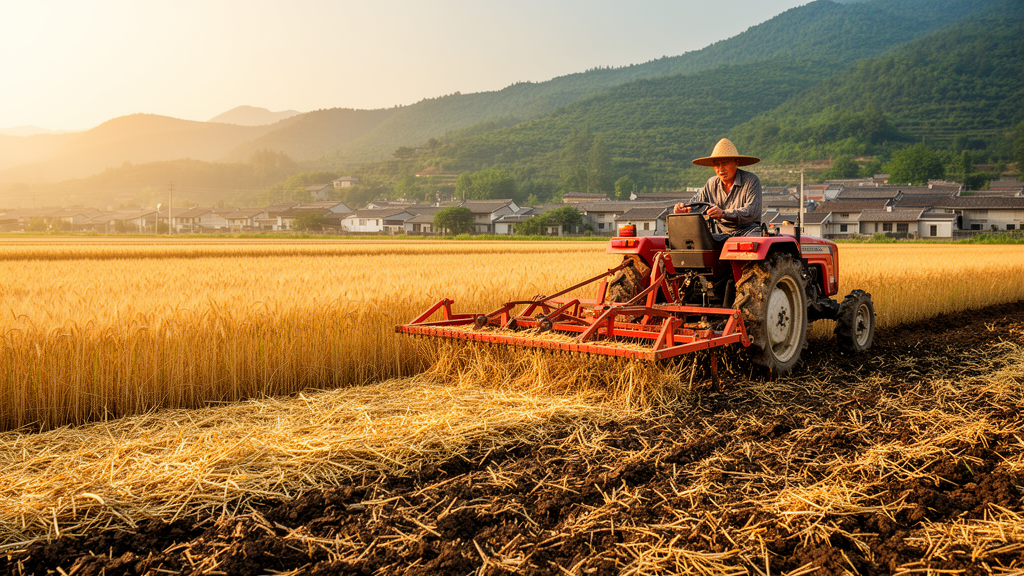
A government-run credit guarantee program in Inner Mongolia appears to nudge farmers into adopting straw-returning technology, a green practice that involves chopping crop residue and plowing it back into the soil rather than burning or discarding it. That is the central finding of a new survey-based study published in Frontiers in Sustainable Food Systems, which analyzed data from 558 farming households across three cities in one of China’s major grain-producing regions. The researchers, from Inner Mongolia Agricultural University, report that farmers who obtained policy-based agricultural credit guarantees devoted a significantly larger share of their land to straw returning than comparable farmers who did not.
Straw returning is widely regarded as a cornerstone of ecological agriculture. By working shredded stalks back into fields, farmers can improve soil structure, raise organic matter, and support crop yields, while avoiding the air pollution caused by open burning. In countries such as the United States, Canada, Australia, Japan, and members of the European Union, where incineration laws and subsidies exist, returning straw to the field is the first-choice treatment. But in places like India and Southeast Asia, where machinery supply is thin and smallholders face tight budgets, the short-term yield gains are not obvious and adoption stays low. Inner Mongolia sits somewhere in between: the region’s comprehensive straw utilization rate and the scale of its field returns rank among the highest in China, yet scattered burning and random disposal of straw persist.
The gap between intention and action is striking. Citing earlier field survey work, the authors note that 72.7 percent of farmers say they are willing to recycle crop straw, but only 16.9 percent actually do it. The study frames this contradiction through the lens of credit rationing theory. Farmers generally lack qualified collateral and have incomplete credit records, making it hard for banks to assess repayment ability at low cost. Raising interest rates to compensate only invites adverse selection and moral hazard, so some farmers who genuinely want to invest in straw returning simply cannot borrow. Straw returning is also capital-intensive: it demands spending on mechanical operations and land adjustments, and it carries the risk of short-term yield fluctuations before the long-term soil benefits arrive.
Policy-based agricultural credit guarantee, or PACG, is designed to break exactly this bottleneck. It is a government-established professional guarantee institution, capitalized with public funds and run without profit as its primary goal, that provides credit-enhancement services for agricultural business entities. When a farmer cannot secure a bank loan for lack of collateral, the guarantee institution stands behind the loan, shares the default risk with the bank, and lowers both the loan threshold and financing costs. In the survey sample, 248 of the 558 farmers—44.44 percent—had obtained such guarantees. The researchers measured the intensity of guarantee support as the ratio of the guaranteed loan amount to total household income, and measured adoption intensity as the share of a household’s total land on which straw-returning technology was applied.
Because the adoption measure is a fraction between zero and one, the team used a fractional probit model estimated by quasi-maximum likelihood rather than ordinary least squares, which could produce fitted values outside the valid range. In the baseline regression, the PACG coefficient was 0.090, significant at the 10 percent level, indicating a positive association between guarantee support and the share of land under straw returning. Among the control variables, years of farming showed a significant negative relationship—longer-tenured farmers appear locked into traditional habits such as burning—while the number of green-production consultations and progressive village-level leadership were both positively associated with adoption.
Correlation is not causation, and the authors acknowledge two threats: reverse causality, since farmers investing in straw returning might be more likely to seek guarantees, and omitted-variable bias. To address these, they used the leave-one-out village PACG rate—the share of other farmers in the same village with guarantees—as an instrumental variable, reasoning that it predicts individual participation but cannot independently drive a household’s straw-returning choice. Because the outcome is fractional, they employed a conditional mixed process (CMP) model rather than standard two-stage least squares. In the second stage, PACG participation remained significantly and positively related to adoption intensity, and the exogeneity Wald test was statistically significant, supporting the model’s handling of endogeneity. Robustness checks using Probit and Logit models with a binary adoption outcome, and propensity score matching with three matching algorithms, produced average treatment effects of roughly 0.35, all significant at the 5 percent level.
The study then probed how the guarantee works. Two channels emerged. First, PACG significantly increased farmers’ expenditure on agricultural socialized services—hiring contractors for straw crushing, deep plowing, and whole-process field trusteeship. For smallholders who cannot afford large straw-crushing machinery and face rising labor costs as rural workers migrate to cities, buying services is the main route into straw returning, and the guarantee coefficient on service spending was 0.345, significant at the 5 percent level. Second, PACG improved the match between the loan repayment period and the green production cycle. Straw-returning costs hit at sowing time, while the income benefits arrive only after harvest; conventional short-term bank loans clash with that rhythm. The guarantee, by sharing default risk, encourages banks to offer loan terms aligned with agricultural production cycles, easing cash-flow pressure. The coefficient on matching was 0.174, significant at the 1 percent level.
The effect was far from uniform across households. Farmers lacking formal social capital—meaning they and their relatives have no experience working in government departments—showed a significantly stronger response, because better-connected farmers can tap acquaintance networks for informal financing that substitutes for the guarantee. Digital literacy, scored with a principal-component index built on UNESCO’s Digital Literacy Global Framework, acted as an amplifier: farmers with high digital literacy could better match credit funds with the technologies and services straw returning requires. In a two-dimensional cross-grouping, the guarantee had no significant effect among farmers rich in formal social capital regardless of digital skill, but among socially unconnected farmers the coefficient was 0.286 for the high-digital-literacy group versus 0.167 for the low group. Region mattered too: in areas designated as agricultural green development pioneers, with supportive subsidies, technical support, and market incentives, PACG significantly boosted adoption, while in areas with weak green policies the guarantee alone showed no significant effect—a pattern the authors call a policy synergy effect.
The authors are candid about limitations. The analysis treats straw returning somewhat simplistically, without fully accounting for real-world constraints such as slow straw decomposition in cold or arid conditions, and the survey covers only Inner Mongolia, so the conclusions apply most directly to regions with similar conditions. Still, the findings carry clear policy weight: the guarantee works best when it is tilted toward farmers who lack informal connections but possess the digital skills to convert credit into green action, and when it is paired with regional green-development policies and digital literacy training. For a practice whose private payoff lags well behind its social benefit, that combination of patient credit and enabling context may be what finally closes the gap between what farmers say they want to do and what they actually do in the field.
Subject of Research: The effect of policy-based agricultural credit guarantees on farmers' adoption of straw-returning technology in Inner Mongolia, China
Article Title: Can the policy-based agricultural credit guarantee influence farmers’ adoption of straw-returning technology?
Article References: Liu, X., Xu, L., & Zhang, X. (2026). Can the policy-based agricultural credit guarantee influence farmers’ adoption of straw-returning technology?. Frontiers in Sustainable Food Systems, 10, Article 1948304. https://doi.org/10.3389/fsufs.2026.1948304
Image Credits: AI Generated
DOI: 10.3389/fsufs.2026.1948304
Keywords: agricultural credit guarantee, straw returning, green production technology, credit rationing, Inner Mongolia, farmers adoption behavior, agricultural socialized services, credit cycle matching, digital literacy, social capital, soil fertility, sustainable agriculture
Cite Scienmag News
Alan Morgan. (October 27, 2026). Government-Backed Loan Guarantees Push Chinese Farmers Toward Straw-Returning, Study Finds. Scienmag. https://scienmag.com/government-backed-loan-guarantees-push-chinese-farmers-toward-straw-returning-study-finds/
Alan Morgan. "Government-Backed Loan Guarantees Push Chinese Farmers Toward Straw-Returning, Study Finds." Scienmag, 27 October 2026, https://scienmag.com/government-backed-loan-guarantees-push-chinese-farmers-toward-straw-returning-study-finds/. Accessed 27 October 2026.
Alan Morgan. "Government-Backed Loan Guarantees Push Chinese Farmers Toward Straw-Returning, Study Finds." Scienmag. October 27, 2026. https://scienmag.com/government-backed-loan-guarantees-push-chinese-farmers-toward-straw-returning-study-finds/


