

Tuesday, October 27, 2026
Science
No Result
View All Result
  • Login
  • HOME
  • SCIENCE NEWS
  • CONTACT US
  • HOME
  • SCIENCE NEWS
  • CONTACT US
No Result
View All Result
Scienmag
No Result
View All Result
Home Science News

Spinal Screws and Rods Show Promise in Treating Fractured Cat Backs

October 27, 2026
in Science News
William Thompson
By William Thompson Scienmag Editorial Profile - Livestock Health and Welfare
Reading Time: 3 mins read
0
Spinal Screws and Rods Show Promise in Treating Fractured Cat Backs

Spinal Screws and Rods Show Promise in Treating Fractured Cat Backs

65
SHARES
587
VIEWS
Share on FacebookShare on Twitter
ADVERTISEMENT

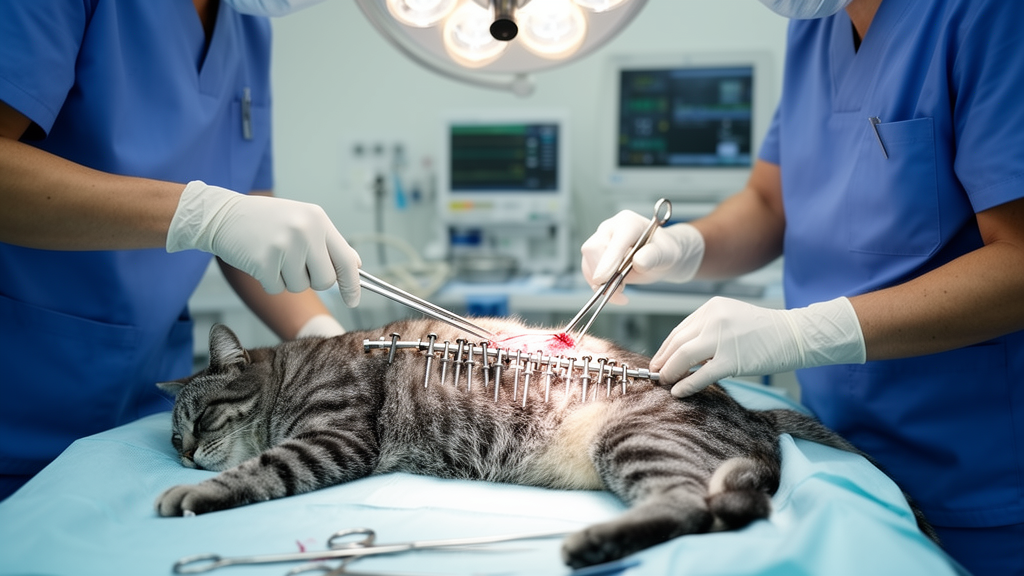
A surgical technique borrowed from human spine medicine and more recently adapted for dogs has now been shown to be technically feasible in cats, according to a small case series from Utrecht University's Faculty of Veterinary Medicine. The study, published in Frontiers in Veterinary Science, describes the use of bilateral pedicle screw and rod fixation (PSRF) in three cats that suffered traumatic fractures and luxations of the caudal lumbar spine, the region near the base of the back where the spinal cord and cauda equina are particularly vulnerable to injury. The approach is a standard of care for spinal stabilization in human patients and has more recently been adopted in canine patients.

Until this report, however, bilateral PSRF at the caudal lumbar and lumbosacral regions of cats had not been described in the veterinary literature, leaving surgeons without a documented reference for this species. The retrospective analysis covered three cats treated between 2016 and 2018. All were presented with traumatic thoracolumbar fractures and luxations and had no comorbidities.

Each animal underwent a neurological examination, pre-operative radiographs and a pre-operative CT scan, and the surgical goal in every case was to decompress and stabilize the spinal cord and cauda equina. The cats were examined by a veterinary surgeon or surgery resident before surgery, immediately after the operation, and again at follow-up appointments; two of the three returned at two to three weeks post-operatively, and all three were assessed at six to seven weeks, when post-operative radiographs were also taken. The outcomes varied with the severity of each injury.

The first cat arrived with a comminuted fracture and luxation of the sixth lumbar vertebra, classified as neurological grade III on the modified Griffith Sharp-Wheeler scale, and improved to grade 0, a normal neurological status, after surgery. The second cat had a comminuted fracture of the caudal vertebral body of the seventh lumbar vertebra with minor dorsal dislocation, and moved from grade IV before surgery to grade III afterwards. The third cat presented with a complete luxation between the fifth and sixth lumbar vertebrae, accompanied by multiple fractures and displaced fracture fragments, and was graded V, the most severe category; this cat showed no improvement following surgery.

The authors emphasize that the key finding is feasibility: the PSRF system could be placed in the vertebrae of all three cats, demonstrating that the hardware and the surgical approach are anatomically workable in feline patients. The report comes with clear limitations inherent to its design. A case series of three animals cannot establish how effective PSRF is compared with other stabilization techniques, nor can it predict outcomes for the broader population of cats with spinal trauma.

The neurological grades were compared before and after surgery within each individual, and the authors note that the potential of the PSRF system in cats warrants further exploration. Even so, the study provides the first documented use of bilateral pedicle screw and rod fixation in the caudal lumbar and lumbosacral spine of cats, giving veterinary neurologists and surgeons a concrete starting point for treating some of the most serious spinal injuries seen in feline trauma patients.

Subject of Research: Pedicle screw and rod fixation for caudal lumbar vertebral fracture and luxation in cats

Article Title: Pedicle screw and rod fixation in three cats with caudal lumbar vertebral fracture and luxation: a case report

Article References: Aartsen, S. A. M., van Stee, L. L., & Meij, B. P. (2026). Pedicle screw and rod fixation in three cats with caudal lumbar vertebral fracture and luxation: a case report. Frontiers in Veterinary Science, 13, Article 1778936. https://doi.org/10.3389/fvets.2026.1778936

Image Credits: AI Generated

DOI: 10.3389/fvets.2026.1778936

Keywords: veterinary neurology, pedicle screw fixation, spinal stabilization, cats, lumbar fracture, vertebral luxation, case series, cauda equina, spinal trauma, orthopedic surgery, Pedicle, screw

Cite Scienmag News

William Thompson. (October 27, 2026). Spinal Screws and Rods Show Promise in Treating Fractured Cat Backs. Scienmag. https://scienmag.com/spinal-screws-and-rods-show-promise-in-treating-fractured-cat-backs/

William Thompson. "Spinal Screws and Rods Show Promise in Treating Fractured Cat Backs." Scienmag, 27 October 2026, https://scienmag.com/spinal-screws-and-rods-show-promise-in-treating-fractured-cat-backs/. Accessed 27 October 2026.

William Thompson. "Spinal Screws and Rods Show Promise in Treating Fractured Cat Backs." Scienmag. October 27, 2026. https://scienmag.com/spinal-screws-and-rods-show-promise-in-treating-fractured-cat-backs/


Tags: adaptation of human spine surgery for veterinary usebilateral pedicle screw and rod fixation in veterinary medicinecase seriescatscauda equinafeline caudal lumbar spine injuriesfeline thoracolumbar fracture treatmentlumbar fractureminimally invasive spinal stabilization in petsorthopedic surgeryPediclepedicle screw fixationSCREWspinal cord decompression in catsspinal injury management in domestic catsspinal screw and rod fixation in catsspinal stabilizationspinal traumatraumatic spinal fractures in catsvertebral luxationveterinary neurologyveterinary neurosurgery advancesveterinary spinal stabilization techniquesveterinary use of human spinal surgery methods
Share26Tweet16
Previous Post

Better digital networks linked to more diverse food supplies across 257 Chinese cities

Next Post

Six Risk Factors Predict Fear of Movement After Bypass Surgery

Related Posts

Dengue Takes Root in Temperate Southern Brazil as Aedes aegypti Spreads
Medicine

Dengue Takes Root in Temperate Southern Brazil as Aedes aegypti Spreads

October 27, 2026
Six Risk Factors Predict Fear of Movement After Bypass Surgery
Medicine

Six Risk Factors Predict Fear of Movement After Bypass Surgery

October 27, 2026
Better digital networks linked to more diverse food supplies across 257 Chinese cities
Science News

Better digital networks linked to more diverse food supplies across 257 Chinese cities

October 27, 2026
Rapidly Failing Heart With Rare Aneurysm Ends in Transplant, Case Report Shows
Medicine

Rapidly Failing Heart With Rare Aneurysm Ends in Transplant, Case Report Shows

October 27, 2026
Senescent Lymph Node Fibroblasts Block Human B Cell Proliferation Through Cell–Cell Contact
Biology

Senescent Lymph Node Fibroblasts Block Human B Cell Proliferation Through Cell–Cell Contact

October 27, 2026
Headwater Lakes and Catchments Emerge as Front Line of Global Water Security
Earth Science

Headwater Lakes and Catchments Emerge as Front Line of Global Water Security

October 27, 2026
Next Post
Six Risk Factors Predict Fear of Movement After Bypass Surgery

Six Risk Factors Predict Fear of Movement After Bypass Surgery

  • Mothers who receive childcare support from maternal grandparents show more optimized

    Mothers who receive childcare support from maternal grandparents show more parental warmth, finds NTU Singapore study

    27656 shares
    Share 11059 Tweet 6912
  • University of Seville Breaks 120-Year-Old Mystery, Revises a Key Einstein Concept

    1061 shares
    Share 424 Tweet 265
  • Bee body mass, pathogens and local climate influence heat tolerance

    682 shares
    Share 273 Tweet 171
  • Researchers record first-ever images and data of a shark experiencing a boat strike

    546 shares
    Share 218 Tweet 137
  • Groundbreaking Clinical Trial Reveals Lubiprostone Enhances Kidney Function

    531 shares
    Share 212 Tweet 133
Science

Embark on a thrilling journey of discovery with Scienmag.com—your ultimate source for cutting-edge breakthroughs. Immerse yourself in a world where curiosity knows no limits and tomorrow’s possibilities become today’s reality!

RECENT NEWS

  • Dengue Takes Root in Temperate Southern Brazil as Aedes aegypti Spreads
  • Six Risk Factors Predict Fear of Movement After Bypass Surgery
  • Spinal Screws and Rods Show Promise in Treating Fractured Cat Backs
  • Better digital networks linked to more diverse food supplies across 257 Chinese cities

Categories

  • Agriculture
  • Anthropology
  • Archaeology
  • Athmospheric
  • Biology
  • Biotechnology
  • Blog
  • Bussines
  • Cancer
  • Chemistry
  • Climate
  • Earth Science
  • Editorial Policy
  • Marine
  • Mathematics
  • Medicine
  • Pediatry
  • Policy
  • Psychology & Psychiatry
  • Science Education
  • Science News
  • Social Science
  • Space
  • Technology and Engineering

Subscribe to Blog via Email

Enter your email address to subscribe to this blog and receive notifications of new posts by email.

Join 5,151 other subscribers

© 2025 Scienmag - Science Magazine

Welcome Back!

Login to your account below

Forgotten Password?

Retrieve your password

Please enter your username or email address to reset your password.

Log In
No Result
View All Result
  • HOME
  • SCIENCE NEWS
  • CONTACT US

© 2025 Scienmag - Science Magazine

Discover more from Science

Subscribe now to keep reading and get access to the full archive.

Continue reading