


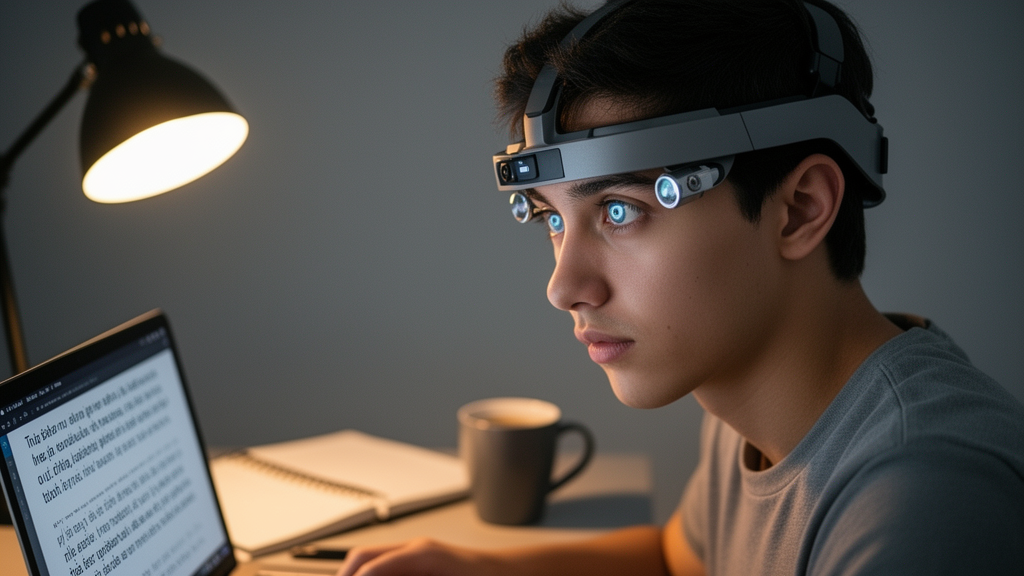
Language anxiety can quietly reshape not just what foreign-language learners say, but how they look, gesture, and move their faces while saying it. A new study published in npj Science of Learning combined eye-tracking with multimodal discourse analysis to observe how English as a Foreign Language (EFL) learners regulate communication under stress, and the results point to a distinctive, measurable pattern of anxious communication.
The researchers, Ting Wen and Yuqing Wei, recruited 120 college students whose scores on the Self-Rating Anxiety Scale fell between 50 and 59, indicating moderate anxiety. Using stratified random sampling, they split the participants into experimental and control groups of 60 each. During impromptu speech and debate tasks, the team recorded language output alongside eye movements, gestures, facial expressions, and physiological signals, creating a rich multimodal picture of communication under anxiety.
The comparison between higher- and lower-anxiety learners revealed a systematic pattern. Anxious participants showed rigid, text-biased gaze behavior, produced redundant language output, and displayed inhibitory nonverbal behavior. Together, the authors interpret these shifts as compensatory pragmatic regulation: strategies the learners deploy to manage communicative pressure when anxiety constrains their usual flexibility.
The eye-tracking measures proved more than descriptive. According to the study, eye-movement indicators related to the students showed strong predictive power for language anxiety levels, suggesting that gaze patterns could serve as an objective, real-time window into an otherwise internal emotional state that learners often struggle to report accurately.
Beyond observation, the team ran exploratory intervention tests using Eye Movement Desensitization and Reprocessing (EMDR) training, a technique better known from trauma therapy. These preliminary tests indicated that EMDR could alleviate anxiety-related cognitive constraints and improve multimodal communication performance. The authors stress that this applied component is supplementary and exploratory, so the findings should be treated as an early signal rather than an established classroom prescription.
The study’s contribution is twofold. Theoretically, it expands understanding of the cognitive mechanisms underlying language anxiety by tying them to observable, coordinated changes across speech, gaze, gesture, and facial expression. Practically, it offers what the authors call actionable intervention pathways for EFL teaching, from recognizing anxious learners’ rigid gaze patterns to testing anxiety-reduction techniques that may free up communicative resources.
Limitations remain worth noting. The sample consisted of college students with moderate anxiety, and the intervention evidence is exploratory, so generalization to other populations, anxiety severities, and learning contexts awaits further research. Still, by grounding an emotional construct in hard physiological and behavioral data, the study moves language anxiety research closer to measurable, teachable territory.
Subject of Research: Eye-tracking study of communicative strategy selection and multimodal pragmatic regulation in language-anxious EFL learners
Article Title: Communicative strategy selection in language anxiety: eye-tracking evidence of EFL learners’ multimodal pragmatic regulation
Article References: Wen, T., & Wei, Y. (2026). Communicative strategy selection in language anxiety: eye-tracking evidence of EFL learners’ multimodal pragmatic regulation. npj Science of Learning. https://doi.org/10.1038/s41539-026-00461-3
Image Credits: AI Generated
DOI: 10.1038/s41539-026-00461-3
Keywords: language anxiety, EFL learners, eye-tracking, multimodal communication, pragmatic regulation, EMDR, impromptu speech, gaze patterns, nonverbal behavior, npj Science of Learning, Communicative, strategy
Cite Scienmag News
Courtney Benton. (October 27, 2026). Eyes Reveal How Anxious Language Learners Rethink Communication. Scienmag. https://scienmag.com/eyes-reveal-how-anxious-language-learners-rethink-communication/
Courtney Benton. "Eyes Reveal How Anxious Language Learners Rethink Communication." Scienmag, 27 October 2026, https://scienmag.com/eyes-reveal-how-anxious-language-learners-rethink-communication/. Accessed 27 October 2026.
Courtney Benton. "Eyes Reveal How Anxious Language Learners Rethink Communication." Scienmag. October 27, 2026. https://scienmag.com/eyes-reveal-how-anxious-language-learners-rethink-communication/


