


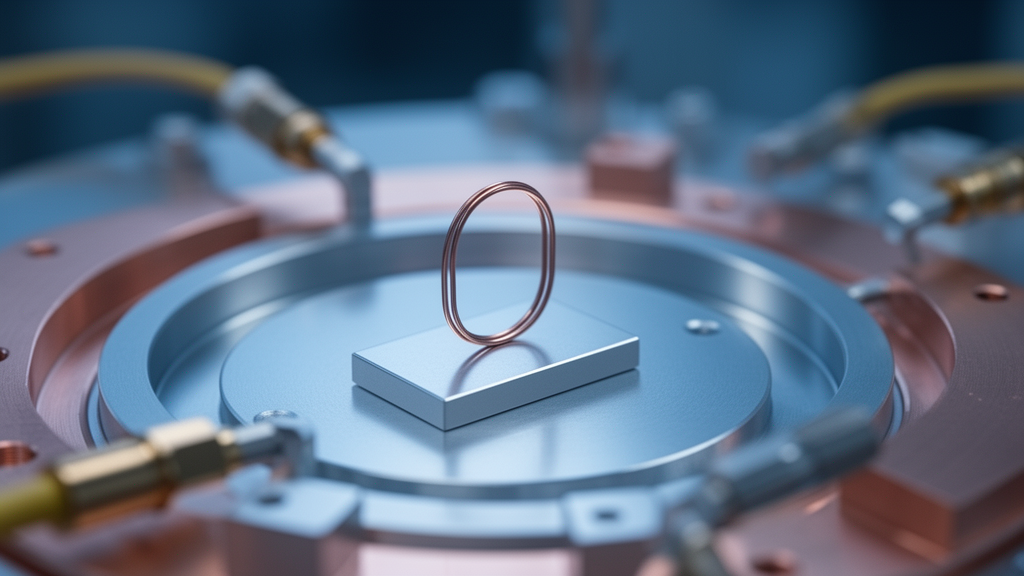
Quantum engineers at Adelaide University have found a simpler way to overcome a long-standing limitation in some of the most sensitive magnetic field detectors ever built, a result that could ripple through brain imaging, medical diagnostics, communications technology and next-generation quantum devices. The research, led by the university's Quantum and Nano Technology Group (QuaNTeG), is published in Physical Review Applied and addresses a problem that has constrained superconducting quantum interference devices, known as SQUIDs, for decades. SQUIDs are among the most sensitive detectors of magnetic fields in existence, capable of registering astonishingly small changes in magnetic flux.
That sensitivity has earned them a place in specialised applications ranging from brain imaging systems, where faint magnetic signals produced by neural activity must be distinguished from noise, to scientific instruments and advanced radio-frequency sensors. Yet these devices have always had a blind spot: while they excel at detecting tiny variations in a magnetic field, they have struggled to accurately identify when a magnetic field is exactly zero. Engineers have traditionally solved this by building complex circuits containing hundreds or even thousands of superconducting loops of different sizes.
The drawback is significant: that approach reduces the overall sensitivity of the device, forcing a design compromise between knowing the absolute field and measuring it with maximum precision. The Adelaide team, which includes PhD students Ross Monaghan and Jonathan Marenkovic, discovered a way to sidestep that trade-off entirely. Instead of fabricating loops of many different sizes, the researchers kept all the loops the same size but strategically replaced some of them with what they call bare loops, which contain no Josephson junctions.
These bare loops alter how magnetic signals move through the circuit, creating what the researchers describe as a synthetic area spread. The effect is that the sensor behaves as though it contains many differently sized loops, even though every loop in the array is physically identical. The magnetic response of the full circuit acquires the same unambiguous, unique signature that a heterogeneous array would produce, but without the fabrication burden or the sensitivity penalty that comes with mixing loop dimensions.
In effect, the team engineered the desired collective behaviour through circuit topology rather than through geometric variety. The researchers first developed the theory behind the approach and then confirmed the effect experimentally using fabricated superconducting circuits operating at very low temperatures, the regime in which superconductivity and Josephson junction physics can function. The results showed that the new design behaved exactly as predicted, validating both the theoretical framework and the practical feasibility of the synthetic area spread concept.
Lead researcher Associate Professor Giuseppe Tettamanzi, from Adelaide University's School of Chemical Engineering, said the discovery could help unlock the full potential of quantum sensing technologies. "For decades, scientists have known how to make these devices identify an absolute magnetic field but doing so required design compromises that reduced their performance," he said. "Our work shows there is another way.
By introducing carefully positioned bare loops, we can achieve the same result while preserving the conditions needed for maximum sensitivity." "Highly sensitive superconducting quantum sensors have enormous potential in medicine, communications, industry and defence," Tettamanzi said. "The closer we get to the fundamental quantum limit of detection, the more information we can extract from very weak signals." By removing the need to dilute sensitivity in order to resolve absolute field values, the new design points toward sensors that can push closer to that fundamental limit while still delivering unambiguous readings.
The practical implications extend beyond raw performance. Because the approach eliminates the need to fabricate large arrays containing many different loop sizes, future devices could be easier and less costly to manufacture, a meaningful consideration for any technology hoping to move from the laboratory into clinics, communications infrastructure and industrial platforms. Potential future applications identified by the team include improved brain monitoring systems, more sensitive radio-frequency receivers, low-noise communication technologies and advanced electromagnetic sensing platforms.
The work is not yet ready for the market. The researchers note that further testing is required before the technology can be commercialised, and the concept is the subject of an international patent application. Further studies are already underway to improve device performance and explore new applications.
Even so, the team believes the breakthrough brings practical quantum-limited sensors a significant step closer to reality, offering a route to absolute magnetic field measurement that no longer demands sacrificing the extraordinary sensitivity that makes SQUIDs worth building in the first place.
Subject of Research: A new superconducting quantum interference device design using bare loops to create a synthetic area spread for absolute magnetic field detection
Article Title: Tiny quantum breakthrough with big implications for medicine and technology
Article References: Tiny quantum breakthrough with big implications for medicine and technology. Original publication (Bibliographic details unavailable.)
Image Credits: AI Generated
DOI: Not provided
Keywords: SQUID, superconducting quantum interference device, quantum sensing, Josephson junction, magnetic field detection, synthetic area spread, brain imaging, medical diagnostics, radio-frequency sensors, Adelaide University, Physical Review Applied, quantum devices
Cite Scienmag News
Katie Riggs. (October 27, 2026). Bare loops offer simpler fix for superconducting quantum sensors. Scienmag. https://scienmag.com/bare-loops-offer-simpler-fix-for-superconducting-quantum-sensors/
Katie Riggs. "Bare loops offer simpler fix for superconducting quantum sensors." Scienmag, 27 October 2026, https://scienmag.com/bare-loops-offer-simpler-fix-for-superconducting-quantum-sensors/. Accessed 27 October 2026.
Katie Riggs. "Bare loops offer simpler fix for superconducting quantum sensors." Scienmag. October 27, 2026. https://scienmag.com/bare-loops-offer-simpler-fix-for-superconducting-quantum-sensors/


