


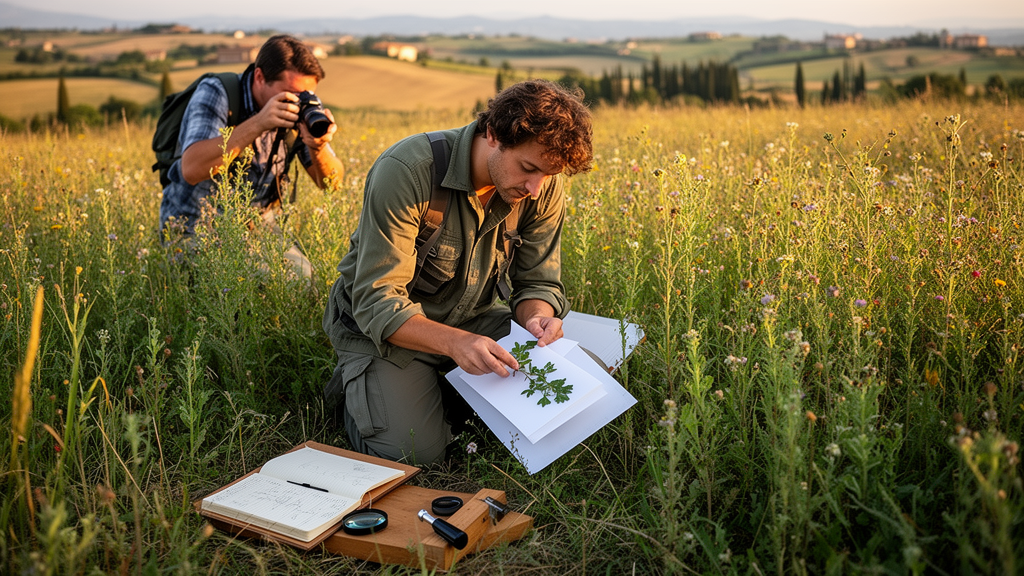
For the first time, botanists have assembled a complete inventory of the vascular plants growing in the municipality of Empoli, a heavily cultivated and urbanized district of Tuscany in central Italy. The new flora documents 757 species and subspecies belonging to 462 genera and 108 families, including 117 alien plants and 51 cultivated ones. The work, published in the Italian Botanist, closes a remarkable gap: between 1860 and 2003, only 26 floristic records existed for a territory that had, in effect, never been systematically studied by botanists.
The inventory was built from more than two decades of field investigations, concentrated most intensively between 2018 and 2022, and combined with a critical review of the sparse historical literature. Individual records accumulated during the survey were stored in the regional database Wikiplantase #Toscana, and the most significant discoveries were published incrementally as the research progressed. In total, the study draws on 11,858 records for Empoli and its neighboring municipalities, of which 6,791, or 57 percent, fall within Empoli itself. Nomenclature follows the current Italian checklists, with families arranged according to the APG IV phylogenetic classification.
A distinctive feature of the study is its use of quantitative tools to frame expectations before and after the survey. Species-area relationships, adjusted through environmental modeling, predicted that the territory should host 834 species and subspecies, 474 genera, 101 families, and 38 alien taxa. The observed counts came close for families, which slightly exceeded the prediction, and fell 3 percent short for genera. The documented species and subspecies total, however, sits 10 percent below the theoretical expectation, a shortfall the authors attribute either to undersampling or to the limited environmental variability and high level of construction in the area. The alien count tells a very different story: at 117 established alien taxa, it exceeds the model’s prediction by 207 percent, a figure the researchers interpret as direct evidence of intense human pressure on the landscape.
That pressure is written across the land itself. Empoli covers 62.28 square kilometers at elevations between 22 and 205 meters, bounded by the Arno river to the north and the Elsa river to the west. The hills are formed of middle Pliocene and Pleistocene clays, conglomerates and sands, while the plain rests on Holocene alluvial deposits. Most of the territory is cultivated, chiefly with olive orchards and vineyards, and the rate of overbuilding reaches 18 percent. Spontaneous vegetation survives only in a few relictual sites, most notably a small forest area. Urbanization has been growing since 1119, the original courses of the Arno and Elsa were altered from the sixteenth century onward by cutting meanders, and human presence in the area has been continuous for the last 100,000 years.
Despite these constraints, the flora is biologically informative. Three families alone account for more than 30 percent of the vascular flora: Asteraceae with 99 taxa, Fabaceae with 77, and Poaceae with 71. The richest genera are Trifolium with 17 taxa, Lathyrum with 14, Crepis with 9, and Allium with 7. The biological spectrum is dominated by hemicryptophytes at 34 percent and therophytes at 32 percent, followed by phanerophytes at 15 percent, geophytes at 14 percent, chamaephytes at 3 percent, and hydrophytes at 2 percent. Chorologically, Mediterranean elements lead at 35 percent, with Eurosiberian taxa at 25 percent and Eurosiberian-Mediterranean ones at 8 percent; 17 percent of taxa have wider distributions, Italian endemics make up just 1 percent, and aliens constitute 14 percent of the established flora.
Seven Italian endemics were recorded: Artemisia caerulescens subsp. cretacea, Crocus biflorus, Daucus broteroi, Ophrys classica, Polygala flavescens subsp. flavescens, Polygala vulgaris subsp. valdarnensis, and Scabiosa uniseta. A further 23 taxa are of phytogeographical interest. Some, such as Lilium martagon, Physospermum cornubiense, and Scilla bifolia, typically grow at higher elevations, making their presence in this lowland district notable. Others, including Asphodelus fistulosus, Imperata cylindrica, Ophrys speculum, and Sisymbrium irio, mark the innermost reaches of their Tuscan distribution here, and the record of Sisymbrium irio is new for the province of Firenze. Species rare in Tuscany and found during the survey include Allium pallens, Butomus umbellatus, Lathyrus tuberosus, Lycopus exaltatus, Tulipa sylvestris, and the Florentine endemism Eriolobus florentinus.
The most frequently observed native species reflect the ordinary, human-shaped countryside: Plantago lanceolata with 117 records, Daucus carota subsp. carota with 110, Trifolium nigrescens subsp. nigrescens with 107, Cichorium intybus with 98, and Dittrichia viscosa subsp. viscosa with 93. Among aliens, the leaders are Artemisia verlotiorum with 194 records, Arundo donax with 141, Robinia pseudoacacia with 70, Sorghum halepense with 56, and Erigeron canadensis with 43. Cultivated plants are led by grapevine with 97 records and olive with 60. Of the alien flora, 28 taxa are classified as invasive, and several appear in European regulations 2016/1141, 2017/1263 and 2019/1262, including Alternanthera philoxeroides and Ludwigia peploides subsp. montevidensis, both mass-occurring along the banks of the Arno, and the tree of heaven, Ailanthus altissima.
Conservation concerns emerge clearly from the data. Forty-two species show some conservation interest, and the most significant is Butomus umbellatus, listed as vulnerable at the national level. The species is very rare in Tuscany and, outside the province of Firenze, has recently been found only in the province of Arezzo. Worryingly, it grows alongside other native plants such as Lysimachia vulgaris and Schoenoplectus tabernaemontani along the very banks of the Arno where invasive aliens are most abundant, a pattern consistent with alien dominance of riparian habitats documented elsewhere in Tuscany. The relictual forest fragments are of special value: within these small areas, more than half of all plants known for the territory occur, including Barlia robertiana, Galanthus nivalis, Hypericum australe, Lilium martagon, Melampyrum cristatum subsp. cristatum, Physospermum cornubiense, and both endemic Polygala subspecies.
Eight species recorded by earlier authors were not rediscovered and may now be locally extinct: Carex caryophyllea, Epipactis helleborine, Hippocrepis biflora, Isolepis cernua, Persicaria amphibia, Pyrus cordata, Roemeria hispida, and the floating fern Salvinia natans. The authors stress, however, that no floristic study can be considered exhaustive, and they quantify where future effort should go. A Map of Relative Floristic Ignorance, computed on a 1,000-meter grid with a temporal coefficient of 20, shows that the cells containing the relictual forests are the best known floristically; since sampling effort there was comparable to surrounding areas, these cells can genuinely be interpreted as the richest in species. By contrast, the cells along the eastern and southern municipal borders show the highest relative ignorance, but these are also the least surveyed, so more intensive fieldwork could change the picture and they cannot safely be read as species-poor.
A Virtual Floristic List built from all available records for Empoli and its surroundings, including Capraia e Limite, Castelfiorentino, Cerreto Guidi, Montelupo Fiorentino, Montespertoli, San Miniato, and Vinci, comprises 789 taxa, of which 619 carry a spatio-temporal probability of occurrence above 95 percent while 18 fall below 10 percent, providing a ranked agenda for future searches. The study also revises alien status assessments: based on their behavior in Empoli, Azolla filiculoides, Prunus cerasifera, and Veronica filiformis should be reclassified for Tuscany from casual to naturalized. The overall alien share of 14 percent matches that of large Italian cities such as Rome, at roughly 14 percent, and Palermo, at 16 percent, though it remains far below the 30 percent recorded for the historical center of Bologna. Phytogeographically, the flora shows a clear Mediterranean affinity while its life forms point to a temperate bioclimate, an inverse of the pattern seen in the nearby Montalbano hills, where Eurosiberian affinities pair with Mediterranean-type life forms. Together, the inventory and its predictive tools offer a template for documenting plant life in landscapes where centuries of cultivation and construction have left only fragments of the original vegetation standing.
Subject of Research: First complete vascular flora inventory of the municipality of Empoli, Tuscany
Article Title: The vascular flora of Empoli (Tuscany, central Italy)
Article References: Peruzzi, L. (2023). The vascular flora of Empoli (Tuscany, central Italy). Italian Botanist, 15, 21-33. https://doi.org/10.3897/italianbotanist.15.101748
Image Credits: AI Generated
DOI: 10.3897/italianbotanist.15.101748
Keywords: floristics, Empoli, Tuscany, vascular plants, alien species, invasive plants, species-area relationship, biodiversity, Italian endemics, riparian vegetation, urban flora, conservation
Cite Scienmag News
Margaret Porter. (October 27, 2026). Botanists complete first full flora of Empoli, revealing heavy alien invasion. Scienmag. https://scienmag.com/botanists-complete-first-full-flora-of-empoli-revealing-heavy-alien-invasion/
Margaret Porter. "Botanists complete first full flora of Empoli, revealing heavy alien invasion." Scienmag, 27 October 2026, https://scienmag.com/botanists-complete-first-full-flora-of-empoli-revealing-heavy-alien-invasion/. Accessed 27 October 2026.
Margaret Porter. "Botanists complete first full flora of Empoli, revealing heavy alien invasion." Scienmag. October 27, 2026. https://scienmag.com/botanists-complete-first-full-flora-of-empoli-revealing-heavy-alien-invasion/


