

Tuesday, October 27, 2026
Science
No Result
View All Result
  • Login
  • HOME
  • SCIENCE NEWS
  • CONTACT US
  • HOME
  • SCIENCE NEWS
  • CONTACT US
No Result
View All Result
Scienmag
No Result
View All Result
Home Science News Technology and Engineering

Robot planner keeps following people even when they vanish from view

October 27, 2026
in Technology and Engineering
Denise Maddox
By Denise Maddox Scienmag Editorial Profile - Mechanical Engineering
Reading Time: 2 mins read
0
Robot planner keeps following people even when they vanish from view

Robot planner keeps following people even when they vanish from view

65
SHARES
587
VIEWS
Share on FacebookShare on Twitter
ADVERTISEMENT

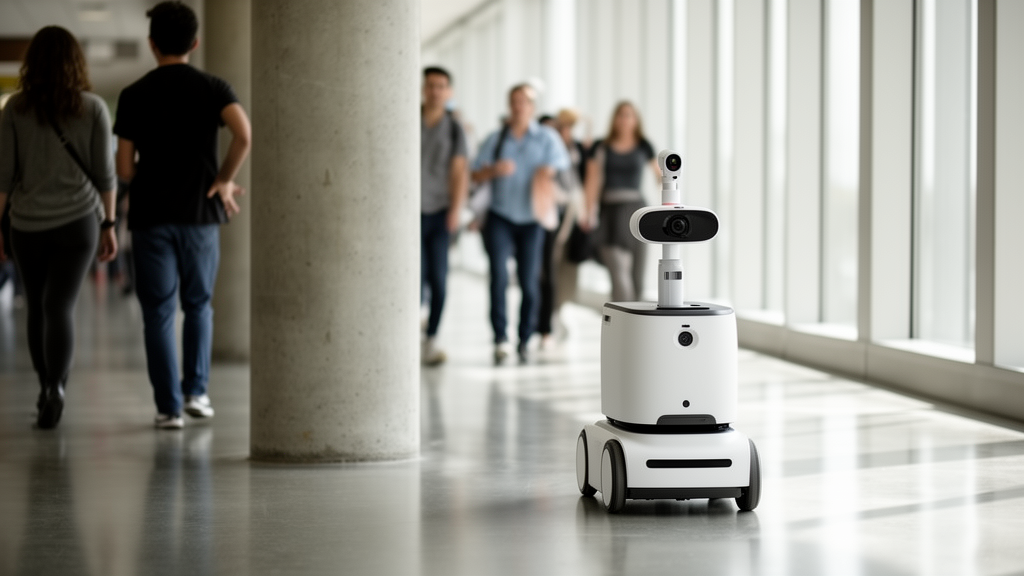
Indoor robots that follow people tend to freeze the moment their target disappears around a corner or into a crowd. A new local planner called IO-TEB, described in Scientific Reports, is designed to keep moving sensibly through exactly those gaps. Instead of treating the last camera sighting as the person's fixed location, the planner maintains a probabilistic estimate of where the hidden person probably is, together with the growing uncertainty of that estimate, and feeds both directly into its trajectory optimization.

In conventional setups, when a person is lost from view, the robot typically stalls at the last seen position. IO-TEB instead lets the optimizer work with the predicted estimate, and when the person remains hidden for longer stretches, the robot actively searches along paths the person is likely to have taken, such as corridors and doorways. The researchers evaluated the planner across 4,320 simulated episodes spanning eight indoor scenes, three durations of occlusion, and real pedestrian trajectory data.

IO-TEB completed 87.36 percent of following tasks, compared with 55.14 percent for the standard timed elastic band planner. An important benchmark comparison involved a conventional design that handles the same probabilistic estimate in a separate finite-state supervisor, switching between modes depending on whether the person is visible. IO-TEB was statistically equivalent to that design, suggesting that embedding the belief estimate directly inside the optimizer costs neither accuracy nor computational overhead, while simplifying the architecture.

Real-time performance was another focus. The team compared IO-TEB with model predictive control using trajectory prediction and with three recent person-following planners. IO-TEB was not the most accurate of these methods, but in the authors' implementation it missed the 100-millisecond control-cycle deadline least often, exceeding the deadline on 3.32 percent of cycles, against a range of 5.14 to 44.21 percent for the alternatives.

Ablation experiments, in which components were removed one at a time, revealed which parts of the design actually drive the improvement. Replacing the last observation with the predicted estimate as the following reference accounted for most of the gain. By contrast, the additional terms that scale with the estimate's uncertainty brought no consistent benefit, a finding that could simplify future implementations.

The results are limited to simulation, albeit with realistic pedestrian trajectories, and the authors note the reported deadline-miss figures apply to their specific implementation. Even so, the study offers a concrete recipe for person-following robots: rather than adding external state machines or heavier predictors, a local planner can absorb a belief about a hidden target and remain computationally lean. The open-access study suggests that modest changes to existing planners, rather than wholesale redesigns, may deliver much of that robustness.

Subject of Research: Robot local planning for indoor person following under intermittent observations

Article Title: Belief-integrated timed elastic band planning for robust indoor person following under intermittent observations

Article References: Guan, J., Liu, S., Guan, K., Zheng, H., & Hu, W. (2026). Belief-integrated timed elastic band planning for robust indoor person following under intermittent observations. Scientific Reports. https://doi.org/10.1038/s41598-026-76768-3

Image Credits: AI Generated

DOI: 10.1038/s41598-026-76768-3

Keywords: robotics, person following, path planning, timed elastic band, probabilistic estimation, occlusion, trajectory optimization, model predictive control, indoor navigation, real-time planning, Belief-integrated, timed

Cite Scienmag News

Denise Maddox. (October 27, 2026). Robot planner keeps following people even when they vanish from view. Scienmag. https://scienmag.com/robot-planner-keeps-following-people-even-when-they-vanish-from-view/

Denise Maddox. "Robot planner keeps following people even when they vanish from view." Scienmag, 27 October 2026, https://scienmag.com/robot-planner-keeps-following-people-even-when-they-vanish-from-view/. Accessed 27 October 2026.

Denise Maddox. "Robot planner keeps following people even when they vanish from view." Scienmag. October 27, 2026. https://scienmag.com/robot-planner-keeps-following-people-even-when-they-vanish-from-view/


Tags: adaptive robot following algorithmsadvanced pursuit strategies for indoor robotsBelief-integrateddynamic path planning for pedestrian trackingindoor navigationindoor robot navigation in complex scenesIndoor robot person-followingIO-TEB planner performance evaluationmodel predictive controlobstacle avoidance in crowded environmentsocclusionpath planningperson followingprobabilistic estimationprobabilistic estimation in autonomous robotsprobabilistic local planner for occlusion handlingreal-time planningreal-world pedestrian trajectory data analysisrobot navigation during visual occlusionroboticstimedtimed elastic bandtrajectory optimizationtrajectory optimization in robotics
Share26Tweet16
Previous Post

Global Map of Sign Languages Aims to Fix Regional Bias in AI Recognition

Next Post

Machine Learning Maps Soil Salinity at Depth—and Shows Where Predictions Falter

Related Posts

Machine Learning Maps Soil Salinity at Depth—and Shows Where Predictions Falter
Technology and Engineering

Machine Learning Maps Soil Salinity at Depth—and Shows Where Predictions Falter

October 27, 2026
Global Map of Sign Languages Aims to Fix Regional Bias in AI Recognition
Technology and Engineering

Global Map of Sign Languages Aims to Fix Regional Bias in AI Recognition

October 27, 2026
New genetic switch lets scientists steer two cell types independently
Technology and Engineering

New genetic switch lets scientists steer two cell types independently

October 27, 2026
Interpretable Linear Model Predicts Concrete Strength with 0.805 Cross-Validated R2
Technology and Engineering

Interpretable Linear Model Predicts Concrete Strength with 0.805 Cross-Validated R2

October 27, 2026
Quantized controller drives uncertain fractional-order neural networks into synchronization
Technology and Engineering

Quantized controller drives uncertain fractional-order neural networks into synchronization

October 27, 2026
Color and Fracture Mapping Yields First Quantitative Grade System for Dimension Stone Quarrying
Technology and Engineering

Color and Fracture Mapping Yields First Quantitative Grade System for Dimension Stone Quarrying

October 27, 2026
Next Post
Machine Learning Maps Soil Salinity at Depth—and Shows Where Predictions Falter

Machine Learning Maps Soil Salinity at Depth—and Shows Where Predictions Falter

  • Mothers who receive childcare support from maternal grandparents show more optimized

    Mothers who receive childcare support from maternal grandparents show more parental warmth, finds NTU Singapore study

    27656 shares
    Share 11059 Tweet 6912
  • University of Seville Breaks 120-Year-Old Mystery, Revises a Key Einstein Concept

    1061 shares
    Share 424 Tweet 265
  • Bee body mass, pathogens and local climate influence heat tolerance

    682 shares
    Share 273 Tweet 171
  • Researchers record first-ever images and data of a shark experiencing a boat strike

    546 shares
    Share 218 Tweet 137
  • Groundbreaking Clinical Trial Reveals Lubiprostone Enhances Kidney Function

    531 shares
    Share 212 Tweet 133
Science

Embark on a thrilling journey of discovery with Scienmag.com—your ultimate source for cutting-edge breakthroughs. Immerse yourself in a world where curiosity knows no limits and tomorrow’s possibilities become today’s reality!

RECENT NEWS

  • Machine Learning Maps Soil Salinity at Depth—and Shows Where Predictions Falter
  • Robot planner keeps following people even when they vanish from view
  • Global Map of Sign Languages Aims to Fix Regional Bias in AI Recognition
  • New genetic switch lets scientists steer two cell types independently

Categories

  • Agriculture
  • Anthropology
  • Archaeology
  • Athmospheric
  • Biology
  • Biotechnology
  • Blog
  • Bussines
  • Cancer
  • Chemistry
  • Climate
  • Earth Science
  • Editorial Policy
  • Marine
  • Mathematics
  • Medicine
  • Pediatry
  • Policy
  • Psychology & Psychiatry
  • Science Education
  • Science News
  • Social Science
  • Space
  • Technology and Engineering

Subscribe to Blog via Email

Enter your email address to subscribe to this blog and receive notifications of new posts by email.

Join 5,151 other subscribers

© 2025 Scienmag - Science Magazine

Welcome Back!

Login to your account below

Forgotten Password?

Retrieve your password

Please enter your username or email address to reset your password.

Log In
No Result
View All Result
  • HOME
  • SCIENCE NEWS
  • CONTACT US

© 2025 Scienmag - Science Magazine

Discover more from Science

Subscribe now to keep reading and get access to the full archive.

Continue reading