


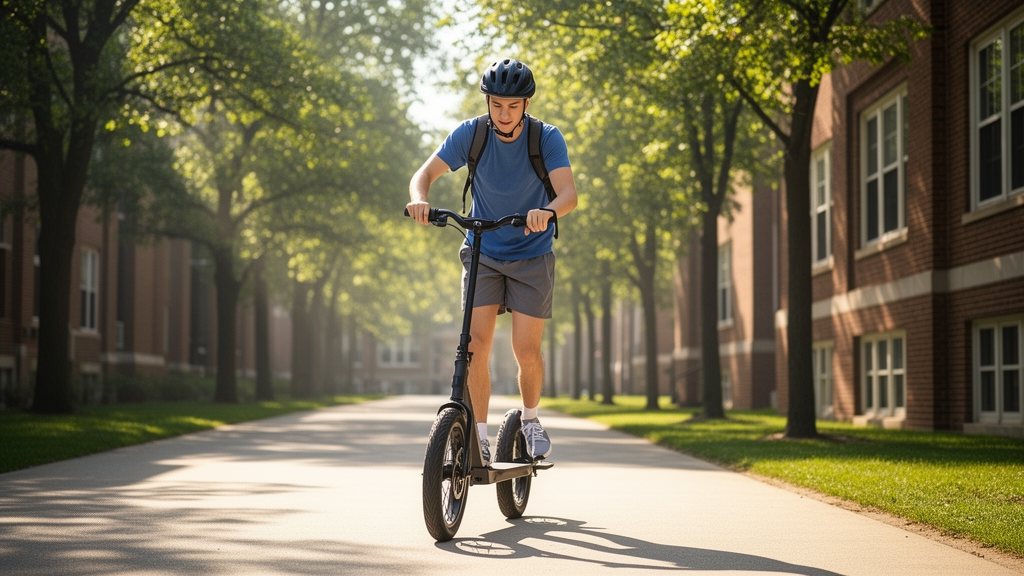
A scooter-like vehicle that blends elements of cycling, running, and gliding has emerged as an unlikely candidate for boosting student mental health. In a randomized controlled trial published in Frontiers in Psychology, researchers at Shandong Sport University report that eight weeks of footbike exercise significantly reduced anxiety and inhibition scores and quickened performance on working-memory and inhibitory-control tasks among university students, all without producing measurable changes in conventional physiological markers such as heart rate, blood pressure, or heart rate variability. The pattern of results led the team to argue that the psychological benefits of this activity flow primarily through improved executive function rather than through general physical conditioning.
The study recruited 60 healthy undergraduates from Shandong Sport University, all around 18 years old and free of chronic disease, movement disorders, injuries, medications, or supplements. An a priori power analysis using G*Power indicated a minimum sample of 34 participants for a two-group, two-timepoint mixed-design repeated-measures analysis of variance with a medium effect size, so the investigators enrolled 60 to allow for attrition. Participants were randomly assigned in equal numbers to an experimental group and a control group. The trial was approved by the university’s ethics committee, and all subjects provided written informed consent before testing began.
The experimental group completed a structured eight-week footbike intervention of three 60-minute sessions per week, held on Mondays, Wednesdays, and Fridays from three to four in the afternoon. The program was deliberately progressive: week one focused on basic gliding control over three kilometers, including mounting, grip width, pushing off, braking, and single-leg gliding; subsequent weeks added rhythm establishment, cardiorespiratory endurance, interval-based speed and endurance work, hip-driven power generation, uphill gliding and gear shifting, and sustained 30-to-40-minute glides as distances climbed to nine kilometers. The final week featured five-to-ten-kilometer timed gliding challenges and team relay events. The control group, by contrast, simply maintained its regular university routine, attending compulsory physical education classes but refraining from any additional organized exercise.
Assessment relied on an unusual combination of tools. Before and after the intervention, participants completed an AI-based psychophysiological health monitoring system that extracts physiological and psychological indicators without physical contact. The system’s first technical principle uses remote photoplethysmography: periodic changes in subcutaneous blood volume create subtle color fluctuations in facial skin that digital cameras can capture, and Eulerian Video Magnification amplifies these imperceptible variations to reconstruct blood-flow and heart-rate signals, which are then fed into a deep neural network. The second principle analyzes micro-vibrations of head, neck, and facial muscles captured by high-frame-rate cameras, converting pixel-level motion trajectories into estimates of emotional and psychological states. Because these facial micro-movements are driven by the autonomic nervous system and lie largely beyond voluntary control, the authors argue they offer an objective complement to self-report questionnaires.
Executive function was probed with two computerized tasks. The 2-back working-memory task presented sequences of eight English letters, requiring participants to judge whether each letter matched the one presented two positions earlier, with practice continuing until accuracy reached 85 percent. The Go/No-Go inhibitory-control task used black W and M letters in a three-to-one ratio, asking participants to press the spacebar rapidly for W stimuli while withholding responses to M. All testing took place between 08:00 and 11:30 to minimize circadian effects, with standardized five-minute rest periods between assessments.
The results were striking for what changed and what did not. After eight weeks, the experimental group showed significantly lower anxiety and inhibition index scores than the control group, alongside significant gains in reaction speed and stress tolerance. Reaction times fell in both cognitive tasks: on the 2-back task, mean reaction time dropped from about 838 milliseconds to roughly 750 milliseconds in the experimental group, while the Go/No-Go reaction time fell from about 385 to 331 milliseconds. Crucially, task accuracy did not decline, indicating genuine gains in cognitive processing efficiency rather than a speed-accuracy trade-off. Repeated-measures analysis of variance confirmed significant group-by-time interactions for the inhibition index and for reaction times on both tasks, and simple-effects analysis showed that the Go/No-Go reaction-time improvement occurred only in the experimental group, while the 2-back improvement was larger there than in controls.
Equally notable were the null findings. Heart rate, blood oxygen saturation, heart rate variability, respiratory rate, and blood pressure showed no significant between-group differences after the intervention. Indices of irritability, stress, self-confidence, vitality, neuroticism, depression, and pleasure were likewise unchanged, as were communication skills, learning adaptability, self-management, and risk tolerance. The authors interpret this dissociation as evidence that the psychological benefits of footbike exercise are tied to cognitive and emotional regulatory adaptations rather than to general physiological conditioning, and they suggest that an eight-week window may be sufficient for cognitive-emotional change yet too short, or the resting measures too insensitive, to reveal cardiovascular adaptation.
To push beyond conventional statistics, the team applied machine learning. A random forest model built on psychological, cognitive, and selected physiological variables achieved its best performance with repeated ten-fold cross-validation at a mean accuracy of 76.7 percent and a Kappa value of 0.689. Feature-importance analysis singled out reaction speed, the anxiety index, stress tolerance, the inhibition index, and 2-back reaction time as the strongest contributors distinguishing the post-intervention experimental group. Principal component analysis reinforced this picture, clearly separating the trained group in multidimensional feature space along dimensions related to reaction speed, stress tolerance, inhibitory control, and executive-task performance. The authors caution, however, that machine learning identifies predictive rather than causal relationships, so future work combining neuroimaging or longitudinal mediation analysis is needed to confirm whether executive function directly mediates the mental-health improvements.
Why might footbike riding carry cognitive demands that ordinary aerobic exercise lacks? Unlike cycling or treadmill walking, the activity requires simultaneous motor planning, dynamic balance control, continuous adjustment of movement rhythm and posture, route judgment, and environmental monitoring. These concurrent cognitive and motor challenges align with the concept of cognitively engaging physical activity, in which the integration of mental processing and motor execution is thought to amplify benefits for executive function. The authors also point to the sport’s moderate intensity, low impact, enjoyment, accessibility, and adaptability, along with its outdoor exposure and social character, as features that may foster positive emotional activation and stress reduction. Because executive function underpins self-regulation, goal-directed behavior, and flexible coping, strengthening it through repeated self-regulatory engagement during exercise could plausibly support emotional regulation under stress.
The study has clear limitations. The sample of 60 students from a single sports university is small, limiting generalizability, and the eight-week duration leaves long-term effects unknown. The authors call for larger multi-center trials, multimodal neurophysiological measures such as EEG, EDA, and functional near-infrared spectroscopy to clarify neural mechanisms, and systematic comparisons of exercise intensities and durations. They also propose extending footbike programs from individual riding to paired and group formats with collaborative tasks, communication, and joint decision-making, potentially broadening benefits from individual cognition to wider educational outcomes. Still, the practical message is concrete: exercise prescriptions for student mental health may need to consider not only frequency, duration, and intensity, but also the cognitive demands of the activity itself, and footbike training, with its blend of balance, rhythm, and rapid decision-making, offers a scalable, low-stigma way to put that principle into university physical education curricula.
Subject of Research: Effects of an 8-week footbike exercise intervention on mental health and executive function in university students
Article Title: FOOTBIKE exercise enhances mental health through improved executive function in university students
Article References: Qi, S., Yu, J., Wei, Z., Yin, L., & Wei, L. (2026). FOOTBIKE exercise enhances mental health through improved executive function in university students. Frontiers in Psychology, 17, Article 1891734. https://doi.org/10.3389/fpsyg.2026.1891734
Image Credits: AI Generated
DOI: 10.3389/fpsyg.2026.1891734
Keywords: footbike, executive function, mental health, university students, randomized controlled trial, working memory, inhibitory control, anxiety, stress tolerance, machine learning, cognitively engaging exercise, physical activity
Cite Scienmag News
Glenn Wilkins. (October 27, 2026). Eight Weeks of Footbike Exercise Lifts Mood and Sharpens Executive Function in University Students. Scienmag. https://scienmag.com/eight-weeks-of-footbike-exercise-lifts-mood-and-sharpens-executive-function-in-university-students/
Glenn Wilkins. "Eight Weeks of Footbike Exercise Lifts Mood and Sharpens Executive Function in University Students." Scienmag, 27 October 2026, https://scienmag.com/eight-weeks-of-footbike-exercise-lifts-mood-and-sharpens-executive-function-in-university-students/. Accessed 27 October 2026.
Glenn Wilkins. "Eight Weeks of Footbike Exercise Lifts Mood and Sharpens Executive Function in University Students." Scienmag. October 27, 2026. https://scienmag.com/eight-weeks-of-footbike-exercise-lifts-mood-and-sharpens-executive-function-in-university-students/


