


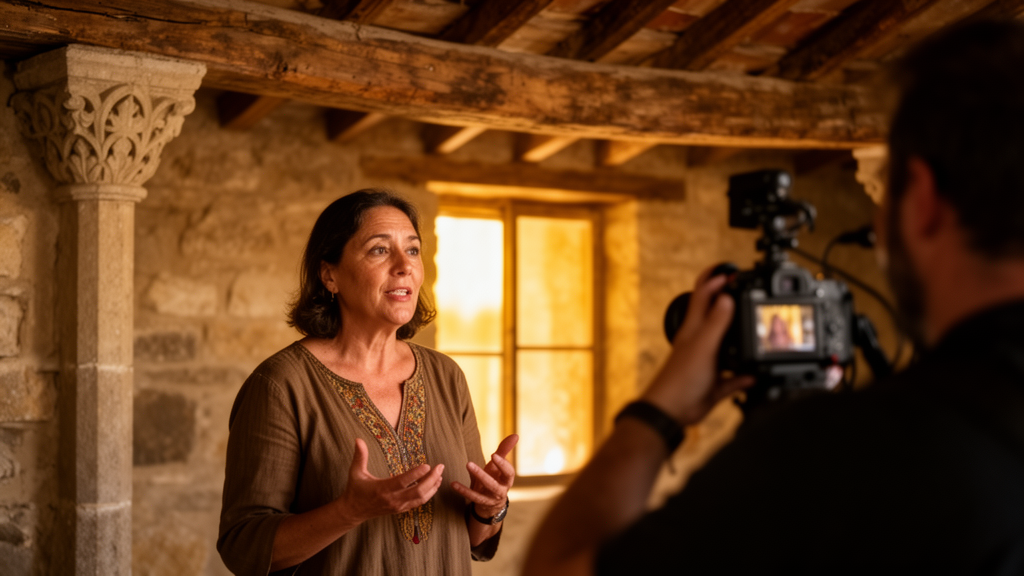
Short-form explainer videos have become a leading channel for bringing intangible cultural heritage to online audiences, but the choice between a human presenter and a digital human narrator can shape how viewers respond. A randomized experiment using videos about Hakka tulou, the fortified earthen dwellings of the Hakka people in China, found that human narrators hold an advantage over digital human narrators, and that this advantage is concentrated in how viewers judge the source rather than the information itself. The study recruited 601 participants in a one-factor, two-level between-subjects design: one group watched an explainer video narrated by a human, the other by a digital human.
The first pathway ran from narrator nonverbal immediacy, meaning gestures, gaze and expressiveness that create a sense of closeness, through narrator credibility to customer inspiration. The second ran from perceived narrator clarity through perceived information quality to the same outcome. Analyzed with partial least squares structural equation modeling, bootstrapping, moderation analysis and multigroup analysis, the results showed that both nonverbal immediacy and perceived clarity scored higher in the human narrator condition.
The links between immediacy and credibility, and between credibility and inspiration, were significantly stronger when a human spoke. By contrast, the links from clarity to information quality, and from information quality to inspiration, did not differ significantly between the two narrator types. This asymmetry suggests the human narrator’s edge lies in the source-evaluation pathway rather than the information-evaluation pathway: viewers may judge the information in these heritage videos similarly regardless of who delivers it, but respond more strongly to the presence of a real person when evaluating credibility and forming inspiration.
The experiment also probed the role of attention. Focused attention, the degree to which viewers concentrated on the video, positively moderated the relationships of both narrator credibility and perceived information quality with customer inspiration. In other words, viewers who paid closer attention translated favorable evaluations of the narrator and the content into stronger inspiration, amplifying both pathways.
Downstream, the study found that customer inspiration was positively associated with electronic word-of-mouth intention, the willingness to recommend or share content with others. Both nonverbal immediacy and perceived clarity contributed to inspiration through their respective mediators, and inspiration in turn was associated with the intention to spread the word, closing the loop from presentation style to dissemination potential in intangible cultural heritage short-form videos.
The findings come with caveats typical of a single-context experiment. The sample was a convenience group of 601 participants, the stimulus material focused on one heritage topic, and the design measured intentions rather than actual sharing behavior. Generalization to other heritage subjects, platforms or cultures remains to be tested.
Subject of Research: Human versus digital human narrators in intangible cultural heritage short videos and their psychological pathways to viewer inspiration and electronic word-of-mouth intention
Article Title: Human and digital human narrators in intangible cultural heritage short videos: dual psychological evaluation pathways through customer inspiration to electronic word-of-mouth intention
Article References: Zhu, H., Li, W., Huang, Z., Hu, B., & Lin, R. (2026). Human and digital human narrators in intangible cultural heritage short videos: dual psychological evaluation pathways through customer inspiration to electronic word-of-mouth intention. Frontiers in Psychology, 17, Article 1960625. https://doi.org/10.3389/fpsyg.2026.1960625
Image Credits: AI Generated
DOI: 10.3389/fpsyg.2026.1960625
Keywords: intangible cultural heritage, digital human narrator, short-form video, customer inspiration, narrator credibility, electronic word-of-mouth, Hakka tulou, nonverbal immediacy, information quality, randomized experiment, PLS-SEM, focused attention
Cite Scienmag News
Courtney Benton. (October 26, 2026). Human Narrators Beat Digital Avatars in Heritage Videos Through Credibility Pathway. Scienmag. https://scienmag.com/human-narrators-beat-digital-avatars-in-heritage-videos-through-credibility-pathway/
Courtney Benton. "Human Narrators Beat Digital Avatars in Heritage Videos Through Credibility Pathway." Scienmag, 26 October 2026, https://scienmag.com/human-narrators-beat-digital-avatars-in-heritage-videos-through-credibility-pathway/. Accessed 26 October 2026.
Courtney Benton. "Human Narrators Beat Digital Avatars in Heritage Videos Through Credibility Pathway." Scienmag. October 26, 2026. https://scienmag.com/human-narrators-beat-digital-avatars-in-heritage-videos-through-credibility-pathway/


