


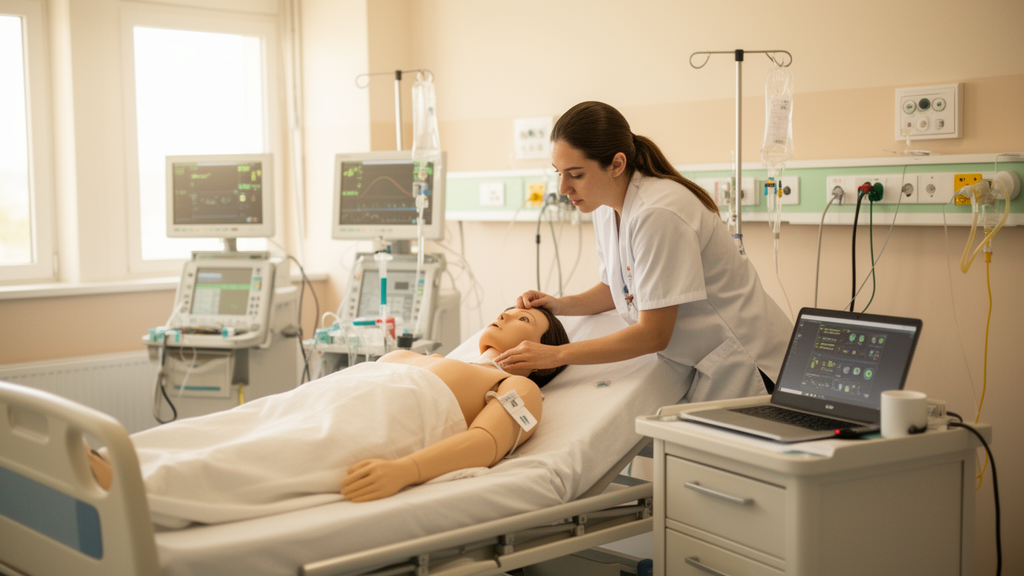
Portugal’s healthcare simulation technicians are a dedicated but non-standardized professional group, according to the first comprehensive cross-sectional analysis of this workforce, published in BMC Medical Education. Simulation-based education relies on increasingly complex equipment, and technicians are widely recognized as vital to running high-quality programs. Yet their roles remain poorly defined internationally and had never been characterized within the Portuguese healthcare context.
The new study set out to fill that gap by documenting academic backgrounds, daily tasks, self-assessed skills, and professional development needs. The research team developed an online survey through a focus group and distributed it via the Portuguese Society for Simulation in Health Sciences. The questionnaire collected sociodemographic information, a 5-point Likert scale self-assessment of skills, and training preferences. Statistical analysis used descriptive measures and non-parametric tests to compare subgroups based on instructor certification.
Nineteen technicians from 11 centers participated. The workforce proved markedly heterogeneous: academic backgrounds ranged from high school to doctoral degrees, with most qualifications concentrated in healthcare and engineering. The study also identified a critical disconnect between infrastructure and personnel, as several centers operate without dedicated technical staff.
Self-assessed confidence varied sharply by task domain. Technicians reported high confidence in administrative duties such as scheduling, scoring 4.47 ± 0.70 on the 5-point scale. In contrast, confidence was lower in pedagogical and advanced technical areas: debriefing scored 2.79 ± 1.48, and virtual or augmented reality scored 2.42 ± 1.02. Subgroup analysis revealed that technicians holding instructor certification reported significantly higher confidence in scenario development (p = 0.028) and debriefing (p = 0.017).
When asked about training preferences, the most requested area was clinical scenario development, selected by 31.58% of respondents. There was also a strong preference for the format of future training: 68.4% favored short, in-person courses. The authors conclude that establishing a national, hands-on training program is essential to bridge the confidence-competence gap in pedagogical tasks and to ensure the long-term sustainability of simulation-based education in Portugal.
As a cross-sectional survey with a small sample of 19 technicians, the study provides a snapshot rather than evidence of change over time, but it offers the first structured baseline for a workforce whose role has long gone undefined.
Subject of Research: Professional profile, skills, and training needs of healthcare simulation technicians in Portugal
Article Title: Characterization of the simulation technician profile in Portugal: a cross-sectional study
Article References: Nicolau, A., Gonçalves, E., Granja, C., & Pereira, I. (2026). Characterization of the simulation technician profile in Portugal: a cross-sectional study. BMC Medical Education. https://doi.org/10.1186/s12909-026-10337-0
Image Credits: AI Generated
DOI: 10.1186/s12909-026-10337-0
Keywords: simulation-based education, simulation technicians, Portugal, cross-sectional study, healthcare education, debriefing, clinical scenario development, instructor certification, professional training, virtual reality, workforce characterization, BMC Medical Education
Cite Scienmag News
Courtney Benton. (October 26, 2026). Portugal’s Simulation Technicians: Dedicated but Non-Standardized, First National Survey Finds. Scienmag. https://scienmag.com/portugals-simulation-technicians-dedicated-but-non-standardized-first-national-survey-finds/
Courtney Benton. "Portugal’s Simulation Technicians: Dedicated but Non-Standardized, First National Survey Finds." Scienmag, 26 October 2026, https://scienmag.com/portugals-simulation-technicians-dedicated-but-non-standardized-first-national-survey-finds/. Accessed 26 October 2026.
Courtney Benton. "Portugal’s Simulation Technicians: Dedicated but Non-Standardized, First National Survey Finds." Scienmag. October 26, 2026. https://scienmag.com/portugals-simulation-technicians-dedicated-but-non-standardized-first-national-survey-finds/


