


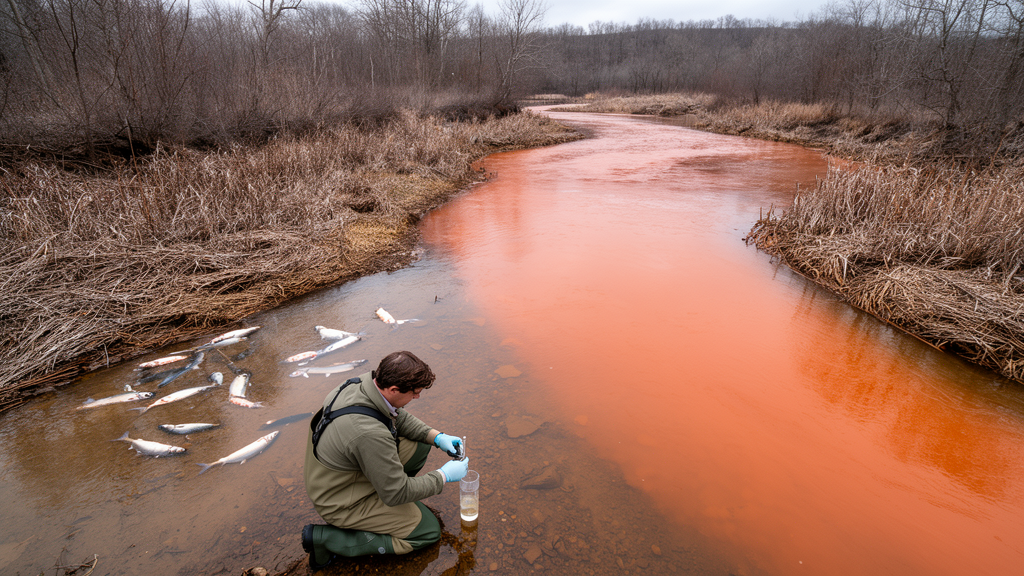
More than eight years after Brazil’s Fundão Dam collapsed and released 43 million cubic meters of iron ore tailings into the Doce River, researchers have mapped the precise environmental tipping points at which aquatic communities across freshwater and marine habitats began to unravel. The new study, published in Environmental Monitoring and Assessment, analyzed more than 3,100 samples containing roughly 3,300 taxa collected between 2018 and 2023 at 62 sites spanning the lower Doce River Basin and the adjacent Atlantic coast. Its central finding is sobering: even small increases in metals and hydrogeochemical disturbance, such as turbidity rising to just 17 NTU in riverine systems and 2 NTU at marine sites, have driven persistent changes in biodiversity and reshaped ecosystem functioning.
The 2015 collapse sent a tailings plume more than 600 kilometers downstream through the Atlantic Forest biome, and fine suspended sediments eventually spread across some 300 kilometers of coastline, reaching sensitive marine reserves including the Santa Cruz REVIS/APA Costa das Algas. Coarser deposits elevated metal concentrations in riverbeds and reservoirs, while the fine fraction stayed in suspension, degrading water quality far from the source. What has remained difficult for scientists is distinguishing which specific stressors matter most, and at what concentrations biological communities begin to reorganize in fundamental ways.
To answer that question, the research team applied threshold indicator taxa analysis, known as TITAN, to a multi-taxa monitoring dataset covering phytoplankton, zooplankton, benthic macroinvertebrates, and fish. The method evaluates each species’ abundance along an environmental gradient, such as the concentration of a particular metal, and computes standardized scores indicating whether that species declines or increases. Where many taxa respond in concert along the gradient, the analysis identifies a change point, interpreted as a critical environmental threshold. The team ran roughly 900 separate TITAN analyses across combinations of regions, variables, and communities, using 500 bootstraps and 500 randomizations for each, and considered a gradient to have a community-level effect only when it altered at least 10 percent of the taxa.
The results revealed a stark asymmetry between harm and opportunity. Negative responses, in which taxa declined along contamination gradients, dominated most environments and taxonomic groups. In freshwater, the most damaging variables were particulate and dissolved fractions of aluminum, particulate barium and lead, turbidity, and suspended particulate material, with effects concentrated in the Doce River and its tributaries. In marine areas, particulate and dissolved arsenic, particulate iron, dissolved chromium and barium, particulate aluminum, turbidity, and nitrite drove the strongest declines, particularly near the central mouth of the Doce River and along the northern coast. Benthic macroinvertebrates and fish were among the most frequently and severely affected communities in both systems.
Positive responses, by contrast, were far less frequent and largely localized to specific taxa and sites. Dissolved barium was associated with increases in certain riverine fish species, while nutrient concentrations including phosphate, nitrite, nitrate, and ammonium elicited positive responses in a handful of opportunistic taxa, particularly plankton in freshwater lakes and marine waters. The researchers are careful about what these increases mean. A positive response to dissolved barium does not indicate a biological benefit; rather, it reflects tolerance and competitive release, as sensitive competitors and predators decline and hardy generalists proliferate in degraded reaches. These localized gains do not compensate for the widespread loss of sensitive, functionally important species.
Exposure gradients shaped the patterns strongly. Riverine environments, which sit directly on hydrologically connected pathways of sediment transport and recurrent re-exposure, showed the strongest evidence of disturbance, with roughly 20 percent of taxa declining in response to aluminum, turbidity, and suspended sediments. Lakes, which lack direct connection to the main channel, displayed more frequent positive responses among phytoplankton and zooplankton, likely because longer water residence times and nutrient retention favored short-lived, fast-growing organisms. In the ocean, responses were weaker and more spatially constrained, reflecting dilution and complex oceanographic dynamics, but the Doce River mouth, the northern coast, and even the protected Costa das Algas area showed clear contamination signals consistent with a predominantly northward drift of tailings. The Abrolhos National Park coral reefs, the most distant sector, exhibited far fewer significant effects.
Life history emerged as a decisive filter on vulnerability. Long-lived taxa such as fish and benthic macroinvertebrates showed the most consistent negative responses to metals and turbidity, including lower change points and a high proportion of declining species. The authors attribute this to slow recovery rates, bioaccumulation, and chronic exposure: many benthic invertebrates are filter feeders or bottom collectors that ingest particles onto which metals adsorb, while fish accumulate contaminants through trophic transfer, with documented effects including aluminum in gills, lead in bones and soft tissues, and copper in the liver. Short-lived plankton, with high reproductive turnover, can recover more quickly and showed more variable, often localized responses.
One of the study’s most consequential findings concerns the ecological role of particulate metals, which are often considered less bioavailable than dissolved forms. The analysis showed that particulate fractions of aluminum, barium, chromium, and iron exerted substantial effects, driving broad-scale declines through turbidity, gill clogging, and habitat smothering, alongside risks of bioaccumulation and biomagnification. This challenges the assumption that only dissolved metals matter for environmental standards. The authors argue that environmental policies should explicitly consider particulate fractions, and they highlight barium, a metal released in quantity by the Fundão rupture, as a particular concern given that its toxicity and distribution remain understudied.
The study also carries warnings for protected areas. Communities in lakes, lagoons, and the Abrolhos park have so far shown fewer threshold responses, suggesting that contaminant levels there have not yet been sufficient to trigger pronounced restructuring. But flood events can resuspend fine sediment and remobilize legacy pollutants stored in riverbeds, progressively extending stressor accumulation into isolated habitats. Seasonal resuspension can restart impact pulses in biological communities, releasing both dissolved and particulate metals into the water column. The authors note that species replacement in these refuges could produce novel biotic communities that are difficult to manage, deliver fewer ecosystem services, and respond poorly to restoration.
The researchers acknowledge important limitations. Without standardized pre-collapse baseline data, the analysis evaluates community thresholds along contemporary disturbance gradients rather than direct trajectories from an unimpacted reference condition. Because data were pooled across the full 2018 to 2023 monitoring period to capture robust multi-year thresholds, seasonal and episodic flood-driven dynamics were integrated into the broader gradient rather than modeled as discrete temporal factors. Even so, the gradient-based benchmarks offer a foundation for future monitoring. The team concludes that identifying ecological thresholds is essential for anticipating regime shifts, detecting contaminant-driven impacts early, and designing habitat-specific recovery strategies, and that long-term, broad-scale biodiversity monitoring must underpin any serious effort to strengthen the regulation of mining activities and safeguard aquatic ecosystems against the next large-scale disaster.
Subject of Research: Ecological thresholds in freshwater and marine communities affected by the 2015 Fundão Dam tailings collapse in Brazil
Article Title: Severe environmental disturbances compromise ecological thresholds in aquatic environments
Article References: Pinha, G. D., Ferreira, B. P., de Matos Costa, F., Bom, F. C., Oliveira, K. S., Di Domenico, M., Santana, M. S., de Almeida Gouveia, N., Delazari, A., Bastos, A. C., Rigo, D., Henschel, E., Eskinazi-Sant’Anna, E. M., Sá, F., Barroso, G. F., Dergam, J. A., de Lourdes Longo, L., Fernandes, L. F. L., Hostim-Silva, M., … Simões, N. R. (2026). Severe environmental disturbances compromise ecological thresholds in aquatic environments. Environmental Monitoring and Assessment, 198(11), Article 1252. https://doi.org/10.1007/s10661-026-16090-7
Image Credits: AI Generated
DOI: 10.1007/s10661-026-16090-7
Keywords: Fundão Dam collapse, Doce River, ecological thresholds, TITAN analysis, mining tailings, heavy metals, turbidity, biodiversity, bioaccumulation, marine ecosystems, freshwater ecology, Brazil
Cite Scienmag News
Violet Maxwell. (October 26, 2026). Mining Dam Disaster Pushed Aquatic Ecosystems Past Critical Ecological Thresholds. Scienmag. https://scienmag.com/mining-dam-disaster-pushed-aquatic-ecosystems-past-critical-ecological-thresholds/
Violet Maxwell. "Mining Dam Disaster Pushed Aquatic Ecosystems Past Critical Ecological Thresholds." Scienmag, 26 October 2026, https://scienmag.com/mining-dam-disaster-pushed-aquatic-ecosystems-past-critical-ecological-thresholds/. Accessed 26 October 2026.
Violet Maxwell. "Mining Dam Disaster Pushed Aquatic Ecosystems Past Critical Ecological Thresholds." Scienmag. October 26, 2026. https://scienmag.com/mining-dam-disaster-pushed-aquatic-ecosystems-past-critical-ecological-thresholds/


