


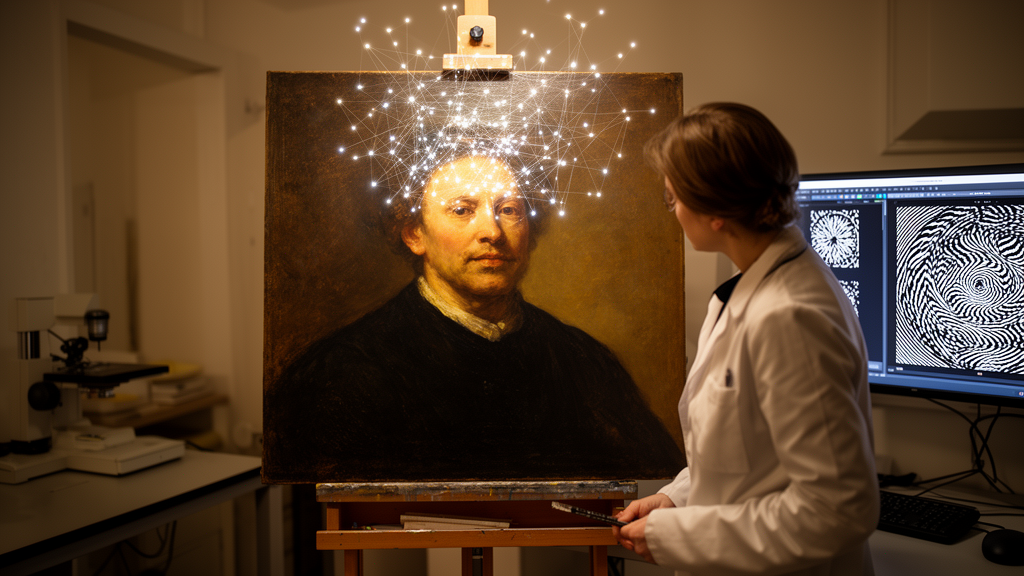
A machine has learned to look at a painting the way one of the world’s leading Rembrandt scholars does, and it is now offering art experts a strikingly new kind of evidence in one of art history’s most persistent puzzles: deciding who actually held the brush. In a study published in the Proceedings of the National Academy of Sciences, a team at Carnegie Mellon University describes an artificial intelligence framework that scans a canvas for statistical patterns associated with Rembrandt’s work and reports back not just a verdict, but a map of exactly which details drove its conclusion. The project was led by mechanical engineering professors Phil LeDuc and Jon Cagan, alongside alumnus Andrés Arias-Rosales and Arthur Wheelock Jr., the renowned Rembrandt scholar who spent more than forty years as a curator at the National Gallery of Art in Washington, D.C. The goal was never to replace the expert, but to give human judgment another layer of evidence to weigh.
For centuries, authenticating whether a painting came from the hand of a master like Rembrandt or from a talented copycat depended entirely on the trained eye of a connoisseur. Then came tools that changed what curators could see: X-rays and infrared imaging allowed them to peer beneath the surface of a painting and analyze details invisible to the human eye. Attribution today is still no easy task. Experts consider everything from historical documents to the artist’s subject matter and his varied styles across the course of his career, including brushwork and the types of paints and supports he used. On top of that, they must keep in mind that Rembrandt’s pupils and assistants may sometimes have painted alongside him, and that later restorers may have changed and added elements to his compositions. Technical information from examination techniques such as X-radiography, infra-reflectography, and X-ray fluorescence analysis rounds out the picture.
The stakes are high. For an art collector or an insurer, a true Rembrandt is a piece of history and cultural identity, and getting the call right matters deeply to scholars, institutions, and the market alike. That is why the Carnegie Mellon engineers did not begin with code. Before diving into the new AI tools, it was crucial for the team to first travel to the National Gallery of Art in Washington, D.C., to study Rembrandt paintings in person and engage in in-depth discussions with Wheelock about the artist, his style, his technique, and the questions and challenges surrounding his work. The idea was to capture decades of expert connoisseurship and translate it into a form an algorithm could learn from, without stripping away the nuance that makes attribution so difficult in the first place.
“Working with him was a dream of mine,” Arias-Rosales said. “We wanted to understand Rembrandt through the eyes of a world-class expert, then understand it through the eyes of ‘the machine’, our AI approach, and bring those together.” That philosophy shaped the entire project. Rather than asking the algorithm to produce a simplistic yes-or-no answer, the researchers set out to build a collaborator, one that would surface patterns a human might overlook and then hand the results back to the scholar for interpretation. The interdisciplinary blend is unusual: engineering, design, and art history converging on a single intriguing problem, a combination LeDuc describes as distinctly Carnegie Mellon, where researchers like to try to help with exciting fields in many different directions.
Once the groundwork was laid, the team asked a carefully bounded question: could an AI approach distinguish Rembrandt from paintings by artists whose work resembles that of the master? To answer it, the researchers curated a dataset of more than thirteen hundred high-resolution digitized images of paintings, including 311 Rembrandts, for the AI analysis. The model learned to identify statistical patterns across characteristics such as edges, color, light distribution, and visible brushstrokes, and it produces a score estimating how strongly a painting aligns with the patterns shown in Rembrandt’s work. When the model was highly confident, it classified paintings with 95.8 percent accuracy, a figure that reflects performance in the regime where the algorithm itself reports strong certainty rather than across every case it encounters.
What separates this framework from a black box is explainability, a property the researchers treated as non-negotiable. “Experts need to understand how the AI model/algorithm came to its decision,” said Cagan. “That is critical in successful human-AI collaboration, so we needed to make sure the algorithm could expose which areas of the painting influenced the algorithm’s conclusion.” To achieve that, the AI approach classifies a painting as either Rembrandt or not, provides carefully calibrated probabilities and confidence scores, and generates visualizations that emphasize the painting areas and details that had the strongest influence on the AI-based classification. A curator can therefore see, at a glance, whether the algorithm’s attention fell on a face, a collar, a patch of background, or a pair of hands, and then bring decades of connoisseurship to bear on those specific regions.
The visualizations turn the tool into something closer to a dialogue than a verdict. If the AI repeatedly highlighted the hands with a low score, suggesting they likely were not painted by Rembrandt, the researchers can digitally remove them from consideration and ask the model to classify the painting again. If the hands disappear and there is high confidence in a Rembrandt attribution, a curator may consider whether the hands were painted by a Rembrandt student instead. This kind of iterative probing lets experts focus on specific details within a painting that they may have otherwise overlooked, and it converts the algorithm’s output into testable hypotheses about how a composition came together and who may have contributed to it.
“The most exciting cases are the ambiguous ones,” said Arias-Rosales. “We wanted to do more than bring opaque or simplistic answers to Wheelock; we wanted to bring him more questions and point to potentially interesting details for him to consider and help solve mysteries of art history.” That framing is deliberate. In attribution, ambiguity is where the real detective work happens, and the researchers viewed their role as expanding the space of questions a scholar can ask rather than collapsing it into a single automated judgment. The framework’s calibrated probabilities and highlighted regions are designed to be considered alongside the full apparatus of connoisseurship: historical documents, material analysis, the artist’s stylistic evolution, and the technical imaging that has long underpinned modern attribution studies.
The team has already tested its AI on a real mystery. In 2024, a painting titled Portrait of a Girl was discovered in an attic in Maine and later sold for $1.41 million because of its possible connection to Rembrandt. When the Carnegie Mellon model analyzed the image, it determined an 84.7 percent confidence that the painting was a Rembrandt. “These results aren’t an authentication, they are a statistical observation meant to be considered alongside historical research, material analysis, X-rays, and other tools with the final decision made by human experts,” said LeDuc. The case illustrates both the promise and the limits of the approach: the model can flag a painting as statistically consistent with Rembrandt’s patterns with meaningful confidence, but the attribution itself remains a human decision built on the full range of evidence that scholarship demands.
Eventually, the team hopes this tool could become an interactive application for museums, curators, and other art professionals, putting explainable pattern analysis directly into the hands of the people who make attribution calls. With Rembrandt as the test case, the researchers believe the framework could be adapted to investigate other artists as well, potentially opening a new front in the study of authorship across centuries of painting. For LeDuc, the project underlines how Carnegie Mellon’s interdisciplinary culture shines, bringing together engineering, design, and art history to solve intriguing problems. What began as an experiment in teaching a machine to see has become something more consequential: a working demonstration that human expertise and statistical pattern recognition can collaborate, each compensating for the other’s blind spots, in service of art history’s unresolved mysteries.
Subject of Research: Explainable AI framework for Rembrandt painting attribution
Article Title: Seeing Rembrandt through the eyes of a machine
Article References: Seeing Rembrandt through the eyes of a machine. Original publication (Bibliographic details unavailable.)
Image Credits: AI Generated
DOI: Not provided
Keywords: Rembrandt, art attribution, explainable AI, Carnegie Mellon University, PNAS, machine learning, art authentication, Portrait of a Girl, Arthur Wheelock, human-AI collaboration, art history, computer vision
Cite Scienmag News
Blake Davidson. (October 26, 2026). Explainable AI learns to spot the hidden patterns of a Rembrandt. Scienmag. https://scienmag.com/explainable-ai-learns-to-spot-the-hidden-patterns-of-a-rembrandt/
Blake Davidson. "Explainable AI learns to spot the hidden patterns of a Rembrandt." Scienmag, 26 October 2026, https://scienmag.com/explainable-ai-learns-to-spot-the-hidden-patterns-of-a-rembrandt/. Accessed 26 October 2026.
Blake Davidson. "Explainable AI learns to spot the hidden patterns of a Rembrandt." Scienmag. October 26, 2026. https://scienmag.com/explainable-ai-learns-to-spot-the-hidden-patterns-of-a-rembrandt/


