


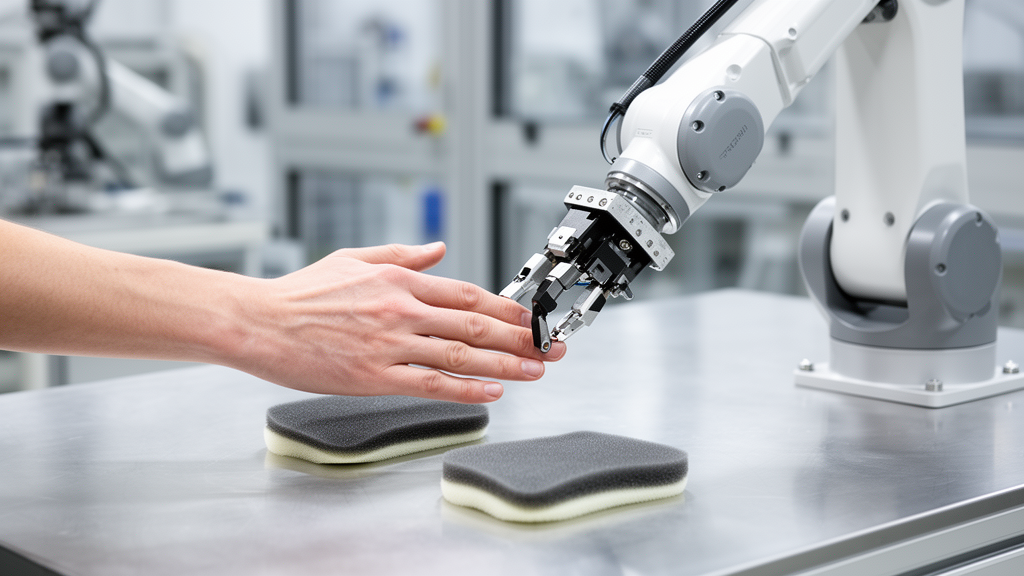
Collaborative robots are moving out of cages and into shared workspaces, where the possibility of physical contact with people is no longer an anomaly but a design assumption. A new Perspective article in Frontiers in Robotics and AI argues that the international standards governing such contact, notably ISO/TS 15066, contain ambiguities that can lead to inconsistent risk assessments or even underestimated hazards, and that the clearest way to resolve them is to think in terms of mechanical energy rather than force alone. The article, written by Riccardo Zanella, Federico Califano and Stefano Stramigioli of the Robotics and Mechatronics group at the University of Twente in the Netherlands, does not introduce new experimental data. Instead, it isolates one central thread from the authors’ earlier critical review of physical human-robot interaction safety constraints: the role of mechanical energy as a unifying quantity for interpreting the standard’s transient-contact limits.
The International Organization for Standardization defines safety functionally, as the ability of a robotic system to operate within limits that reduce risks to humans to an acceptable level. That definition sounds straightforward, but the authors point out that applying it in practice raises questions that are almost philosophical. Should safety mean the prevention of physical injury, or the broader avoidance of pain and discomfort? Can a system be called safe if a small but nonzero probability of harm remains? And what should a robot do, in safety terms, when a human suddenly runs into it while the robot is stationary and behaving correctly? Safety, they emphasize, is not an intrinsic property of a machine but an emergent characteristic of the interaction context, depending on the robot’s behavior, the environment, the task and human actions.
ISO/TS 15066 bridges the gap between the abstract concept and its operational implementation by specifying quantitative limits for mitigating human injury. Maximum allowable force and pressure values, measured within average pain tolerance for different anatomical regions, are translated into limits on the mechanical energy that a robot may transfer during contact. The energy-transfer formulation is not a new criterion proposed by the Twente team; it is already part of the informative Annex A of the standard. What the Perspective contributes is a careful physical interpretation of that formulation, particularly at the instant of maximum tissue compression, and an examination of what its simplifying assumptions imply for safety assessment and robot performance.
The standard’s transient-contact model reduces the robot to an effective mass, a configuration-dependent reflected inertia evaluated at the contact point, and models the impacted human body region as a second effective mass capturing the inertial properties of the anatomical segment. Tissue deformation at the interface is represented by a linear elastic spring with a characteristic stiffness. The human-robot interaction is thus idealized as a collision between two lumped masses connected by a compliant element. This reduced representation assumes one-dimensional normal impact, a single effective contact point, linear tissue stiffness and effective masses evaluated along the impact direction, while neglecting friction, shear, evolving contact area and nonlinear tissue dynamics. The authors stress that the model is not intended to capture viscoelastic, shear or distributed-contact effects; it is retained only to expose the dominant normal compression mechanism and its energy balance.
Within this framework, the pain-sensitive force thresholds map to a maximum admissible elastic potential energy that the tissue can safely store during contact-induced deformation. That, in turn, limits the kinetic energy the robot, moving at a given relative pre-collision velocity, can transfer to the human and convert into elastic deformation at impact. The critical instant for safety evaluation, the authors argue, coincides with the moment of maximum deformation, when the biomechanical loading attains its peak and the relative velocity vanishes. The subsequent response, whether elastic restitution or inelastic dissipation, occurs after this peak-load condition has already been reached and therefore does not change the maximum deformation used for the assessment. This differs from common literature interpretations that relate safety to the energy dissipated under a potential inelastic-impact assumption. In the energy-centric view, whether the impact later returns or dissipates energy is secondary, because it cannot alter the deformation already achieved. The authors acknowledge that this reading relies on the lumped mass-spring simplification, which excludes strong damping, viscoelasticity, repeated impacts and secondary collisions, and they flag this as a key limitation of ISO-oriented safety assessment.
The relationship between the two effective masses determines how impact energy is partitioned, and this is where the authors identify one of the standard’s most consequential gaps. When the robot’s effective mass dominates, only a fraction of the initial robot kinetic energy is stored in the tissue, while the residual energy remains in the robot as post-impact motion; in this regime the admissible initial kinetic energy can significantly exceed the tissue’s energy capacity. Conversely, when the human effective mass dominates, nearly all transferred kinetic energy is converted into elastic deformation, and the admissible robot kinetic energy approaches the tissue energy capacity itself. In the limiting case where the human effective mass becomes infinite, the interaction reduces to a clamped condition in which the contacted body segment is effectively immobilized and cannot recoil. This is the most conservative scenario, and the authors note that ISO/TS 15066 distinguishes quasi-static and transient contacts through empirical scaling of admissible force limits but does not explicitly reformulate the energy balance for true clamp-like conditions, where the finite-mass interpretation becomes physically inconsistent.
The distinction matters because it changes which quantity must be bounded. When recoil is possible, part of the pre-impact kinetic energy remains as motion of the coupled human-robot system after maximum compression, so only the relative kinetic-energy component is available for tissue deformation. When recoil is prevented, that mechanism for reducing deformation energy disappears, and the robot’s kinetic energy itself becomes the conservative quantity to be limited to the tissue’s elastic energy capacity. Less conservative bounds are justified only when the interaction can be reliably treated as a transient contact with finite human effective mass and possible recoil. The authors acknowledge that the conservative clamped bound may reduce robot performance, as their earlier numerical work showed, but argue it is the physically grounded limit when a clamp-like situation cannot be ruled out.
Energy-based metrics also have limits of their own, and the Perspective is careful not to overstate them. Energy thresholds combine force magnitude and interaction duration into a single scalar, capturing cumulative mechanical load, and if admissible energy thresholds could be measured directly they would reduce dependence on detailed contact models, tissue-specific stiffness assumptions and force-to-energy mappings, providing a global energy budget for dynamic safety control. Directly measurable energy-based hazard thresholds, such as energy-to-failure values, correlate naturally with injury risk rather than pain perception, because pain also depends on pressure distribution, contact area, strain rate, deformation gradient and receptor density. The same nominal amount of mechanical energy may produce very different pain responses depending on whether the contact is highly localized or distributed over a compliant surface. Injury thresholds, derived from structural failure tests, post-mortem specimens, anthropomorphic test devices or accident reconstructions, show lower inter-subject variability but are less informative for mild or pre-injury conditions. Pain thresholds, being lower than mild injury thresholds, can serve as a conservative safety criterion under the assumption that pressures below the pain threshold will not produce tissue injury, but safe energy limits for pain or mild contacts cannot be measured directly and must be derived from force and pressure limits.
Looking forward, the authors outline several research directions. One is the development of biomechanics-aware interaction models that go beyond the lumped mass-spring approximation, combining musculoskeletal dynamics, data-driven soft-tissue models and reduced-order representations such as strain maps to capture posture-dependent dynamics, distributed compliance, multi-contact interactions and tissue-specific effects, while estimating internal safety variables such as tissue deformation, muscle strain, excessive joint loading and fatigue in real time. A natural modeling framework for this is the port-Hamiltonian formulation, which describes physical systems explicitly in terms of energy storage, dissipation and power exchange through well-defined interaction ports. In this structure, the robot, the human body and the environment can be represented as interconnected energetic subsystems, exposing where mechanical energy is injected, stored, dissipated or transferred during contact. Unlike control methods that impose global kinetic-energy or velocity bounds, the port-Hamiltonian structure can localize energy exchange at specific interaction ports, offering a more direct route to enforceable constraints on the energy and power transmitted to the human, and its modularity supports interconnecting heterogeneous components such as rigid robot dynamics, compliant tissues and musculoskeletal joints while preserving a physically meaningful energy balance.
The authors also argue that safety assessment must extend beyond accidental, transient impacts to scenarios in which contact is intentional and maintained over time, such as rehabilitation, exoskeletons, personal assistance, service robotics and collaborative load handling. These sustained-contact interactions cannot be assessed through a single pre-impact kinetic-energy bound. For contacts involving relative motion, mechanical power provides a natural metric for quantifying continuous energy exchange; for contacts with little or no relative motion, such as clamping, support or intentional stops, assessment should also consider strain accumulation, stored elastic energy over time, exposure duration, loading history, fatigue and possible tissue recovery. From a control perspective, future methods should move beyond scalar global energy limits toward context-aware constraints that jointly regulate energy and power flow, adapting kinetic-energy bounds to the robot configuration, the possible contact location, the impact direction and the admissible loading of the exposed body region. The core message of the Perspective is simple: a robot must not carry more kinetic energy than can be safely converted into biomechanical loading during contact, and making that energy accounting explicit, rather than treating it as a hidden assumption inside a force threshold, is the surest path to standards that are both safe and consistently applied.
Subject of Research: Energy-based interpretation of ISO/TS 15066 safety limits for physical human-robot interaction
Article Title: An energy-centric perspective on safety for physical human-robot interaction under ISO guidelines
Article References: Zanella, R., Califano, F., & Stramigioli, S. (2026). An energy-centric perspective on safety for physical human-robot interaction under ISO guidelines. Frontiers in Robotics and AI, 13, Article 1901111. https://doi.org/10.3389/frobt.2026.1901111
Image Credits: AI Generated
DOI: 10.3389/frobt.2026.1901111
Keywords: human-robot interaction, ISO/TS 15066, robot safety, mechanical energy, collaborative robots, tissue deformation, kinetic energy limits, port-Hamiltonian modeling, pain thresholds, transient contact, robotics standards, University of Twente
Cite Scienmag News
Denise Maddox. (October 26, 2026). Energy, Not Just Force, Is the Key to Safer Human-Robot Contact Under ISO Guidelines. Scienmag. https://scienmag.com/energy-not-just-force-is-the-key-to-safer-human-robot-contact-under-iso-guidelines/
Denise Maddox. "Energy, Not Just Force, Is the Key to Safer Human-Robot Contact Under ISO Guidelines." Scienmag, 26 October 2026, https://scienmag.com/energy-not-just-force-is-the-key-to-safer-human-robot-contact-under-iso-guidelines/. Accessed 26 October 2026.
Denise Maddox. "Energy, Not Just Force, Is the Key to Safer Human-Robot Contact Under ISO Guidelines." Scienmag. October 26, 2026. https://scienmag.com/energy-not-just-force-is-the-key-to-safer-human-robot-contact-under-iso-guidelines/


