

Monday, October 26, 2026
Science
No Result
View All Result
  • Login
  • HOME
  • SCIENCE NEWS
  • CONTACT US
  • HOME
  • SCIENCE NEWS
  • CONTACT US
No Result
View All Result
Scienmag
No Result
View All Result
Home Science News Technology and Engineering

AI Workflow Maps Rock Fractures from Drone Images with Scarce Labels

October 26, 2026
in Technology and Engineering
Denise Maddox
By Denise Maddox Scienmag Editorial Profile - Mechanical Engineering
Reading Time: 2 mins read
0
AI Workflow Maps Rock Fractures from Drone Images with Scarce Labels

AI Workflow Maps Rock Fractures from Drone Images with Scarce Labels

65
SHARES
587
VIEWS
Share on FacebookShare on Twitter
ADVERTISEMENT

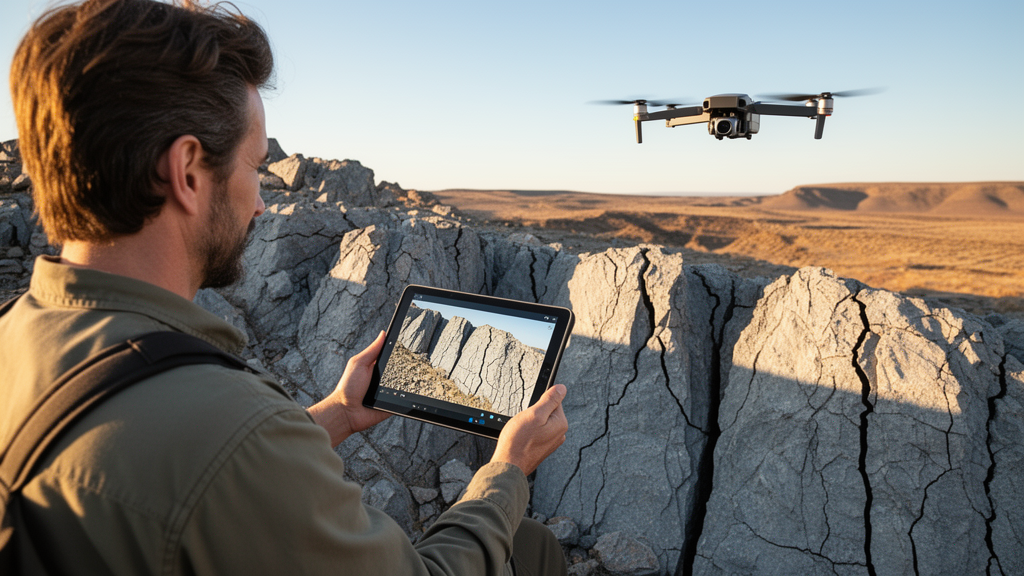
Extracting fracture networks from drone photogrammetry with far less manual labeling is the aim of a workflow described in Scientific Reports. Jiayu Wang and Gongquan Li developed an informatics pipeline that transfers segmentation knowledge from a large source dataset, GeoCrack, to a small, site-specific UAV dataset called RockCrack, addressing the scarcity of pixel-level fracture annotations for newly surveyed areas. The challenge is substantial.

Outcrop fractures are typically thin, low-contrast, and discontinuous, and they are easily confused with heterogeneous textures, weathering patterns, and shadows in aerial imagery. Labeling such imagery pixel by pixel is labor-intensive, which means each new survey site traditionally requires extensive annotation before machine-learning models can be applied. The new workflow treats GeoCrack as the source domain and RockCrack as the target domain, using feature-space analysis to identify a measurable discrepancy between the two datasets.

At the core of the workflow is GRNet, a segmentation model that combines Deformable Large-Kernel Attention at the bottleneck with Spatial-Channel Squeeze-and-Excitation mechanisms in the encoder. The performance figures show the effect of pretraining. On GeoCrack itself, GRNet achieves an intersection-over-union (IoU) of 66.84% and an F1-score of 80.12%.

When trained from scratch on the small RockCrack dataset, it reaches a five-fold mean crack-class IoU of 56.69 ± 4.34% and an F1-score of 72.28 ± 3.61%. After GeoCrack pretraining followed by target-domain fine-tuning, the best-performing configuration improves to a mean IoU of 58.96 ± 3.64% and an F1-score of 74.13 ± 2.93%. Fine-tuning outperformed direct source-only deployment in the reported experiments, indicating that source-domain knowledge contributed to the gains on the target site.

The authors note, however, that differences between the leading transfer strategies are small and fold-dependent, meaning the ranking of top configurations may vary with the particular data split used for evaluation. The workflow produces pixel-level fracture maps that can feed subsequent processing steps, including skeletonization, trace vectorization, and fracture-network characterization. These downstream products are what ultimately support discontinuity mapping, rock-mass characterization, and geotechnical interpretation of outcrop imagery collected during UAV surveys.

The researchers are explicit about the limits of their results. They state that further spatial calibration, uncertainty assessment, and geological validation are required before the outputs can be used for quantitative rock-mass analysis or engineering decisions. The fracture maps are therefore an intermediate product that still requires expert geological judgment in safety-relevant applications.

The study reports a workflow for applying deep segmentation models in settings where labeled geological imagery is limited. By quantifying the domain gap through feature-space analysis and reporting measured performance gains from cross-domain pretraining, the authors document an approach to label-scarce fracture mapping, with the reported uncertainty ranges and stated validation requirements framing the results as research findings rather than deployment-ready outputs.

Subject of Research: Label-scarce cross-domain deep learning segmentation of geological outcrop fractures from UAV photogrammetric imagery

Article Title: An informatics workflow for label-scarce cross-domain segmentation of geological outcrop fractures from UAV photogrammetric imagery

Article References: Wang, J., & Li, G. (2026). An informatics workflow for label-scarce cross-domain segmentation of geological outcrop fractures from UAV photogrammetric imagery. Scientific Reports. https://doi.org/10.1038/s41598-026-77360-5

Image Credits: AI Generated

DOI: 10.1038/s41598-026-77360-5

Keywords: UAV photogrammetry, geological fractures, image segmentation, deep learning, GRNet, GeoCrack, RockCrack, domain adaptation, rock-mass characterization, label scarcity, fracture networks, informatics

Cite Scienmag News

Denise Maddox. (October 26, 2026). AI Workflow Maps Rock Fractures from Drone Images with Scarce Labels. Scienmag. https://scienmag.com/ai-workflow-maps-rock-fractures-from-drone-images-with-scarce-labels/

Denise Maddox. "AI Workflow Maps Rock Fractures from Drone Images with Scarce Labels." Scienmag, 26 October 2026, https://scienmag.com/ai-workflow-maps-rock-fractures-from-drone-images-with-scarce-labels/. Accessed 26 October 2026.

Denise Maddox. "AI Workflow Maps Rock Fractures from Drone Images with Scarce Labels." Scienmag. October 26, 2026. https://scienmag.com/ai-workflow-maps-rock-fractures-from-drone-images-with-scarce-labels/


Tags: AI workflow for fracture network extractiondeep learningdeep learning models for fracture detectiondeformable large-kernel attention in segmentation modelsdomain adaptationdrone photogrammetry for rock fracture mappingevaluating segmentation model performance with IoU and Ffeature-space analysis in remote sensingfracture networksGeoCrackgeological fracturesGRNetimage segmentationimage segmentation in low-contrast aerial imageryinformaticslabel scarcityreducing manual annotation in geological imagingrock-mass characterizationRockCracksemi-supervised learning with scarce pixel labelsspatial-channel squeeze-and-excitation mechanismstransfer learning from GeoCrack to RockCrack datasetsUAV photogrammetryUAV-based geological survey analysis
Share26Tweet16
Previous Post

Frequency and Wavelet Cues Give Lightweight Detector an Edge in Scene Text Detection

Next Post

Wireless sensor networks help AI judge cultural fit of factory translations

Related Posts

Wireless sensor networks help AI judge cultural fit of factory translations
Technology and Engineering

Wireless sensor networks help AI judge cultural fit of factory translations

October 26, 2026
Frequency and Wavelet Cues Give Lightweight Detector an Edge in Scene Text Detection
Technology and Engineering

Frequency and Wavelet Cues Give Lightweight Detector an Edge in Scene Text Detection

October 26, 2026
Bias Detection and Fairness Auditing in Large Language Models Remain Fragmented, Review Finds
Technology and Engineering

Bias Detection and Fairness Auditing in Large Language Models Remain Fragmented, Review Finds

October 26, 2026
Smarter Starting Points Slash the Cost of Encrypted Division and Square Root
Technology and Engineering

Smarter Starting Points Slash the Cost of Encrypted Division and Square Root

October 26, 2026
Psychological Sex Differences Strongly Predict Occupational Segregation, Study Finds
Technology and Engineering

Psychological Sex Differences Strongly Predict Occupational Segregation, Study Finds

October 26, 2026
Causal Inference Boosts Privacy-Preserving Federated Learning Across Organizations
Technology and Engineering

Causal Inference Boosts Privacy-Preserving Federated Learning Across Organizations

October 26, 2026
Next Post
Wireless sensor networks help AI judge cultural fit of factory translations

Wireless sensor networks help AI judge cultural fit of factory translations

  • Mothers who receive childcare support from maternal grandparents show more optimized

    Mothers who receive childcare support from maternal grandparents show more parental warmth, finds NTU Singapore study

    27656 shares
    Share 11059 Tweet 6912
  • University of Seville Breaks 120-Year-Old Mystery, Revises a Key Einstein Concept

    1061 shares
    Share 424 Tweet 265
  • Bee body mass, pathogens and local climate influence heat tolerance

    682 shares
    Share 273 Tweet 171
  • Researchers record first-ever images and data of a shark experiencing a boat strike

    546 shares
    Share 218 Tweet 137
  • Groundbreaking Clinical Trial Reveals Lubiprostone Enhances Kidney Function

    531 shares
    Share 212 Tweet 133
Science

Embark on a thrilling journey of discovery with Scienmag.com—your ultimate source for cutting-edge breakthroughs. Immerse yourself in a world where curiosity knows no limits and tomorrow’s possibilities become today’s reality!

RECENT NEWS

  • Wireless sensor networks help AI judge cultural fit of factory translations
  • AI Workflow Maps Rock Fractures from Drone Images with Scarce Labels
  • Frequency and Wavelet Cues Give Lightweight Detector an Edge in Scene Text Detection
  • Antifibrotic uptake for IPF and PPF rises faster at academic centers than community hospitals

Categories

  • Agriculture
  • Anthropology
  • Archaeology
  • Athmospheric
  • Biology
  • Biotechnology
  • Blog
  • Bussines
  • Cancer
  • Chemistry
  • Climate
  • Earth Science
  • Editorial Policy
  • Marine
  • Mathematics
  • Medicine
  • Pediatry
  • Policy
  • Psychology & Psychiatry
  • Science Education
  • Science News
  • Social Science
  • Space
  • Technology and Engineering

Subscribe to Blog via Email

Enter your email address to subscribe to this blog and receive notifications of new posts by email.

Join 5,151 other subscribers

© 2025 Scienmag - Science Magazine

Welcome Back!

Login to your account below

Forgotten Password?

Retrieve your password

Please enter your username or email address to reset your password.

Log In
No Result
View All Result
  • HOME
  • SCIENCE NEWS
  • CONTACT US

© 2025 Scienmag - Science Magazine

Discover more from Science

Subscribe now to keep reading and get access to the full archive.

Continue reading