


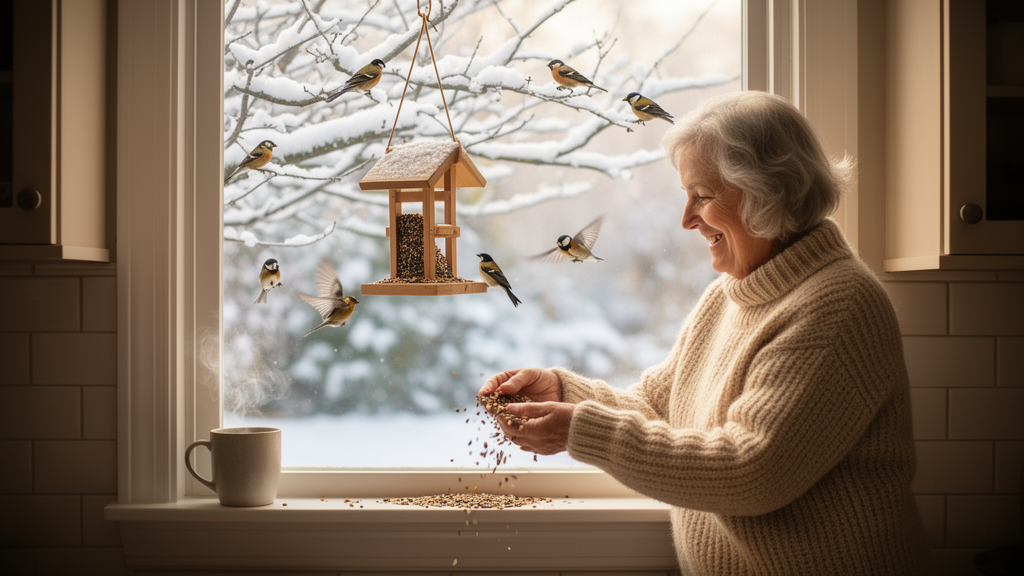
More than 56 million adults in the United States put out food for wild birds, making backyard feeding one of the most widespread forms of human-wildlife interaction in North America. Yet scientists have known surprisingly little about what this daily ritual actually does for the people who practice it. A new study led by researchers at Virginia Tech, published on Sept. 2 in the journal Ambio, offers a systematic answer: among people who feed and watch birds, the overwhelming majority reported that the activity had a positive effect on their well-being, and they described that effect through three distinct pathways — emotions, engagement, and a sense of meaning.
The research team, which included scientists from the Cornell Lab of Ornithology, The Ohio State University, North Carolina State University, ZSL (the Zoological Society of London), and a therapist, surveyed participants in Project FeederWatch, a long-running citizen science program run by the Cornell Lab of Ornithology in which volunteers submit observations of birds at their feeders during the winter months. Rather than relying on a single snapshot, the researchers measured participants’ well-being twice: once before the six-month FeederWatch season began, using a common mental well-being questionnaire, and again at the end of the season, when they also asked participants to reflect on how feeding and observing birds had affected them. This before-and-after design allowed the team to situate the reported effects of bird feeding within the broader context of participants’ lives over the same period.
At the end of the season, 95 percent of participants said that feeding and observing birds had affected their well-being positively. By comparison, 55 percent said that other events in their lives had a positive effect over the same period. “Feeding and observing birds is a really meaningful way for people to connect with nature, and people feel that it has positive impacts on their well-being,” said Kelley Langhans, a research scientist at Virginia Tech and the study’s lead author.
Emotions emerged as the most common way people described the connection. Participants reported feeling joy, gratitude, hope, and calm when they fed birds, and some said that watching birds helped reduce stress or gave them something positive to focus on during difficult periods, including illness or the death of a family member. A second pathway was engagement: tending and watching feeders sparked curiosity, held people’s attention, and helped them build bird-identification skills over time. The third pathway involved meaning. Some participants felt they were helping birds or contributing to science through their Project FeederWatch submissions, while others described a stronger connection to nature itself, or to family members who watched the birds alongside them. The study’s title — “It’s a good reason to get up every morning!” — captures how the routine can structure daily life and provide a sense of purpose.
The findings arrive at a moment when wildlife agencies and researchers are weighing both sides of the bird-feeding ledger. Feeders can benefit birds by providing food, but they can also create risks, including disease transmission, predation, and window collisions, depending on how they are managed. The study’s authors argue that understanding the human well-being impacts of feeding is essential for crafting balanced guidance. “We know there may be risks, as well as benefits, for birds from feeding, but we also know this activity can be an important way for people to connect with nature,” said Ashley Dayer, a professor in the Department of Fish and Wildlife Conservation in Virginia Tech’s College of Natural Resources and Environment. “Understanding more about those human well-being impacts helps us support wildlife agencies in taking a more measured approach and, rather than dismissing bird feeding, instead thinking about how people can feed birds responsibly while reducing risks to wildlife.”
Because the study focused on Project FeederWatch participants — people already motivated to observe and record birds — the findings describe the perspectives of an engaged community in the United States and Canada rather than the general population, and the self-reported well-being effects reflect participants’ own assessments rather than clinical measurements. Even so, the scale of the response, with nearly all participants reporting positive effects, provides a detailed picture of how a routine wildlife interaction is experienced on the ground. The researchers also note that the activity’s benefits and risks are intertwined: the same feeders that bring people joy and connection can pose hazards to the birds themselves, which is why responsible practices matter.
For those who feed birds, the study’s authors point to practical steps that can reduce the risks. “We encourage people who want to feed birds to check out guidance from Project FeederWatch and other experts on how to do so safely,” Langhans said. “Practices like regularly cleaning feeders, keeping cats indoors, and collision-proofing windows can do a lot to mitigate risks to birds.” The work was supported by the National Science Foundation and later by the Fralin Life Sciences Institute at Virginia Tech, and the full study is available in Ambio.
Subject of Research: How feeding and observing wild birds affects the self-reported well-being of Project FeederWatch participants in the United States and Canada
Article Title: Research explains why feeding birds can make you feel better
Article References: Research explains why feeding birds can make you feel better. Original publication (Bibliographic details unavailable.)
Image Credits: AI Generated
DOI: Not provided
Keywords: bird feeding, well-being, Project FeederWatch, citizen science, human-nature connection, Virginia Tech, Cornell Lab of Ornithology, wildlife recreation, mental well-being, Ambio, bird conservation, nature engagement
Cite Scienmag News
Margaret Porter. (October 26, 2026). Feeding Birds Boosts Well-Being for Most Participants in Long-Term Survey. Scienmag. https://scienmag.com/feeding-birds-boosts-well-being-for-most-participants-in-long-term-survey/
Margaret Porter. "Feeding Birds Boosts Well-Being for Most Participants in Long-Term Survey." Scienmag, 26 October 2026, https://scienmag.com/feeding-birds-boosts-well-being-for-most-participants-in-long-term-survey/. Accessed 26 October 2026.
Margaret Porter. "Feeding Birds Boosts Well-Being for Most Participants in Long-Term Survey." Scienmag. October 26, 2026. https://scienmag.com/feeding-birds-boosts-well-being-for-most-participants-in-long-term-survey/


