


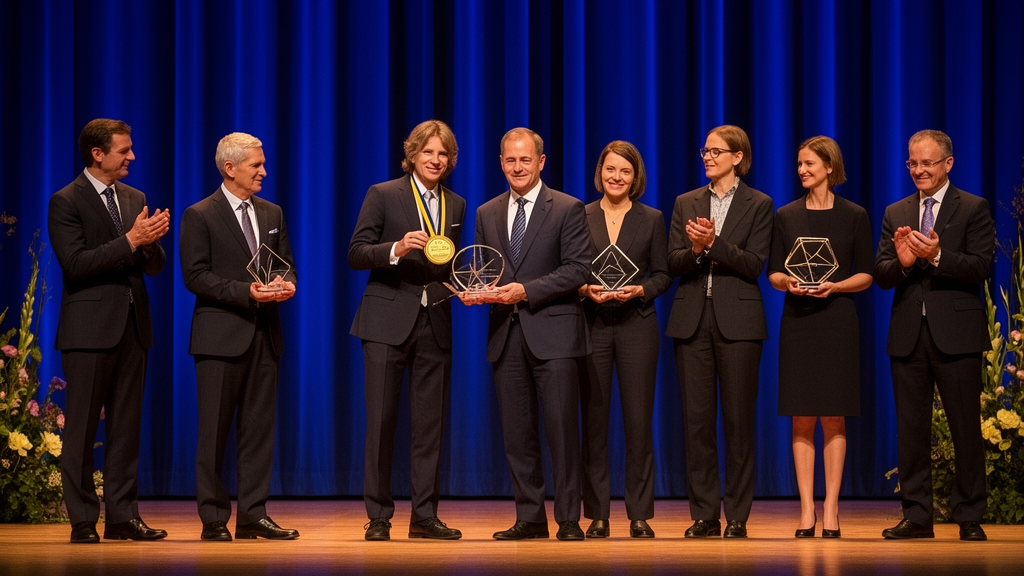
The Brain & Behavior Research Foundation has announced five recipients of its 2026 Outstanding Achievement Prizes for research spanning schizophrenia, mood disorders, child and adolescent mental health, early brain development and cognitive neuroscience. The honorees are Joseph A. Gogos, Steven A. Kushner, Andrew H. Miller, Cynthia Rogers and Sheena Josselyn. Their work is described by the foundation as advancing the understanding and treatment of mental illness. The prizewinners are scheduled to present their research at the BBRF International Mental Health Research Symposium in New York City on October 30, with the awards presented at the International Awards Dinner that evening.
Gogos, M.D., Ph.D., of Columbia University, the Zuckerman Mind Brain Behavior Institute and the Stavros Niarchos Foundation Center for Precision Psychiatry & Mental Health, received the Lieber Prize for Outstanding Achievement in Schizophrenia Research. His research is directed at identifying biological mechanisms underlying schizophrenia and translating those discoveries into new approaches for diagnosis, prevention and treatment. The announcement describes this as translational work on schizophrenia biology but does not report the results of a particular clinical trial or establish that an intervention has improved outcomes for patients. Kushner, M.D., Ph.D., of Columbia University, the New York State Psychiatric Institute and the Stavros Niarchos Foundation Center for Precision Psychiatry & Mental Health, received the Maltz Prize for Innovative & Promising Schizophrenia Research. His work combines clinical and fundamental neuroscience to investigate mechanisms underlying schizophrenia and related disorders. The foundation provides no quantitative results or effect estimates from individual studies in the announcement.
Miller, M.D., of Emory University School of Medicine’s Department of Psychiatry and Behavioral Sciences, received the Colvin Prize for Outstanding Achievement in Mood Disorders Research. He is described as a pioneer in studying the role of inflammation in depression. His research has shown that chronic inflammation can access the brain, interact with neurotransmitter systems and neurocircuits, and lead to depressive symptoms. This is presented as a mechanistic finding about inflammation and depression, not as evidence that a specific anti-inflammatory treatment has been shown to prevent or resolve depressive illness. Rogers, M.D., of Washington University School of Medicine’s Departments of Psychiatry and Pediatrics, received the Ruane Prize for Outstanding Achievement in Child & Adolescent Psychiatric Research. The child psychiatrist and researcher co-directs the Washington University Neonatal Development Research group and studies how experiences from before birth through a child’s earliest years shape the developing brain and influence mental health later in life. The announcement does not identify a single developmental pathway or study population behind the cited research.
Josselyn, Ph.D., FRSC, of the Hospital for Sick Children and the University of Toronto, received the Goldman-Rakic Prize for Outstanding Achievement in Cognitive Neuroscience Research. Her work examines how experience becomes memory and where memories are represented in the brain. The foundation describes the prize as recognizing a career centered on the neural mechanisms of memory rather than a new clinical intervention. Special committees drawn from the BBRF Scientific Council selected the 2026 recipients. The council is described as a volunteer group of 192 scientists working across disciplines in brain and behavior research. In the announcement, BBRF President and CEO Jeffrey Borenstein said the prizewinners had made important contributions to understanding the brain and the biological processes underlying mental illness. He described their work as reflecting progress in genetics and precision psychiatry, inflammation, early brain development and the mechanisms of memory.
The release is a grant and award announcement rather than a peer-reviewed research report, and it summarizes the general themes of the five scientists’ programs without presenting study methods, effect sizes, statistical uncertainty or clinical-trial outcomes. BBRF, which identifies itself as the world’s largest private funder of mental health research grants, awards grants intended to develop improved treatments, cures and methods of prevention for mental illness. Its stated research portfolio includes addiction, attention-deficit hyperactivity disorder, anxiety, autism, bipolar disorder, borderline personality disorder, depression, eating disorders, obsessive-compulsive disorder, post-traumatic stress disorder and schizophrenia, as well as suicide prevention. The foundation reports that it has awarded more than $487 million since 1987 to fund more than 5,900 scientists worldwide. It also states that 100% of every dollar donated for research is invested in research, with operating expenses covered by separate foundation grants. The five 2026 prize recipients are affiliated with Columbia University and associated institutes, Emory University School of Medicine, Washington University School of Medicine, the Hospital for Sick Children and the University of Toronto.
Subject of Research: Awards for mental health and brain research on schizophrenia, depression, child development and memory
Article Title: Brain & Behavior Research Foundation announces 2026 Outstanding Achievement prizewinners
Article References: Brain & Behavior Research Foundation announces 2026 Outstanding Achievement prizewinners. Original publication (Bibliographic details unavailable.)
Image Credits: AI Generated
DOI: Not provided
Keywords: mental health research, schizophrenia, depression, inflammation, brain development, memory, cognitive neuroscience, precision psychiatry, research awards, BBRF, Brain, Behavior
Cite Scienmag News
Cassandra Pierce. (October 26, 2026). Brain & Behavior Research Foundation announces 2026 Outstanding Achievement prizewinners. Scienmag. https://scienmag.com/brain-behavior-research-foundation-announces-2026-outstanding-achievement-prizewinners/
Cassandra Pierce. "Brain & Behavior Research Foundation announces 2026 Outstanding Achievement prizewinners." Scienmag, 26 October 2026, https://scienmag.com/brain-behavior-research-foundation-announces-2026-outstanding-achievement-prizewinners/. Accessed 26 October 2026.
Cassandra Pierce. "Brain & Behavior Research Foundation announces 2026 Outstanding Achievement prizewinners." Scienmag. October 26, 2026. https://scienmag.com/brain-behavior-research-foundation-announces-2026-outstanding-achievement-prizewinners/


