


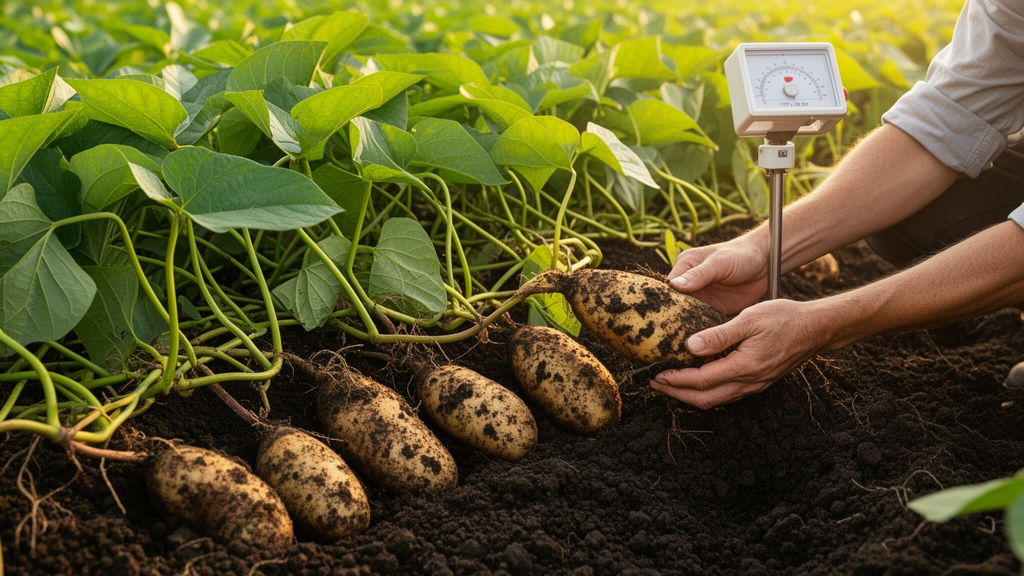
A field evaluation of 30 greater yam genotypes found substantial differences among the plants across 23 morphological, yield and biochemical traits, pointing to promising material for breeding crops suited to the semi-arid conditions of north-western India. The randomized block experiment was conducted in Udaipur over three kharif seasons, from 2018 to 2020, with every genotype represented once in each of three blocks. Researchers then combined estimates of genetic variability, trait associations, path coefficients and genetic diversity to identify characteristics and genotypes that could support future selection and hybridization programs.
Greater yam, or Dioscorea alata L., is an economically important tuber crop whose tubers contribute to food security, household income and rural livelihoods, including through value-added uses. Despite its importance, systematic characterization of its genetic resources has remained limited, particularly under semi-arid conditions in north-western India. The study addressed that gap by evaluating the 30 genotypes for variation in traits including tuber weight, yield per vine, vine and tuber dimensions, leaf number, total soluble solids, starch and ascorbic acid content. The analysis found highly significant genotypic differences for all measured traits, indicating meaningful variation available to plant breeders.
Some of the strongest variation occurred in traits directly relevant to production. Tuber weight had genotypic and phenotypic coefficients of variation of 33.40% and 28.43%, while yield per vine recorded corresponding values of 37.59% and 30.62%. Total soluble solids also showed high variation, with genotypic and phenotypic coefficients of 24.23% and 24.40%. The estimated heritability of vine length reached 84.28%, accompanied by genetic advance of 95.78%. These measurements suggest that vine length is strongly influenced by genetic differences and may be particularly useful as a selection criterion, although the experimental results do not by themselves establish the performance of new varieties in other environments.
Tuber yield per vine was positively associated with tuber length at a correlation of 0.99, leaf number at 0.99, tuber weight at 0.97 and vine length at 0.96. Path-coefficient analysis further identified vine length, with a direct path coefficient of 1.033, and tuber length, at 0.760, as the leading direct contributors to yield in the tested material. Tocher’s clustering placed the 30 genotypes into four groups, with the greatest divergence occurring between Cluster III and Cluster II at 400.62. Cluster II had the strongest performance for yield and quality traits. Among the individual genotypes, TGy-14-9 was identified as promising for high yield, MPY-8 for high starch content, and MPY-4 for high ascorbic acid content.
The findings position vine length and tuber length as priorities for greater yam improvement in semi-arid north-western India, while also highlighting genotypes that may contribute useful yield or nutritional characteristics to breeding programs. The research was based on a three-season field trial of 30 genotypes at one location, so broader testing would be needed to establish how consistently the selected traits and promising genotypes perform across other soils, climates and production systems. Even with that limitation, the results provide a concrete genetic resource for breeders seeking greater yam varieties that combine higher tuber output with desirable quality traits.
Subject of Research: Genetic variability and trait associations in 30 greater yam genotypes evaluated in semi-arid north-western India
Article Title: Character association, path coefficient and genetic diversity analyses of quantitative and qualitative traits in greater yam (Dioscorea alata L.) genotypes from North-western India
Article References: Singh, P., Ameta, K. D., Meena, A. R., Indurthi, S., Meena, S., Jain, D., Kumar, L., Kamboj, A., Meena, T. K., & Choudhary, R. C. (2026). Character association, path coefficient and genetic diversity analyses of quantitative and qualitative traits in greater yam (Dioscorea alata L.) genotypes from North-western India. BMC Plant Biology. https://doi.org/10.1186/s12870-026-09816-9
Image Credits: AI Generated
DOI: 10.1186/s12870-026-09816-9
Keywords: greater yam, Dioscorea alata, genetic diversity, heritability, genetic advance, path analysis, tuber yield, genotype selection, plant breeding, semi-arid agriculture, Character, association
Cite Scienmag News
Alan Morgan. (October 26, 2026). Greater yam study identifies traits and genotypes for higher yields. Scienmag. https://scienmag.com/greater-yam-study-identifies-traits-and-genotypes-for-higher-yields/
Alan Morgan. "Greater yam study identifies traits and genotypes for higher yields." Scienmag, 26 October 2026, https://scienmag.com/greater-yam-study-identifies-traits-and-genotypes-for-higher-yields/. Accessed 26 October 2026.
Alan Morgan. "Greater yam study identifies traits and genotypes for higher yields." Scienmag. October 26, 2026. https://scienmag.com/greater-yam-study-identifies-traits-and-genotypes-for-higher-yields/


