


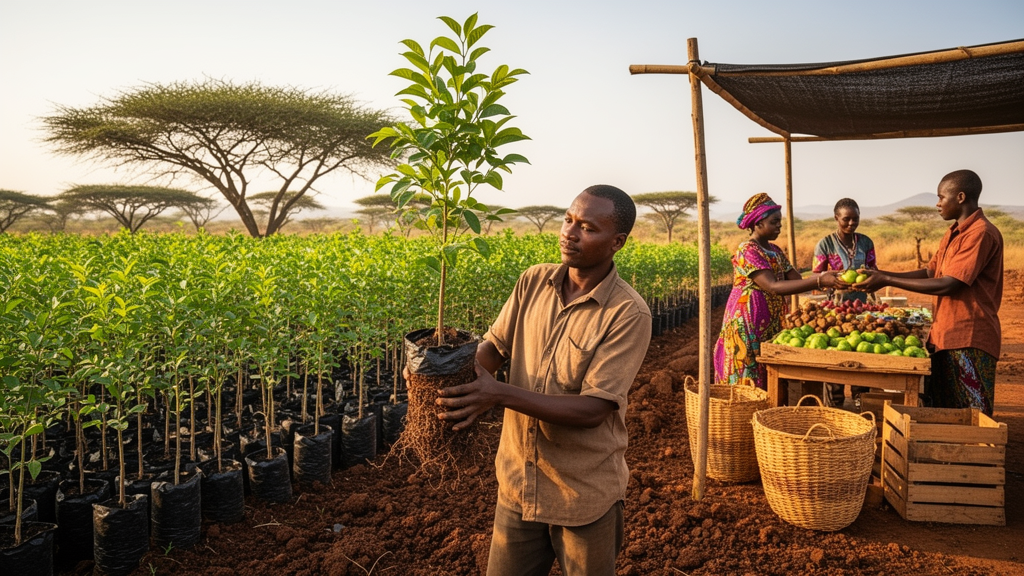
A mixed-methods study of smallholder farming systems in southwestern Ethiopia found that affordable seedlings and proximity to markets were the factors most strongly associated with households scaling up agroforestry. The research included a survey of 373 randomly selected households across four districts and found that households farther from the nearest market had lower odds of scaling, while households reporting affordable seedlings had more than seven times the odds of scaling compared with the reference category. These results identify statistical associations, not proof that changing prices or market distance would directly cause expansion.
The study assessed the governance, market and policy conditions influencing agroforestry scaling rather than testing a farming intervention. Researchers combined the household survey with key-informant interviews, focus group discussions, stakeholder analysis and a document review. They used descriptive statistics and a stakeholder power–interest analysis to examine institutional relationships, while binary logistic regression assessed factors associated with households scaling up agroforestry. The regression was statistically significant, with an omnibus χ² of 29.94 and p < 0.001, and explained 7.7% to 19.9% of the variation in agroforestry scaling.
Two factors emerged as the only significant determinants in the model. Distance to the nearest market had an odds ratio of 0.64 (p = 0.006), indicating lower odds of agroforestry scaling among households located farther away. Seedling affordability had an odds ratio of 7.05 (p = 0.001), indicating more than sevenfold higher odds among households reporting that seedlings were affordable. Because the analysis was observational, the findings do not establish that seedling prices or geographic access to markets cause farmers to adopt or expand agroforestry. The model also accounted for only a limited share of the observed variation, indicating that other relevant influences were not fully captured.
Interviews and focus group discussions pointed to interconnected weaknesses in the enabling environment for agroforestry. Participants identified inadequate extension services, weak links between farmers and input suppliers, limited market linkages and gaps in policy implementation. The stakeholder analysis found fragmented coordination among institutions and insufficient engagement of influential market actors. Rather than operating as separate barriers, governance, markets and policy were found to function as connected parts of the institutional system surrounding smallholder farms, with weak links among them constraining the conditions under which agroforestry could expand.
National policies supporting agroforestry had not eliminated those constraints in the four southwestern Ethiopian districts examined. The study situates agroforestry within a broader framing of sustainable livelihoods, biodiversity conservation, climate-change adaptation and ecosystem resilience, but its empirical results focus specifically on the governance, market and policy determinants of scaling in the surveyed smallholder population. The regional scope and the model’s limited explanatory power mean that the findings should not automatically be generalized to all Ethiopian farms or to other parts of Sub-Saharan Africa. Within the study area, however, the results identify seedling affordability and market accessibility as the clearest measured correlates of expansion, while also showing how institutional coordination, extension support, input and market linkages, and policy implementation shape the wider environment in which farmers make scaling decisions.
Subject of Research: Institutional, market and policy factors associated with agroforestry scaling among smallholder households in southwestern Ethiopia.
Article Title: Enabling environment for agroforestry scaling in smallholder farming systems of southwestern Ethiopia
Article References: Ararsa, F., Asfaw, A., Taye, S., Olani, S., Hagazi, N., Woldemeskel, E., Hailemariam, G., & Mokria, M. (2026). Enabling environment for agroforestry scaling in smallholder farming systems of southwestern Ethiopia. Discover Sustainability. https://doi.org/10.1007/s43621-026-04525-7
Image Credits: AI Generated
DOI: 10.1007/s43621-026-04525-7
Keywords: agroforestry, smallholder farming, Ethiopia, seedling affordability, market access, agricultural policy, extension services, stakeholder coordination, binary logistic regression, Enabling, environment, scaling
Cite Scienmag News
Violet Maxwell. (October 26, 2026). Affordable seedlings and market access linked to agroforestry scaling in Ethiopia. Scienmag. https://scienmag.com/affordable-seedlings-and-market-access-linked-to-agroforestry-scaling-in-ethiopia/
Violet Maxwell. "Affordable seedlings and market access linked to agroforestry scaling in Ethiopia." Scienmag, 26 October 2026, https://scienmag.com/affordable-seedlings-and-market-access-linked-to-agroforestry-scaling-in-ethiopia/. Accessed 26 October 2026.
Violet Maxwell. "Affordable seedlings and market access linked to agroforestry scaling in Ethiopia." Scienmag. October 26, 2026. https://scienmag.com/affordable-seedlings-and-market-access-linked-to-agroforestry-scaling-in-ethiopia/


