


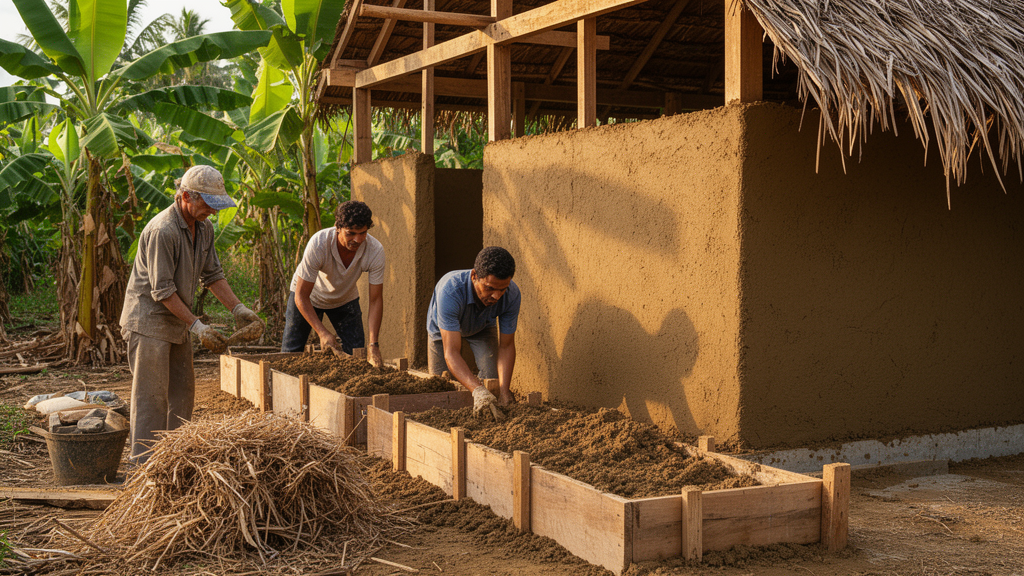
A comprehensive review of 50 peer-reviewed articles identifies adobe construction as a potential bioeconomy strategy for sustainable housing in tropical biomes. The literature review found increasing research interest in earthen building linked to sustainability, bioeconomy and circular-economy objectives. Its authors argue that adobe deserves attention because it uses locally available natural resources and has low embodied energy, positioning it as a possible low-impact construction approach in tropical regions.
The review examines adobe within broader efforts to develop production models with lower carbon dioxide emissions as concerns about adverse climatic events and fossil-fuel-based economic development intensify. Adobe is an ancient earthen construction technique that has re-emerged as a potential low-impact solution. The selected literature connects its use of local resources and relatively low embodied energy with bioeconomy and circular-economy principles, which seek to reduce emissions through alternative forms of production and resource use.
Researchers followed the Preferred Reporting Items for Systematic Reviews and Meta-Analyses, or PRISMA, statement while assembling the evidence. They searched scientific journal databases including Scopus, Web of Science and Periódicos CAPES, and processed selected records with Rayyan and Manus software. The search associated the descriptor “adobe” with “sustainability,” “bioeconomy” and “circular economy” in three languages.
The researchers noted that broader search terms, including the generic descriptor “sustainability,” returned an impractically large number of publications, making the narrower combination necessary for their review strategy. Following the application of inclusion and exclusion criteria, 50 peer-reviewed articles were selected. The analysis found that publication activity on adobe and sustainability-related concerns has grown in recent years, a development the authors associate with increasing interest in the low-carbon economy.
The studies also covered a broad spectrum of research areas. The analysis also identified low national research production, although national output showed a growing trend. Growth in publications was particularly evident in low-seismicity regions.
By mapping the available literature, the review documents both the expanding scholarly attention given to adobe and the uneven geographic distribution of that research. The central finding is that earthen construction can be analyzed as part of a bioeconomy-based approach to housing in tropical biomes, with its low embodied energy and use of local natural resources offering the principal features identified by the authors.
Subject of Research: Systematic review of adobe housing, bioeconomy and sustainability in tropical biomes
Article Title: Adobe construction as a bioeconomy strategy for a sustainable housing in tropical biomes
Article References: Bovolato, L. E., da Silva, J. F. M., Macedo, P. H. B., Kliger, D., Buynevich, I. V., de Oliveira, M., & Pimenta, R. S. (2026). Adobe construction as a bioeconomy strategy for a sustainable housing in tropical biomes. Discover Sustainability. https://doi.org/10.1007/s43621-026-04696-3
Image Credits: AI Generated
DOI: 10.1007/s43621-026-04696-3
Keywords: adobe construction, earthen housing, tropical biomes, bioeconomy, circular economy, low-carbon economy, embodied energy, sustainable construction, systematic review, Adobe, construction, strategy
Cite Scienmag News
Violet Maxwell. (October 26, 2026). Review evaluates adobe as a tropical bioeconomy housing strategy. Scienmag. https://scienmag.com/review-evaluates-adobe-as-a-tropical-bioeconomy-housing-strategy/
Violet Maxwell. "Review evaluates adobe as a tropical bioeconomy housing strategy." Scienmag, 26 October 2026, https://scienmag.com/review-evaluates-adobe-as-a-tropical-bioeconomy-housing-strategy/. Accessed 26 October 2026.
Violet Maxwell. "Review evaluates adobe as a tropical bioeconomy housing strategy." Scienmag. October 26, 2026. https://scienmag.com/review-evaluates-adobe-as-a-tropical-bioeconomy-housing-strategy/


