

Monday, October 26, 2026
Science
No Result
View All Result
  • Login
  • HOME
  • SCIENCE NEWS
  • CONTACT US
  • HOME
  • SCIENCE NEWS
  • CONTACT US
No Result
View All Result
Scienmag
No Result
View All Result
Home Science News Psychology & Psychiatry

Hemispheric preferences associated with thinking styles in Kerala undergraduates

October 26, 2026
in Psychology & Psychiatry
Glenn Wilkins
By Glenn Wilkins Scienmag Editorial Profile - Clinical Psychology
Reading Time: 3 mins read
0
Hemispheric preferences associated with thinking styles in Kerala undergraduates

Hemispheric preferences associated with thinking styles in Kerala undergraduates

65
SHARES
587
VIEWS
Share on FacebookShare on Twitter
ADVERTISEMENT

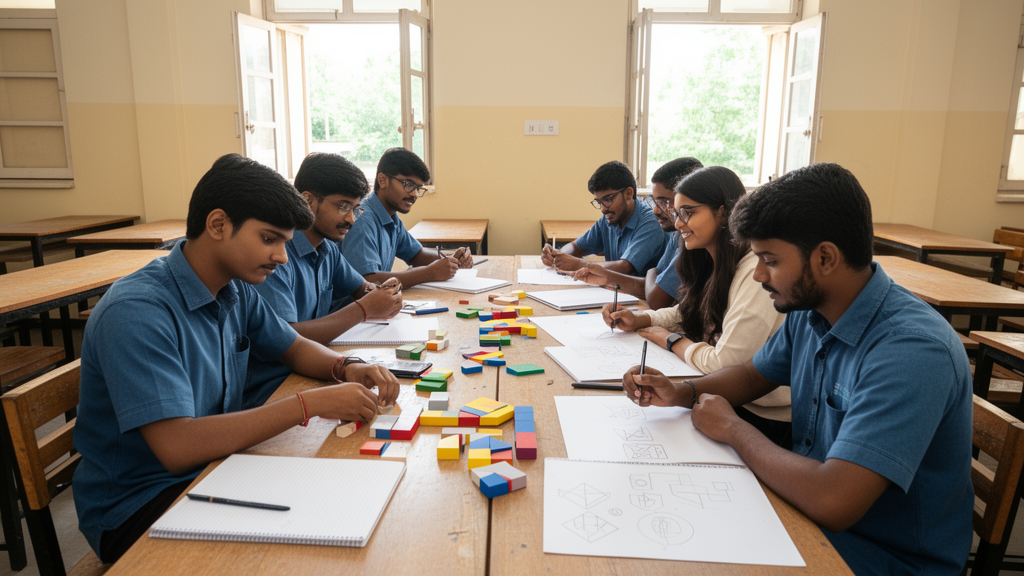
An observational survey of 400 undergraduate students in Malappuram district, Kerala, India, found that brain-hemisphere preference was associated with differences in specific thinking and learning characteristics, although the two groups did not differ significantly in overall learning style. Using the SOLAT test, researchers classified 248 students as right-hemisphere-preferring and 144 as left-hemisphere-preferring. Right-hemisphere-preferring students obtained higher overall thinking-style scores, with a moderate effect size, while most students in both groups displayed moderate levels of learning and thinking styles.

The study used a descriptive survey design to identify students’ hemispheric preferences, assess their learning and thinking styles, and compare the results across preference groups and individual components. The researchers applied descriptive statistics, including percentages, means and standard deviations, alongside independent-samples t-tests, one-way analysis of variance, Welch analysis of variance, Tukey HSD and Games-Howell post hoc tests. Effect sizes were evaluated with Cohen’s d, η² and ω². Because the design was observational, the results show associations rather than establishing that hemispheric preference caused the observed differences.

Students with a left-hemisphere preference tended to favor structured, sequential and verbal learning approaches. Students with a right-hemisphere preference showed greater inclinations toward interactive, creative and imaginative learning and thinking. Creativity and imaginative thinking emerged as especially salient components among the right-hemisphere-preferring group. These component-level differences occurred even though the groups showed no significant difference in overall learning style. The measured effect sizes ranged from small to moderate, indicating that the reported associations were meaningful but did not amount to a deterministic division between sharply separated cognitive types.

Overall thinking-style scores differed significantly between the hemispheric-preference groups, with the right-hemisphere-preferring students scoring higher and the comparison accompanied by a moderate effect size. The authors characterized hemispheric preference as having a nuanced, component-specific relationship with learning and thinking rather than operating as a rigid functional divide. Their findings therefore support an interpretation of hemispheric preference as a reflection of relative cognitive tendencies operating alongside integrative and overlapping cognitive processes. The survey does not show that students with a particular preference will always learn or think in a certain way, nor does it establish that one form of learning is superior to another.

The study’s scope was limited to 400 undergraduates in Malappuram district, and its descriptive design does not establish causal relationships or long-term educational outcomes. Within that scope, the results provide evidence of a complex association: students with different hemispheric preferences reported distinct patterns in several learning and thinking components, but retained broadly similar overall learning-style profiles. The authors said the findings support balanced and inclusive pedagogical approaches in higher education that address diverse cognitive orientations, including structured, sequential, verbal, interactive, creative and imaginative approaches.

Subject of Research: Associations between hemispheric preference and learning and thinking styles among undergraduates in Kerala, India

Article Title: Cognitive preferences and hemispheric preference: an analysis of learning and thinking styles among undergraduate students

Article References: P.C., J., Miglani, S., Panigrahi, A. R., Pawar, A., Patel, J., & Pany, S. (2026). Cognitive preferences and hemispheric preference: an analysis of learning and thinking styles among undergraduate students. BMC Psychology. https://doi.org/10.1186/s40359-026-05429-x

Image Credits: AI Generated

DOI: 10.1186/s40359-026-05429-x

Keywords: hemispheric preference, learning styles, thinking styles, undergraduate students, cognitive psychology, creativity, imaginative thinking, SOLAT, observational survey, India, Cognitive, preferences

Cite Scienmag News

Glenn Wilkins. (October 26, 2026). Hemispheric preferences associated with thinking styles in Kerala undergraduates. Scienmag. https://scienmag.com/hemispheric-preferences-associated-with-thinking-styles-in-kerala-undergraduates/


Glenn Wilkins. "Hemispheric preferences associated with thinking styles in Kerala undergraduates." Scienmag, 26 October 2026, https://scienmag.com/hemispheric-preferences-associated-with-thinking-styles-in-kerala-undergraduates/. Accessed 26 October 2026.

Glenn Wilkins. "Hemispheric preferences associated with thinking styles in Kerala undergraduates." Scienmag. October 26, 2026. https://scienmag.com/hemispheric-preferences-associated-with-thinking-styles-in-kerala-undergraduates/

Tags: association between brain preferences and thinking stylescognitivecognitive psychologycreativityHemispheric brain preferences in undergraduate studentshemispheric influence on structured versus creative learninghemispheric preferencehemispheric preferences and creativity in studentsimaginative thinkingimpact of brain lateralization on educational outcomesIndiainfluence of brain dominance on learning approacheslearning stylesobservational surveyobservational survey methodology in educational researchpreferencesright vs. left hemisphere cognitive differencesSOLATSOLAT test for brain hemisphere classificationstatistical analysis of thinking style differencesthinking stylesthinking styles and learning characteristics in Keralaundergraduate students
Share26Tweet16
Previous Post

Flash-heated bamboo biochar produces tougher, absorption-dominant shielding composite

Next Post

Dual-Channel AI Model Links Sentiment, Performance and Educational Tool Adoption

Related Posts

Self-medication common among Brazilian health science students, study finds
Psychology & Psychiatry

Self-medication common among Brazilian health science students, study finds

October 26, 2026
Research report: Beyond the clinic: a feasibility trial of the super skills for life program for childhood anxiety in Pakistan
Psychology & Psychiatry

Research report: Beyond the clinic: a feasibility trial of the super skills for life program for childhood anxiety in Pakistan

October 26, 2026
Systematic review finds 12 transference assessment tools, only two patient-based
Psychology & Psychiatry

Systematic review finds 12 transference assessment tools, only two patient-based

October 26, 2026
Student engagement linked to later well-being in novice male English teachers
Psychology & Psychiatry

Student engagement linked to later well-being in novice male English teachers

October 26, 2026
Qualitative study examines uncertainty in 12 vestibular schwannoma surgery patients
Psychology & Psychiatry

Qualitative study examines uncertainty in 12 vestibular schwannoma surgery patients

October 26, 2026
Review maps psychosocial challenges faced by Chinese childhood cancer survivors
Psychology & Psychiatry

Review maps psychosocial challenges faced by Chinese childhood cancer survivors

October 26, 2026
Next Post
Dual-Channel AI Model Links Sentiment, Performance and Educational Tool Adoption

Dual-Channel AI Model Links Sentiment, Performance and Educational Tool Adoption

  • Mothers who receive childcare support from maternal grandparents show more optimized

    Mothers who receive childcare support from maternal grandparents show more parental warmth, finds NTU Singapore study

    27656 shares
    Share 11059 Tweet 6912
  • University of Seville Breaks 120-Year-Old Mystery, Revises a Key Einstein Concept

    1061 shares
    Share 424 Tweet 265
  • Bee body mass, pathogens and local climate influence heat tolerance

    682 shares
    Share 273 Tweet 171
  • Researchers record first-ever images and data of a shark experiencing a boat strike

    546 shares
    Share 218 Tweet 137
  • Groundbreaking Clinical Trial Reveals Lubiprostone Enhances Kidney Function

    531 shares
    Share 212 Tweet 133
Science

Embark on a thrilling journey of discovery with Scienmag.com—your ultimate source for cutting-edge breakthroughs. Immerse yourself in a world where curiosity knows no limits and tomorrow’s possibilities become today’s reality!

RECENT NEWS

  • Dual-Channel AI Model Links Sentiment, Performance and Educational Tool Adoption
  • Hemispheric preferences associated with thinking styles in Kerala undergraduates
  • Flash-heated bamboo biochar produces tougher, absorption-dominant shielding composite
  • Microbial recontamination associated with household water use practices in Cambodia

Categories

  • Agriculture
  • Anthropology
  • Archaeology
  • Athmospheric
  • Biology
  • Biotechnology
  • Blog
  • Bussines
  • Cancer
  • Chemistry
  • Climate
  • Earth Science
  • Editorial Policy
  • Marine
  • Mathematics
  • Medicine
  • Pediatry
  • Policy
  • Psychology & Psychiatry
  • Science Education
  • Science News
  • Social Science
  • Space
  • Technology and Engineering

Subscribe to Blog via Email

Enter your email address to subscribe to this blog and receive notifications of new posts by email.

Join 5,151 other subscribers

© 2025 Scienmag - Science Magazine

Welcome Back!

Login to your account below

Forgotten Password?

Retrieve your password

Please enter your username or email address to reset your password.

Log In
No Result
View All Result
  • HOME
  • SCIENCE NEWS
  • CONTACT US

© 2025 Scienmag - Science Magazine

Discover more from Science

Subscribe now to keep reading and get access to the full archive.

Continue reading