

Monday, October 26, 2026
Science
No Result
View All Result
  • Login
  • HOME
  • SCIENCE NEWS
  • CONTACT US
  • HOME
  • SCIENCE NEWS
  • CONTACT US
No Result
View All Result
Scienmag
No Result
View All Result
Home Science News Biology

RNA-scaffolded condensates help neurons read exceptionally long genes

October 26, 2026
in Biology
Juliet Wilcox
By Juliet Wilcox Scienmag Editorial Profile - Human Genetics
Reading Time: 2 mins read
0
RNA-scaffolded condensates help neurons read exceptionally long genes

RNA-scaffolded condensates help neurons read exceptionally long genes

65
SHARES
587
VIEWS
Share on FacebookShare on Twitter
ADVERTISEMENT

A peer-reviewed study reports that the RNA-binding protein SFPQ uses long RNA molecules as scaffolds to form meshwork-like condensates inside neuronal nuclei. Researchers at Ehime University found that these membraneless structures bring together factors involved in transcription, RNA splicing and chromatin regulation. Experiments in which SFPQ condensates could not form were associated with incomplete reading of exceptionally long genes, impaired RNA splicing and reduced gene expression, indicating that condensate formation supports several coordinated steps required to process these genes.

Mammalian neurons express many exceptionally long genes, ranging from more than 100 kilobases to over 2 megabases, that are important for forming synapses and neural circuits. Genetic information is normally read from DNA into RNA through transcription, and the longer a gene is, the more time is generally required to read it from beginning to end. Gene expression must also be regulated at several stages.

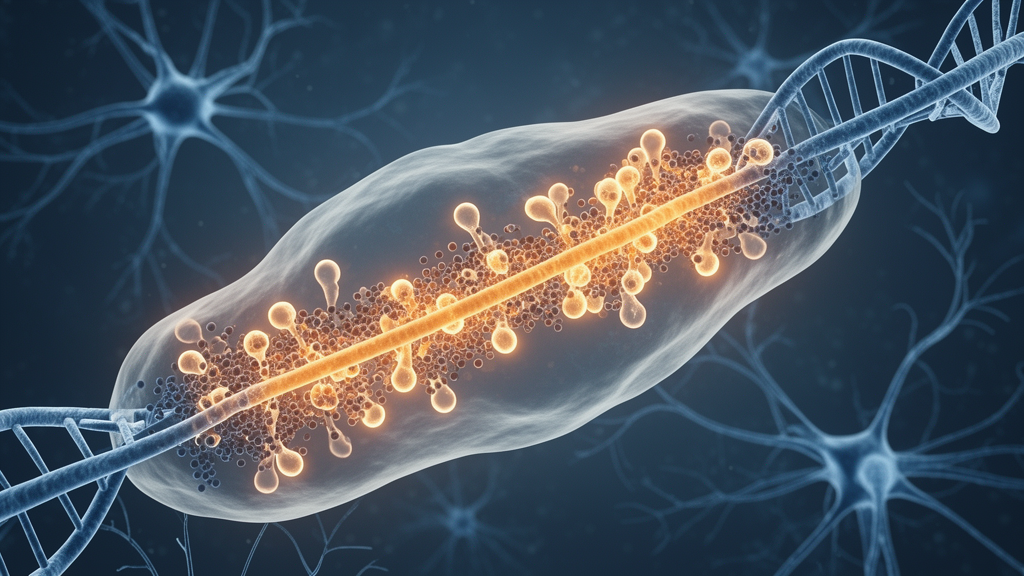
The new findings suggest that neurons use a shared nuclear arrangement to coordinate transcription of exceptionally long genes with the processing and regulation of the resulting RNA. The study focused on SFPQ and used super-resolution microscopy and other experimental approaches to investigate how the protein organizes molecules within the nucleus. The microscopy images showed meshwork-like condensates formed with RNA acting as a scaffold.

A condensate is a membraneless structure in which particular molecules gather together. In this case, the SFPQ structures contained diverse molecules involved in transcription, splicing—the joining of appropriate parts of newly made RNA—and regulation of chromatin, the structure that packages DNA. The observations support a physical explanation for how multiple processes can be gathered within the same nuclear space while a long gene is being read and its RNA is processed.

Functional disruption produced several linked defects. When the researchers prevented SFPQ condensates from forming, extra-long genes were not read properly to their ends, RNA splicing was impaired and gene expression decreased. It therefore supports a bounded conclusion: loss of the RNA-scaffolded condensates was associated with compromised completion, splicing and expression of exceptionally long neuronal genes, rather than proving that a single condensate component independently controls each outcome.

The authors describe the structures as a possible physical basis for a previously proposed transcriptional elongation condensate, a shared workspace for factors needed to read long genes. Their results connect the spatial organization of the nucleus with the measured defects in gene expression, shifting attention from isolated molecular reactions to the way transcription, RNA splicing and chromatin regulation can be coordinated within one structure. The work does not show that the condensates cause human neurological disease, but SFPQ and related proteins have previously been linked to autism spectrum disorder and amyotrophic lateral sclerosis.

The release identifies abnormal expression of extra-long genes as a subject for further study in neurodevelopmental and neurodegenerative disorders; it does not report a clinical application, treatment or preventive strategy.

Subject of Research: RNA-scaffolded SFPQ condensates and the expression of exceptionally long neuronal genes

Article Title: A new mechanism for reading extra-long genes in neurons

Article References: A new mechanism for reading extra-long genes in neurons. Original publication (Bibliographic details unavailable.)

Image Credits: AI Generated

DOI: Not provided

Keywords: SFPQ, neuronal gene expression, RNA condensates, long genes, transcription, RNA splicing, chromatin regulation, super-resolution microscopy, neuronal nuclei, mechanism, reading, extra-long

Cite Scienmag News

Juliet Wilcox. (October 26, 2026). RNA-scaffolded condensates help neurons read exceptionally long genes. Scienmag. https://scienmag.com/rna-scaffolded-condensates-help-neurons-read-exceptionally-long-genes/

Juliet Wilcox. "RNA-scaffolded condensates help neurons read exceptionally long genes." Scienmag, 26 October 2026, https://scienmag.com/rna-scaffolded-condensates-help-neurons-read-exceptionally-long-genes/. Accessed 26 October 2026.

Juliet Wilcox. "RNA-scaffolded condensates help neurons read exceptionally long genes." Scienmag. October 26, 2026. https://scienmag.com/rna-scaffolded-condensates-help-neurons-read-exceptionally-long-genes/


Tags: chromatin regulationcondensate formation and gene readoutextra-longlong gene processing in neural cellslong gene transcription regulationlong genesmechanismmembraneless nuclear structuresneural circuit gene regulationneuronal gene expressionneuronal nuclear condensatesneuronal nucleinuclear organization of long genesReadingRNA condensatesRNA scaffolds in neuronsRNA splicingRNA splicing and chromatin regulationRNA-binding protein SFPQSFPQsuper-resolution microscopysuper-resolution microscopy in neurosciencetranscription
Share26Tweet16
Previous Post

Research report: Differential MMR protein stability and heterogeneity in bladder versus non-bladder urothelial carcinomas

Next Post

Research report: AI-use orientations and self-perceived AI competence among medical students: a cross-sectional study, Brazil

Related Posts

Mycology seeks fungal biosynthesis papers for special collection
Biology

Mycology seeks fungal biosynthesis papers for special collection

October 26, 2026
Monk parakeet aggression shows no major sex-based difference
Biology

Monk parakeet aggression shows no major sex-based difference

October 26, 2026
Mycology opens submissions for fungal biomanufacturing collection
Biology

Mycology opens submissions for fungal biomanufacturing collection

October 26, 2026
Cryo-EM reveals dual DNA and histone binding by cancer-linked BRD4
Biology

Cryo-EM reveals dual DNA and histone binding by cancer-linked BRD4

October 26, 2026
Observational study links healthy diets with slower biological aging
Biology

Observational study links healthy diets with slower biological aging

October 26, 2026
New white-throated egg-eating snake described from Ethiopia’s forest
Biology

New white-throated egg-eating snake described from Ethiopia’s forest

October 26, 2026
Next Post
Research report: AI-use orientations and self-perceived AI competence among medical students: a cross-sectional study, Brazil

Research report: AI-use orientations and self-perceived AI competence among medical students: a cross-sectional study, Brazil

  • Mothers who receive childcare support from maternal grandparents show more optimized

    Mothers who receive childcare support from maternal grandparents show more parental warmth, finds NTU Singapore study

    27656 shares
    Share 11059 Tweet 6912
  • University of Seville Breaks 120-Year-Old Mystery, Revises a Key Einstein Concept

    1061 shares
    Share 424 Tweet 265
  • Bee body mass, pathogens and local climate influence heat tolerance

    682 shares
    Share 273 Tweet 171
  • Researchers record first-ever images and data of a shark experiencing a boat strike

    546 shares
    Share 218 Tweet 137
  • Groundbreaking Clinical Trial Reveals Lubiprostone Enhances Kidney Function

    531 shares
    Share 212 Tweet 133
Science

Embark on a thrilling journey of discovery with Scienmag.com—your ultimate source for cutting-edge breakthroughs. Immerse yourself in a world where curiosity knows no limits and tomorrow’s possibilities become today’s reality!

RECENT NEWS

  • ATLAS detects quantum entanglement between particle pairs from Higgs decays
  • Research report: AI-use orientations and self-perceived AI competence among medical students: a cross-sectional study, Brazil
  • RNA-scaffolded condensates help neurons read exceptionally long genes
  • Research report: Differential MMR protein stability and heterogeneity in bladder versus non-bladder urothelial carcinomas

Categories

  • Agriculture
  • Anthropology
  • Archaeology
  • Athmospheric
  • Biology
  • Biotechnology
  • Blog
  • Bussines
  • Cancer
  • Chemistry
  • Climate
  • Earth Science
  • Editorial Policy
  • Marine
  • Mathematics
  • Medicine
  • Pediatry
  • Policy
  • Psychology & Psychiatry
  • Science Education
  • Science News
  • Social Science
  • Space
  • Technology and Engineering

Subscribe to Blog via Email

Enter your email address to subscribe to this blog and receive notifications of new posts by email.

Join 5,151 other subscribers

© 2025 Scienmag - Science Magazine

Welcome Back!

Login to your account below

Forgotten Password?

Retrieve your password

Please enter your username or email address to reset your password.

Log In
No Result
View All Result
  • HOME
  • SCIENCE NEWS
  • CONTACT US

© 2025 Scienmag - Science Magazine

Discover more from Science

Subscribe now to keep reading and get access to the full archive.

Continue reading