


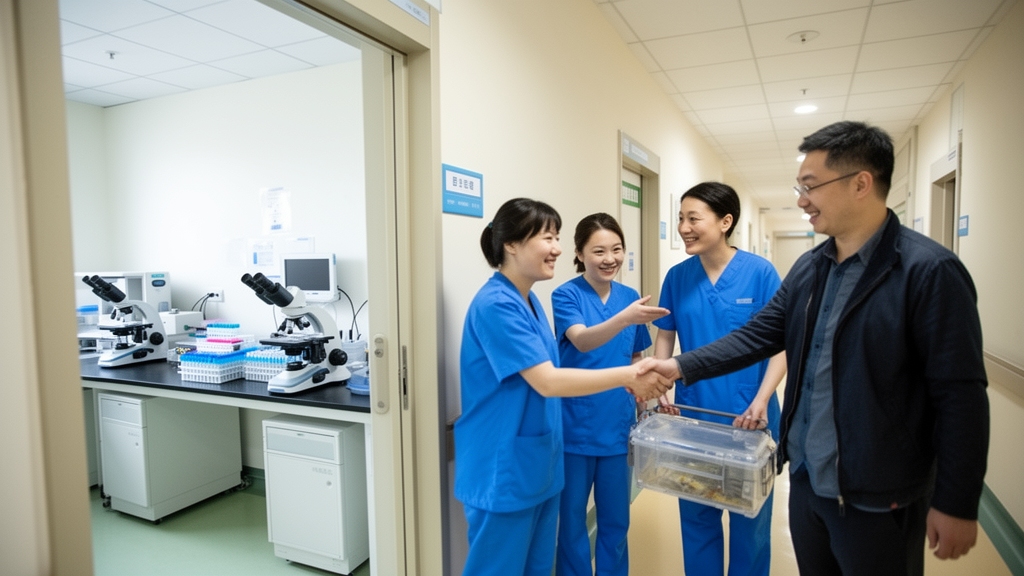
Medical staff in Chinese public hospitals showed broad willingness to engage in collaborative innovation with biomedical firms, even though few reported that their hospital had an established practice or had personally participated. In a cross-sectional survey conducted from June 8 to September 8, 2023, 810 medical staff working in public hospitals across 21 Chinese provinces completed questionnaires. Only 18.8% reported existing hospital-level collaborative innovation, while 6.7%, or 54 of 810 respondents, said they had personal participation experience. In contrast, 650 respondents, or 80.2%, expressed willingness to engage. The results document a substantial difference between staff interest and reported institutional practice.
The study examined two related outcomes: whether hospitals already had collaborative innovation practices and whether individual medical staff were willing to participate. Its conceptual approach combined the Diffusion of Innovations and Organizational Readiness for Change frameworks, which were used to organize the analysis around factors such as adopter characteristics, perceived innovation attributes and organizational readiness. Researchers used descriptive statistics, chi-squared tests and logistic regression to identify characteristics associated with existing practice and willingness. Participants were recruited through convenience and snowball methods, so the results describe the surveyed public-hospital staff rather than all hospitals or health workers in China.
Reported hospital-level practice was associated with professional role, perceived disadvantages and institutional status. Nurses had higher odds of reporting existing collaborative practice than the reference group, with an odds ratio of 1.919. Staff who perceived more disadvantages associated with collaboration also had higher odds of reporting such practice, with an odds ratio of 1.135, while employees of hospitals that were not classified as research hospitals had nearly twice the odds of reporting it compared with staff in research hospitals, with an odds ratio of 1.924. These cross-sectional associations do not show that any of the measured characteristics caused collaboration to develop or that the same pattern would be found in a representative sample of Chinese hospitals.
Willingness to participate had a different pattern of associations. Compared with respondents aged 20–29, those aged 30–39 had lower odds of expressing willingness, with an odds ratio of 0.445, and those aged 50 or older had lower odds still, at 0.230. Stronger perceptions of the role of hospitals in collaborative innovation were associated with greater willingness, with an odds ratio of 1.240, as were stronger perceptions of the role of individual staff members, at 1.285. Department was also associated with willingness: surgeons had lower odds than internal-medicine staff, with an odds ratio of 0.473, and general practitioners had lower odds still, at 0.165. The study therefore identified demographic, attitudinal and professional differences in stated willingness rather than a uniform level of interest across the workforce.
The authors said that bridging the gap between individual willingness and limited organizational practice would require clearer communication about the dual roles of collaborative innovation, including its relevance to hospital development and individual career growth. They also emphasized acknowledging the disadvantages of collaboration, providing institutional support for staff dealing with those disadvantages, and reforming promotion criteria that undervalue industry collaboration relative to traditional academic metrics. The analysis does not establish that willingness will translate into future participation, nor does it demonstrate that the proposed organizational or promotion reforms will increase collaboration. Its findings instead provide a cross-sectional snapshot in which staff willingness is high but reported hospital-level practice and personal participation remain limited.
Subject of Research: Cross-sectional assessment of hospital–biomedical firm collaboration and medical-staff willingness in Chinese public hospitals
Article Title: Collaborative innovation between hospitals and biomedical firms in China: a cross-sectional study of practice and willingness from the perspective of medical staff
Article References: Yu, W., Liu, X., Tsomo, T., Dai, M., Xiao, T., Tian, J., Zou, H., Liu, Y., Xu, Y., Jia, W., & Ge, Y. (2026). Collaborative innovation between hospitals and biomedical firms in China: a cross-sectional study of practice and willingness from the perspective of medical staff. BMC Health Services Research. https://doi.org/10.1186/s12913-026-15591-y
Image Credits: AI Generated
DOI: 10.1186/s12913-026-15591-y
Keywords: hospital–industry collaboration, biomedical firms, medical staff, public hospitals, China, cross-sectional survey, organizational readiness, innovation diffusion, willingness to participate, health services research, Collaborative, innovation
Cite Scienmag News
Ophelia Keating. (October 26, 2026). Chinese hospital staff welcome biomedical collaboration despite limited practice. Scienmag. https://scienmag.com/chinese-hospital-staff-welcome-biomedical-collaboration-despite-limited-practice/
Ophelia Keating. "Chinese hospital staff welcome biomedical collaboration despite limited practice." Scienmag, 26 October 2026, https://scienmag.com/chinese-hospital-staff-welcome-biomedical-collaboration-despite-limited-practice/. Accessed 26 October 2026.
Ophelia Keating. "Chinese hospital staff welcome biomedical collaboration despite limited practice." Scienmag. October 26, 2026. https://scienmag.com/chinese-hospital-staff-welcome-biomedical-collaboration-despite-limited-practice/


