


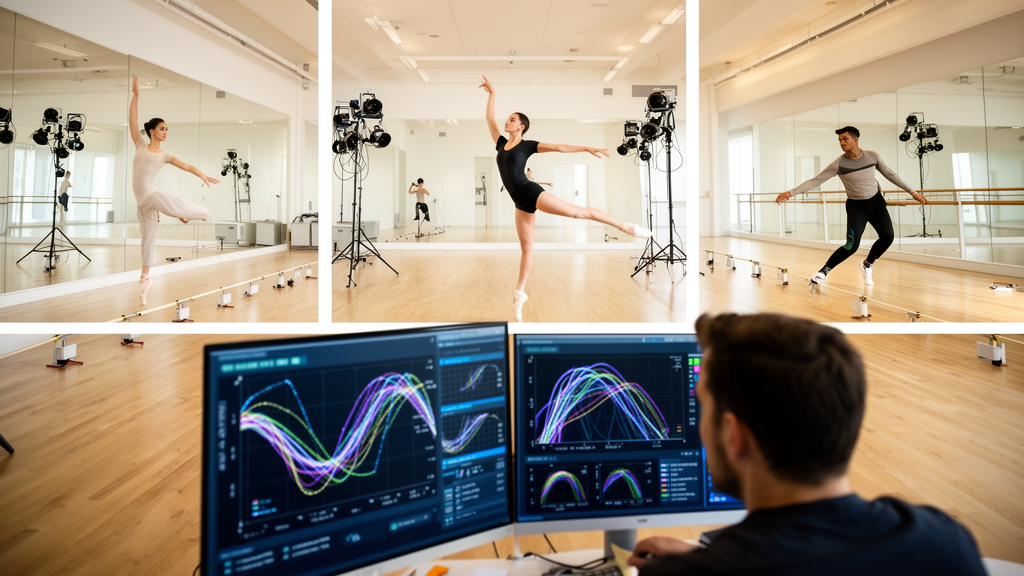
A computer-vision system trained with causal inference and invariant learning produced more reliable dance movement quality scores when tested across unfamiliar dancers and recording conditions in a machine-learning study involving 125 performers. The Causal Invariant Dance Evaluation System, or CIDES, reached 92.5% evaluation accuracy on a known test set and reduced average absolute error by 38.7% relative to the strongest baseline in a cross-domain evaluation. Its reported correlation coefficient remained above 89.1%, with a 95% confidence interval of 87.5% to 90.7%.
The experiments support robustness within the study’s datasets and test design; they did not constitute a classroom trial or establish that the system could replace dance teachers. The research, published in 2026, addresses a weakness of conventional deep-learning systems for dance evaluation: they can learn correlations tied to a particular performer, costume, background, or lighting setup rather than the mechanics of movement itself. Such spurious associations may appear useful during known-domain testing but fail when a system encounters a new dancer or scene.
The proposed approach begins from the assumption that movement quality should remain comparatively stable when superficial conditions change. In that model, domain and environmental variables are treated as potential confounders, while a core feature is defined as a representation intended to remain informative about the movement-quality score across environments. Video data were converted into time-series sequences of three-dimensional skeletal keypoints using a Microsoft Kinect V2 depth sensor and a supporting pose-estimation algorithm.
The self-constructed dataset included more than 18,000 samples from 125 dancers of varying technical ability, each performing standardized routines under five differentiated lighting and background conditions. Spatial information from the keypoints included the geometric relationships and angles between joints, while temporal information described aspects such as rhythm, fluency, and stability. The system trained two parallel encoders: one sought features intended to be causally associated with the expert-assigned quality score, while the other captured variation associated with domain factors.
A reconstruction objective preserved information needed to reproduce an input, while a dependence penalty discouraged the two representations from encoding the same information. This separation was intended to keep irrelevant visual or stylistic variation from propagating into the final score. The second major component applied invariant risk minimization across environments defined using dancer identity and scene lighting.
Rather than minimizing prediction error within each environment alone, the training objective penalized differences in how prediction errors changed from one environment to another. The mathematical objective combined the sum of environmental risks with a term representing variance in risk gradients across environments. The implementation also aligned each environment’s predictive distribution with an anchor distribution and matched core-feature distributions across domains using maximum mean discrepancy.
In simplified terms, the system was rewarded not only for predicting expert scores accurately, but also for using relationships that behaved consistently as performers and visual conditions changed. The modules were trained jointly with the score-prediction loss, while the domain encoder was discarded at inference so that new movement sequences were scored through the core-feature pathway and shared predictor. On the known test set, CIDES achieved 92.5% evaluation accuracy, which the paper describes as comparable to mainstream deep-learning methods.
The more demanding cross-domain test showed a 38.7% reduction in average absolute error compared with the best-performing baseline. Additional analyses involving Human3.6M, CMU MoCap, NTU RGB+D, and DanceDB reported that the full model produced the lowest cross-domain mean squared error, averaging 62.3% below the baseline across those motion-capture datasets. Public-dataset quality scores were mapped to a normalized range from zero to one so that different annotation schemes could be compared.
Ablation tests also indicated that neither component was dispensable: removing invariant learning degraded cross-domain performance by more than 15%, while adding the causal module alone lowered error by roughly 30% to 40%. These comparisons concern the selected datasets and baseline systems, not performance across every type of dance or recording setup. The system’s behavior was also evaluated by difficulty level, from beginner through master.
CIDES and a causal-only model both reached an average absolute error of 0.59 at the master level, whereas the baseline error rose from 0.98 to 1.52 across the same range. In comparisons with expert ratings, predictions from the complete system showed positive correlation with scores from 20 to 80, but the underlying data remained scattered: error bars were reported at approximately ±3 to ±5 points for invariant learning, compared with ±5 to ±8 points for the broader comparison. The authors interpreted this tighter concentration as evidence of greater rating stability across performance levels, although the figures also show that agreement was not perfect.
A separate comparison reported a positive correlation of 0.6 to 0.8 for CIDES and domain-adaptation models in unknown environments, an improvement in positive-correlation stability of 40% compared with the baseline. Causal-effect analysis identified body balance as the most influential variable in the study’s analysis of movement characteristics, with a reported confidence interval of 0.47 to 0.57; the source does not provide a separate point estimate for that interval. Motion amplitude had an effect size of 0.45, emotional expression 0.41, and cadence consistency 0.38, with the confidence interval for cadence consistency reported as statistically significant.
These results connect the model’s emphasis on invariant movement characteristics to specific aspects of dance performance. In a separate feature-representation analysis, causal invariant features produced a trend-line slope 18% higher than traditional features for a given movement-complexity level, while the standard deviation of scores in the high-complexity region fell by 40%. The system was also reported to retain more than 92% classification accuracy under fluctuations of ±15% in rhythm stability and changes of ±30% in ambient lighting.
Computational results suggest that the added robustness did not require a prohibitive inference delay. Single-frame latency was 12.4 milliseconds, compared with a stated real-time response threshold of 33 milliseconds. The multi-task training procedure increased training time by approximately 15%, but the architecture retains only the core-feature encoder and shared predictor when producing a score.
The experiments used Python 3.8 and PyTorch 1.10, with training performed on a workstation containing an NVIDIA GeForce RTX 3090. Sensitivity analysis found that the cross-domain mean absolute error decreased and then increased as the invariant-learning weight rose from 0.1 to 1.0. Its minimum, 0.59, occurred near a weight of 0.5, while changes within the range of 0.3 to 0.7 produced less than a 1.5% variation in evaluation accuracy.
These timing results were measured in the reported experimental setup and do not establish latency in other hardware or live-classroom configurations. Several boundaries qualify the findings. The principal dataset was assembled by the researchers and included standardized routines performed by 125 dancers, so the tested range of choreography, camera placement, motion-capture quality, and expert-label variation may not represent live teaching or unrestricted dance.
Although external motion-capture datasets were used for generalization comparisons, the paper does not describe deployment with independent teachers, real-time student feedback, or long-term educational outcomes. The structural model depends on assumptions about which variables are core causes and which are domain-related; the reported associations do not by themselves establish that altering balance, amplitude, expression, or cadence would cause an expert score to change. The data are also available from the corresponding author by request rather than through a fully specified public repository in the article.
Accordingly, the results demonstrate improved robustness within the study’s data and test design, not proof that the system can provide valid pedagogical judgments in every setting. Taken together, the study presents a machine-learning approach to making automated dance scoring less dependent on the circumstances in which a performance was recorded. Its central design combines explicit feature disentanglement with consistency penalties across multiple training environments, followed by a simpler inference path that discards the domain encoder.
That design produced clear advantages in the reported cross-domain comparisons, especially where conventional baselines deteriorated as performers or conditions changed. The results also show that causal assumptions and domain-generalization objectives can be translated into a working computer-vision pipeline for human movement assessment. Whether CIDES can preserve those gains in real dance studios, with new teachers, freer choreography, and live video rather than controlled depth-sensor capture, remains untested, but the experiments offer a quantified account of where the system improved and where its evidence stops.
Subject of Research: Robust machine-learning evaluation of dance movement quality across changing performers and recording environments
Article Title: Research on robustness evaluation system of dance movement quality based on causal inference and invariant learning
Article References: Feng, Y. (2026). Research on robustness evaluation system of dance movement quality based on causal inference and invariant learning. Discover Artificial Intelligence, 6(1), Article 1165. https://doi.org/10.1007/s44163-026-02223-x
Image Credits: AI Generated
DOI: 10.1007/s44163-026-02223-x
Keywords: dance assessment, causal inference, invariant learning, computer vision, domain generalization, movement quality, skeleton keypoints, expert ratings, machine learning, cross-domain evaluation, Research, robustness
Cite Scienmag News
Blake Davidson. (October 26, 2026). Causal AI improves cross-domain dance scoring in 125-dancer study. Scienmag. https://scienmag.com/causal-ai-improves-cross-domain-dance-scoring-in-125-dancer-study/
Blake Davidson. "Causal AI improves cross-domain dance scoring in 125-dancer study." Scienmag, 26 October 2026, https://scienmag.com/causal-ai-improves-cross-domain-dance-scoring-in-125-dancer-study/. Accessed 26 October 2026.
Blake Davidson. "Causal AI improves cross-domain dance scoring in 125-dancer study." Scienmag. October 26, 2026. https://scienmag.com/causal-ai-improves-cross-domain-dance-scoring-in-125-dancer-study/


