

Monday, October 26, 2026
Science
No Result
View All Result
  • Login
  • HOME
  • SCIENCE NEWS
  • CONTACT US
  • HOME
  • SCIENCE NEWS
  • CONTACT US
No Result
View All Result
Scienmag
No Result
View All Result
Home Science News Chemistry

Zeolite pores enable ligand-free olefin carbonylation

October 26, 2026
in Chemistry
Bethany Barker
By Bethany Barker Scienmag Editorial Profile - Catalysis
Reading Time: 2 mins read
0
Zeolite pores enable ligand-free olefin carbonylation

Zeolite pores enable ligand-free olefin carbonylation

65
SHARES
587
VIEWS
Share on FacebookShare on Twitter
ADVERTISEMENT

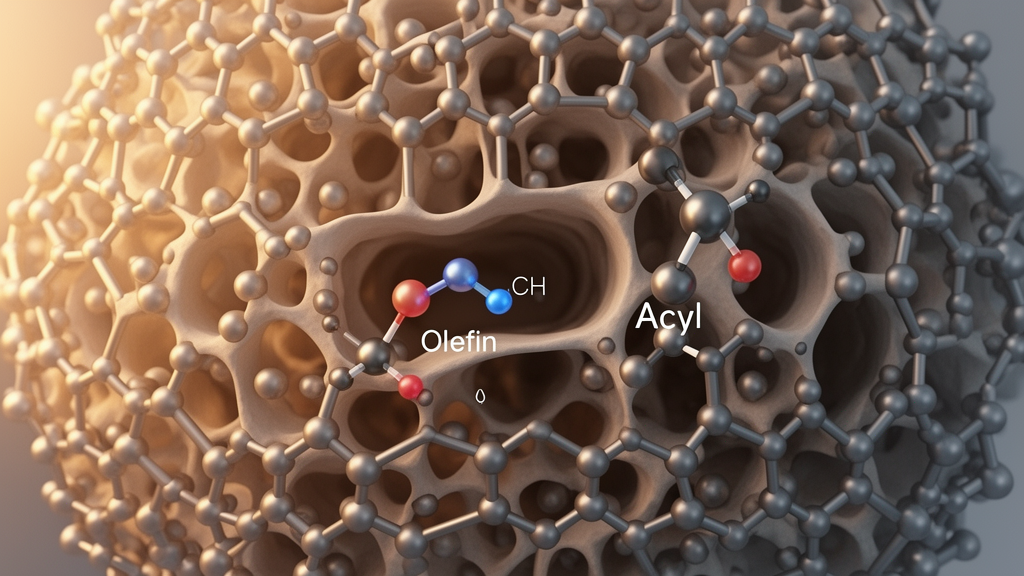
Researchers at the Dalian Institute of Chemical Physics of the Chinese Academy of Sciences have demonstrated two olefin carbonylation reactions catalyzed by zeolites without precious metals or organic ligands: the conversion of propene to isobutyric acid and the conversion of ethene to propionic acid. Both processes also proceeded in the presence of water, according to the team’s peer-reviewed study in Nature. The findings indicate that the size and position of pores within a zeolite can determine which olefins undergo carbonylation and which reaction pathway is favored.

“Zeolite-catalysed olefin carbonylation based on tuning spatial confinement” describes a catalyst design strategy that uses the material’s confined architecture as an active component of the reaction. The researchers found that active sites near the openings of ten-membered rings catalyzed propene carbonylation, whereas sites associated with eight-membered-ring cages catalyzed ethene carbonylation. This matching between pore geometry and the reactant appears to promote the desired reaction while suppressing a competing pathway: olefin polymerization.

Industrial carbonylation systems commonly use precious metals such as rhodium or iridium together with organic ligands to control catalytic activity and selectivity. The new zeolite processes instead rely on the dimensions and spatial arrangement of pores and channels within a crystalline solid. In propene carbonylation, for example, the confined environment facilitated formation of isobutyric acid; in ethene carbonylation, it supported production of propionic acid. Because the catalyst is a solid rather than a liquid-phase catalyst, it may also be easier to separate from reaction products, potentially simplifying catalyst recovery and product purification.

The study builds on work from the same team in 2017, when zeolites were used for carbonylation of dimethyl ether in a process that enabled large-scale industrial production of anhydrous ethanol. That earlier result showed that zeolites could function as catalysts rather than only as molecular sieves. The researchers subsequently explored whether their pore environments could support additional carbonylation chemistry and whether a general relationship could be established between architecture and selectivity. The two newly demonstrated reactions suggest that this approach may provide a framework for discovering and designing further zeolite-catalyzed transformations, although the study does not establish performance across the full range of possible olefins or operating conditions.

Subject of Research: Zeolite pore architecture for selective olefin carbonylation

Article Title: Zeolite pore architecture unlocks new olefin carbonylation reactions

Article References: Zeolite pore architecture unlocks new olefin carbonylation reactions. Original publication (Bibliographic details unavailable.)

Image Credits: AI Generated

DOI: Not provided

Keywords: zeolites, olefin carbonylation, isobutyric acid, propionic acid, spatial confinement, selective catalysis, porous materials, catalyst design, chemical synthesis, Zeolite, pore, architecture

Cite Scienmag News

Bethany Barker. (October 26, 2026). Zeolite pores enable ligand-free olefin carbonylation. Scienmag. https://scienmag.com/zeolite-pores-enable-ligand-free-olefin-carbonylation/

Bethany Barker. "Zeolite pores enable ligand-free olefin carbonylation." Scienmag, 26 October 2026, https://scienmag.com/zeolite-pores-enable-ligand-free-olefin-carbonylation/. Accessed 26 October 2026.

Bethany Barker. "Zeolite pores enable ligand-free olefin carbonylation." Scienmag. October 26, 2026. https://scienmag.com/zeolite-pores-enable-ligand-free-olefin-carbonylation/


Tags: architecturecatalyst designchemical synthesisethene to propionic acid via zeolite catalystsisobutyric acidligand-free olefin carbonylation reactionsnon-metallic catalytic pathways for acetic acid synthesisolefin carbonylationPorepore architecture influence on olefin transformationporous materialspropionic acidselective catalysisspatial confinementspatial confinement in zeolite catalysissuppression of olefin polymerization inwater-compatible olefin carbonylation processeszeoliteZeolite catalyst design for olefin carbonylationzeolite pore size and reaction selectivityzeolite-catalyzed conversion of propene to isobutyric acidzeolites
Share26Tweet16
Previous Post

Cytokine profile links occult hepatitis B to six elevated growth factors

Next Post

Varna canal measurements reveal hazardous short-period water oscillations

Related Posts

Varna canal measurements reveal hazardous short-period water oscillations
Chemistry

Varna canal measurements reveal hazardous short-period water oscillations

October 26, 2026
Liquid membranes bend 100 times more easily than lipid membranes
Chemistry

Liquid membranes bend 100 times more easily than lipid membranes

October 26, 2026
Stanford team observes first real-time quantum jump in sound
Chemistry

Stanford team observes first real-time quantum jump in sound

October 26, 2026
Layered magnetic crystal converts microwaves into optical signals
Chemistry

Layered magnetic crystal converts microwaves into optical signals

October 26, 2026
Sandia-Led AI Project Targets Uncertainty in Turbulent Flow Models
Chemistry

Sandia-Led AI Project Targets Uncertainty in Turbulent Flow Models

October 26, 2026
Quasi-BIC design improves quantum-well photodetection for machine vision
Chemistry

Quasi-BIC design improves quantum-well photodetection for machine vision

October 26, 2026
Next Post
Varna canal measurements reveal hazardous short-period water oscillations

Varna canal measurements reveal hazardous short-period water oscillations

  • Mothers who receive childcare support from maternal grandparents show more optimized

    Mothers who receive childcare support from maternal grandparents show more parental warmth, finds NTU Singapore study

    27656 shares
    Share 11059 Tweet 6912
  • University of Seville Breaks 120-Year-Old Mystery, Revises a Key Einstein Concept

    1061 shares
    Share 424 Tweet 265
  • Bee body mass, pathogens and local climate influence heat tolerance

    682 shares
    Share 273 Tweet 171
  • Researchers record first-ever images and data of a shark experiencing a boat strike

    546 shares
    Share 218 Tweet 137
  • Groundbreaking Clinical Trial Reveals Lubiprostone Enhances Kidney Function

    531 shares
    Share 212 Tweet 133
Science

Embark on a thrilling journey of discovery with Scienmag.com—your ultimate source for cutting-edge breakthroughs. Immerse yourself in a world where curiosity knows no limits and tomorrow’s possibilities become today’s reality!

RECENT NEWS

  • AI, Green Resources and Semiconductor Markets Form a Tightly Linked Financial Network
  • Aboriginal early years workers identify priorities for infant nutrition and active play
  • Pooled healthy-person urine reveals urinary N-glycan diversity by reversed-phase LC/MS/MS
  • Varna canal measurements reveal hazardous short-period water oscillations

Categories

  • Agriculture
  • Anthropology
  • Archaeology
  • Athmospheric
  • Biology
  • Biotechnology
  • Blog
  • Bussines
  • Cancer
  • Chemistry
  • Climate
  • Earth Science
  • Editorial Policy
  • Marine
  • Mathematics
  • Medicine
  • Pediatry
  • Policy
  • Psychology & Psychiatry
  • Science Education
  • Science News
  • Social Science
  • Space
  • Technology and Engineering

Subscribe to Blog via Email

Enter your email address to subscribe to this blog and receive notifications of new posts by email.

Join 5,151 other subscribers

© 2025 Scienmag - Science Magazine

Welcome Back!

Login to your account below

Forgotten Password?

Retrieve your password

Please enter your username or email address to reset your password.

Log In
No Result
View All Result
  • HOME
  • SCIENCE NEWS
  • CONTACT US

© 2025 Scienmag - Science Magazine

Discover more from Science

Subscribe now to keep reading and get access to the full archive.

Continue reading