

Monday, October 26, 2026
Science
No Result
View All Result
  • Login
  • HOME
  • SCIENCE NEWS
  • CONTACT US
  • HOME
  • SCIENCE NEWS
  • CONTACT US
No Result
View All Result
Scienmag
No Result
View All Result
Home Science News Chemistry

Pilot system co-produces hydrogen and fresh water from seawater

October 26, 2026
in Chemistry
Bethany Barker
By Bethany Barker Scienmag Editorial Profile - Catalysis
Reading Time: 2 mins read
0
Pilot system co-produces hydrogen and fresh water from seawater

Pilot system co-produces hydrogen and fresh water from seawater

65
SHARES
587
VIEWS
Share on FacebookShare on Twitter
ADVERTISEMENT

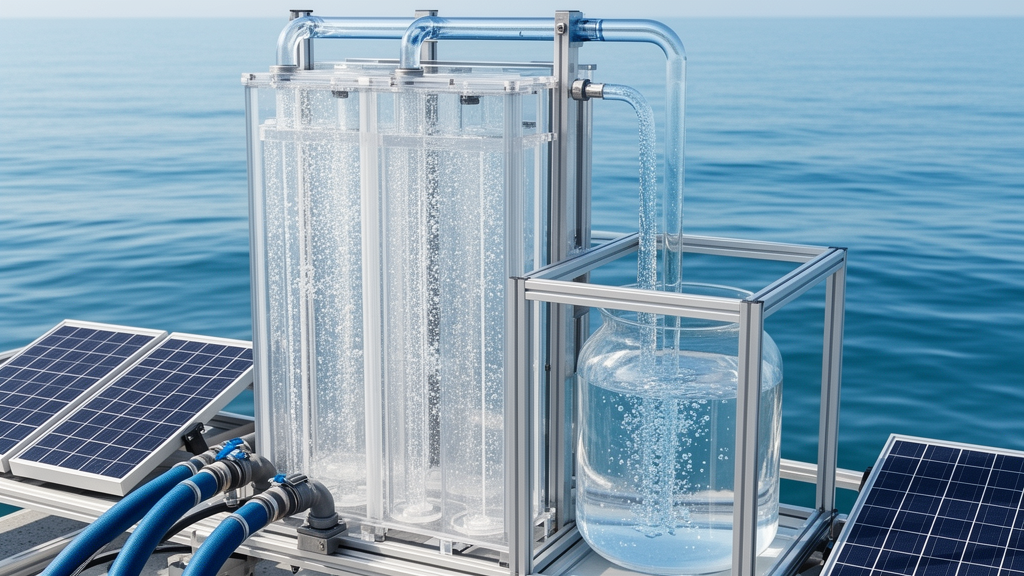
A 250-kilowatt experimental system co-produced hydrogen and fresh water from seawater by using low-grade waste heat from alkaline water electrolysis to drive low-temperature vacuum distillation. The system produced hydrogen at 48 normal cubic metres per hour and fresh water at 31.6 kilograms per hour, while improving electrical efficiency by 14.4% compared with conventional alkaline electrolysis using fresh water alone.

The demonstration was developed by a team led by Prof. Deng Dehui and Associate Prof. Liu Yanting from the Dalian Institute of Chemical Physics at the Chinese Academy of Sciences. Published in Nature Energy on September 15, the experimental study introduced a “seawater to hydrogen and fresh water” route, abbreviated STHW. In this configuration, alkaline water electrolysis generates hydrogen and releases heat that would otherwise be lost as low-grade waste. The recovered heat supplies energy for seawater desalination, and part of the resulting fresh water is returned to the electrolysis process while the remainder is available for external use.

Researchers first evaluated the route in a 20-kilowatt industrial pilot system. That system achieved a hydrogen productivity of 3.8 normal cubic metres per hour and co-produced 1.2 kilograms of fresh water per hour. It operated stably for 100 days. The duration applies to the 20-kilowatt pilot, not the later 250-kilowatt system. Together, the two experimental scales demonstrated the basic process at different sizes, but the supplied research report does not provide a comparable duration of continuous operation for the 250-kilowatt installation.

At the larger scale, the 250-kilowatt system produced both high-purity hydrogen and fresh water at the rates reported above. Its 14.4% electrical-efficiency improvement was measured against conventional alkaline electrolysis using fresh water alone. This comparison concerns the operating conditions tested in the study and does not by itself establish performance at utility scale, long-term durability under other conditions, or commercial viability. The work was an engineering demonstration of coupled electrolysis and desalination rather than an assessment of the technology across multiple industrial sites.

The process also generates concentrated brine after desalination. The researchers identified salt, uranium and bromine as resources that could potentially be recovered from this stream, but the supplied report does not specify recovery yields or document the performance of separate downstream extraction processes. The central experimental result is therefore the simultaneous production of hydrogen and usable fresh water through heat integration: the 20-kilowatt pilot sustained operation for 100 days, and the 250-kilowatt system reached reported output rates of 48 normal cubic metres of hydrogen and 31.6 kilograms of fresh water per hour. The study presents a pathway for making electrolysis waste heat perform useful desalination work while adding a fresh-water output, while further evidence would be needed to establish deployment readiness.

Subject of Research: Experimental seawater electrolysis and vacuum distillation for hydrogen and fresh-water co-production

Article Title: New strategy enables co-production of hydrogen and fresh water from seawater

Article References: New strategy enables co-production of hydrogen and fresh water from seawater. Original publication (Bibliographic details unavailable.)

Image Credits: AI Generated

DOI: Not provided

Keywords: seawater electrolysis, green hydrogen, freshwater production, waste heat recovery, vacuum distillation, alkaline electrolysis, desalination, pilot scale, electrical efficiency, concentrated brine, strategy, enables

Cite Scienmag News

Bethany Barker. (October 26, 2026). Pilot system co-produces hydrogen and fresh water from seawater. Scienmag. https://scienmag.com/pilot-system-co-produces-hydrogen-and-fresh-water-from-seawater/

Bethany Barker. "Pilot system co-produces hydrogen and fresh water from seawater." Scienmag, 26 October 2026, https://scienmag.com/pilot-system-co-produces-hydrogen-and-fresh-water-from-seawater/. Accessed 26 October 2026.

Bethany Barker. "Pilot system co-produces hydrogen and fresh water from seawater." Scienmag. October 26, 2026. https://scienmag.com/pilot-system-co-produces-hydrogen-and-fresh-water-from-seawater/


Tags: alkaline electrolysisalkaline water electrolysis innovationsco-generation of fresh water and hydrogenconcentrated brinedesalinationelectrical efficiencyenablesenergy-efficient seawater electrolysisenvironmentally friendly hydrogen production methodsexperimental hydrogen production systemsfreshwater productiongreen hydrogenintegrated hydrogen and water generation technologylow-temperature vacuum distillation for desalinationpilot scalepilot-scale seawater electrolysis demonstrationseawater desalination using waste heatSeawater electrolysisSeawater hydrogen productionStrategysustainable hydrogen and water supplyvacuum distillationwaste heat recoverywaste heat utilization in electrolysis
Share26Tweet16
Previous Post

Montreal travel shifted modestly during wildfire smoke advisories

Next Post

Early gut microbiome plateau linked to threefold type 1 diabetes risk

Related Posts

Dual-View Microscope Records Neuronal Activity in 3D at 100 Hz
Chemistry

Dual-View Microscope Records Neuronal Activity in 3D at 100 Hz

October 26, 2026
CMS search tightens limits on quantum black holes at LHC
Chemistry

CMS search tightens limits on quantum black holes at LHC

October 26, 2026
SUNY advances barrier-layer control for photonic integrated circuits
Chemistry

SUNY advances barrier-layer control for photonic integrated circuits

October 26, 2026
Research report: New doping method could boost the performance of organic semiconductors
Chemistry

Research report: New doping method could boost the performance of organic semiconductors

October 26, 2026
KIT Photonics Teams Named Finalists for Germany’s Future Prize
Chemistry

KIT Photonics Teams Named Finalists for Germany’s Future Prize

October 26, 2026
Würzburg VR laser lab wins German Physical Society teaching prize
Chemistry

Würzburg VR laser lab wins German Physical Society teaching prize

October 26, 2026
Next Post
Early gut microbiome plateau linked to threefold type 1 diabetes risk

Early gut microbiome plateau linked to threefold type 1 diabetes risk

  • Mothers who receive childcare support from maternal grandparents show more optimized

    Mothers who receive childcare support from maternal grandparents show more parental warmth, finds NTU Singapore study

    27656 shares
    Share 11059 Tweet 6912
  • University of Seville Breaks 120-Year-Old Mystery, Revises a Key Einstein Concept

    1061 shares
    Share 424 Tweet 265
  • Bee body mass, pathogens and local climate influence heat tolerance

    682 shares
    Share 273 Tweet 171
  • Researchers record first-ever images and data of a shark experiencing a boat strike

    546 shares
    Share 218 Tweet 137
  • Groundbreaking Clinical Trial Reveals Lubiprostone Enhances Kidney Function

    531 shares
    Share 212 Tweet 133
Science

Embark on a thrilling journey of discovery with Scienmag.com—your ultimate source for cutting-edge breakthroughs. Immerse yourself in a world where curiosity knows no limits and tomorrow’s possibilities become today’s reality!

RECENT NEWS

  • Early gut microbiome plateau linked to threefold type 1 diabetes risk
  • Pilot system co-produces hydrogen and fresh water from seawater
  • Montreal travel shifted modestly during wildfire smoke advisories
  • SUNY funds Binghamton AI cancer diagnostics and RNA delivery research

Categories

  • Agriculture
  • Anthropology
  • Archaeology
  • Athmospheric
  • Biology
  • Biotechnology
  • Blog
  • Bussines
  • Cancer
  • Chemistry
  • Climate
  • Earth Science
  • Editorial Policy
  • Marine
  • Mathematics
  • Medicine
  • Pediatry
  • Policy
  • Psychology & Psychiatry
  • Science Education
  • Science News
  • Social Science
  • Space
  • Technology and Engineering

Subscribe to Blog via Email

Enter your email address to subscribe to this blog and receive notifications of new posts by email.

Join 5,151 other subscribers

© 2025 Scienmag - Science Magazine

Welcome Back!

Login to your account below

Forgotten Password?

Retrieve your password

Please enter your username or email address to reset your password.

Log In
No Result
View All Result
  • HOME
  • SCIENCE NEWS
  • CONTACT US

© 2025 Scienmag - Science Magazine

Discover more from Science

Subscribe now to keep reading and get access to the full archive.

Continue reading