

Monday, October 26, 2026
Science
No Result
View All Result
  • Login
  • HOME
  • SCIENCE NEWS
  • CONTACT US
  • HOME
  • SCIENCE NEWS
  • CONTACT US
No Result
View All Result
Scienmag
No Result
View All Result
Home Science News Technology and Engineering

Kinematic Model Tests Ductile-Hinge Layouts for Curved Bridge Launching

October 26, 2026
in Technology and Engineering
Denise Maddox
By Denise Maddox Scienmag Editorial Profile - Mechanical Engineering
Reading Time: 2 mins read
0
Kinematic Model Tests Ductile-Hinge Layouts for Curved Bridge Launching

Kinematic Model Tests Ductile-Hinge Layouts for Curved Bridge Launching

65
SHARES
587
VIEWS
Share on FacebookShare on Twitter
ADVERTISEMENT

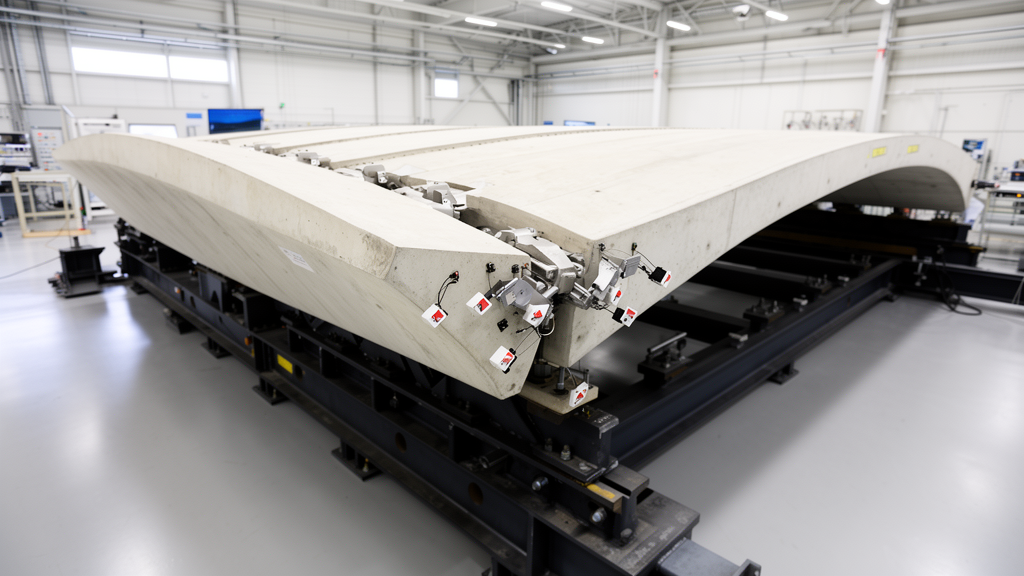
A geometric-kinematic modeling study combined with a dual-strategy heuristic screening method to evaluate ductile-hinge layouts for multi-body coordinated incremental launching of spatially curved bridges. The work focused on a 1,991-metre steel box-girder viaduct weighing 36,000 tonnes, a construction arrangement intended for bridge projects where site constraints limit conventional launching conditions.

The framework represents bridge segments as composite rigid bodies and updates their positions through chainage-based boundary lookup. Spatial posture is calculated with a safeguarded endpoint-based Rodrigues transformation, allowing the model to track how the coordinated system changes as the launching sequence proceeds. The study presents the approach as a quantitative pre-construction tool rather than as a field demonstration.

To screen potential hinge arrangements, the researchers combined a proximity rule for detecting lateral-deviation exceedances with a global assessment of candidates associated with height-difference exceedances. The heuristic was designed to identify feasible layouts with fewer ductile hinges. In the reported case, one simulation containing 772 states took approximately 14 seconds, illustrating the computational efficiency sought by the model.

For the example viaduct, adding five hinges reduced the maximum lateral deviation from 2.997 metres to 0.911 metres. The maximum height difference fell from 1.727 metres to 0.586 metres. Internal geometric checks and convergence checks supported the numerical consistency of the simulations, while the fixed-layout test found that the selected arrangement remained within the stated 1.0-metre lateral-deviation and 0.8-metre height-difference constraints across 100 simulations with independent 10-millimetre coordinate perturbations.

These results show how a kinematic simulation can be linked to hinge-layout screening in an incremental-launching process for bridges with spatially variable curvature. The study does not establish performance in completed bridge projects, and the reported evidence is limited to modeling, numerical checks and perturbation simulations. Its contribution is a computational method for comparing layouts and quantifying changes in geometric deviations before construction, with the authors describing the approach as a design tool for multi-body coordinated incremental launching of spatially curved bridges.

Subject of Research: Computational screening of ductile-hinge layouts for spatially curved bridge launching

Article Title: Kinematic modeling and dual-strategy heuristic screening of ductile hinge layout for multi-body coordinated incremental launching of spatial curve bridges

Article References: Zhang, X., Xiao, L., Li, M., Chen, L., Wang, M., Zheng, H., & Zhu, H. (2026). Kinematic modeling and dual-strategy heuristic screening of ductile hinge layout for multi-body coordinated incremental launching of spatial curve bridges. Scientific Reports. https://doi.org/10.1038/s41598-026-76812-2

Image Credits: AI Generated

DOI: 10.1038/s41598-026-76812-2

Keywords: bridge engineering, incremental launching, ductile hinges, kinematic modeling, curved bridges, composite rigid bodies, geometric deviation, construction design, steel box girders, Kinematic, modeling, dual-strategy

Cite Scienmag News

Denise Maddox. (October 26, 2026). Kinematic Model Tests Ductile-Hinge Layouts for Curved Bridge Launching. Scienmag. https://scienmag.com/kinematic-model-tests-ductile-hinge-layouts-for-curved-bridge-launching/

Denise Maddox. "Kinematic Model Tests Ductile-Hinge Layouts for Curved Bridge Launching." Scienmag, 26 October 2026, https://scienmag.com/kinematic-model-tests-ductile-hinge-layouts-for-curved-bridge-launching/. Accessed 26 October 2026.

Denise Maddox. "Kinematic Model Tests Ductile-Hinge Layouts for Curved Bridge Launching." Scienmag. October 26, 2026. https://scienmag.com/kinematic-model-tests-ductile-hinge-layouts-for-curved-bridge-launching/


Tags: bridge engineeringchainage-based boundary lookup in bridge designcomposite rigid bodiescomposite rigid body bridge modelingcomputational efficiency in bridge launching simulationsconstruction designcurved bridge launching simulationcurved bridgesdual-strategyductile hingesductile-hinge layout optimizationgeometric deviationgeometric-kinematic modeling for bridge constructionheight difference control in bridge segment movementheuristic screening for hinge placementincremental launchingkinematickinematic modelinglateral deviation reduction in curved bridge launchModelingmulti-body system analysis for bridge segmentsRodrigues transformation in bridge kinematicsspatially curved bridge incremental launchingsteel box girders
Share26Tweet16
Previous Post

Higher Platelet-to-White Blood Cell Ratio Linked to Survival in HFpEF

Next Post

Finite-element study maps stresses around 4-mm ultra-short dental implants

Related Posts

Sentinel-node gastrectomy linked to better five-year pancreatic volume preservation
Technology and Engineering

Sentinel-node gastrectomy linked to better five-year pancreatic volume preservation

October 26, 2026
Attention-enhanced YOLOv8s advances photovoltaic defect detection
Technology and Engineering

Attention-enhanced YOLOv8s advances photovoltaic defect detection

October 26, 2026
Thicker walls and more openings raise bending loads in PLA specimens
Technology and Engineering

Thicker walls and more openings raise bending loads in PLA specimens

October 26, 2026
Semantic Labels Guide Terrain-Specific Humanoid Behavior in Simulation
Technology and Engineering

Semantic Labels Guide Terrain-Specific Humanoid Behavior in Simulation

October 26, 2026
Finite-element study maps stresses around 4-mm ultra-short dental implants
Technology and Engineering

Finite-element study maps stresses around 4-mm ultra-short dental implants

October 26, 2026
Higher Platelet-to-White Blood Cell Ratio Linked to Survival in HFpEF
Technology and Engineering

Higher Platelet-to-White Blood Cell Ratio Linked to Survival in HFpEF

October 26, 2026
Next Post
Finite-element study maps stresses around 4-mm ultra-short dental implants

Finite-element study maps stresses around 4-mm ultra-short dental implants

  • Mothers who receive childcare support from maternal grandparents show more optimized

    Mothers who receive childcare support from maternal grandparents show more parental warmth, finds NTU Singapore study

    27656 shares
    Share 11059 Tweet 6912
  • University of Seville Breaks 120-Year-Old Mystery, Revises a Key Einstein Concept

    1061 shares
    Share 424 Tweet 265
  • Bee body mass, pathogens and local climate influence heat tolerance

    682 shares
    Share 273 Tweet 171
  • Researchers record first-ever images and data of a shark experiencing a boat strike

    546 shares
    Share 218 Tweet 137
  • Groundbreaking Clinical Trial Reveals Lubiprostone Enhances Kidney Function

    531 shares
    Share 212 Tweet 133
Science

Embark on a thrilling journey of discovery with Scienmag.com—your ultimate source for cutting-edge breakthroughs. Immerse yourself in a world where curiosity knows no limits and tomorrow’s possibilities become today’s reality!

RECENT NEWS

  • Sentinel-node gastrectomy linked to better five-year pancreatic volume preservation
  • Traceability Linked to Modest Smallholder Price Gains and Export Readiness
  • Attention-enhanced YOLOv8s advances photovoltaic defect detection
  • Thicker walls and more openings raise bending loads in PLA specimens

Categories

  • Agriculture
  • Anthropology
  • Archaeology
  • Athmospheric
  • Biology
  • Biotechnology
  • Blog
  • Bussines
  • Cancer
  • Chemistry
  • Climate
  • Earth Science
  • Editorial Policy
  • Marine
  • Mathematics
  • Medicine
  • Pediatry
  • Policy
  • Psychology & Psychiatry
  • Science Education
  • Science News
  • Social Science
  • Space
  • Technology and Engineering

Subscribe to Blog via Email

Enter your email address to subscribe to this blog and receive notifications of new posts by email.

Join 5,151 other subscribers

© 2025 Scienmag - Science Magazine

Welcome Back!

Login to your account below

Forgotten Password?

Retrieve your password

Please enter your username or email address to reset your password.

Log In
No Result
View All Result
  • HOME
  • SCIENCE NEWS
  • CONTACT US

© 2025 Scienmag - Science Magazine

Discover more from Science

Subscribe now to keep reading and get access to the full archive.

Continue reading