


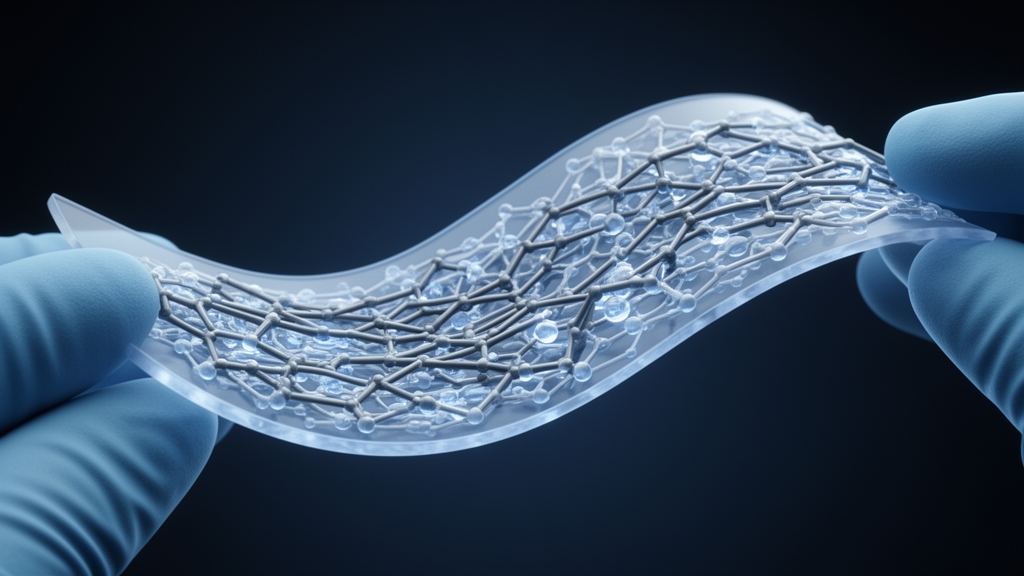
Flexible solar cells for satellites, aerospace vehicles, and emerging lightweight electronics face a persistent materials problem: the substrate that carries the photovoltaic film must be strong enough to survive repeated bending, yet light enough not to erode the power delivered per unit mass. Polyimide films have long served as the substrate of choice because they combine excellent thermal stability with mechanical flexibility, but their density, which can exceed 1.3 g cm−3, limits the specific power of the thin-film cells built on them. The obvious fix, introducing pores to shed weight, tends to undermine mechanical integrity, while conventional carbon nanotube reinforcement suffers from aggregation and weak bonding with the surrounding polymer. A team from Zhengzhou University of Light Industry, the Shanghai Institute of Space Power-Sources, Shanghai Ocean University, Shanghai Jiao Tong University, and the Shanghai Institute of Technology reports a design that resolves this strength–density dilemma.
The researchers built a coaxial hybrid in which a porous covalent organic framework (COF) shell is grown directly onto carboxylated multi-walled carbon nanotubes (MWCNTs) through a solvothermal process. These hybrids were then incorporated into a polyimide matrix by in situ polymerization, producing an interconnected, layered porous network. The division of labor within this architecture is deliberate: the carbon nanotubes act as mechanical reinforcement, while the covalently bonded COF shells improve interfacial compatibility with the polymer and facilitate stress transfer between the nanotubes and the matrix. Anchoring the COF to the nanotube surface suppresses nanotube aggregation, strengthens the composite interface, and introduces the porosity that lowers density, all without sacrificing the mechanical continuity that porous lightening usually destroys. Combined with the thermally stable molecular structure of polyimide itself, the design achieves lightweight construction while preserving robustness.
The measured properties of the optimized MWCNT–COF/PI film quantify how far the trade-off has been pushed. The composite reaches a tensile strength of 97.53 MPa and a Young’s modulus of 1.53 GPa, while its density falls to just 0.73 g cm−3, a 45.1% reduction compared with the unmodified polyimide film. The material also exhibits improved hydrophobicity and retains thermal stability, with no significant mass loss below 500 °C. The COF shells themselves show high thermal stability, consistent with the covalent organic framework chemistry used to form them.
To test whether the substrate can carry high-performance devices, the team used an ultrathin, 6 μm-thick composite film as the carrier for flexible gallium arsenide solar cells. Dual-junction and triple-junction GaAs cells fabricated on the film achieved power-conversion efficiencies of 26.6% and 31.5%, respectively, under AM0 illumination, the solar spectrum relevant to space applications. Because the substrate contributes so little mass, the specific power figures are striking: 8,998 W kg−1 for the dual-junction device and 7,749 W kg−1 for the triple-junction device. These values reflect the combination of high cell efficiency and the ultralight, mechanically sound film beneath it.
Mechanical durability was assessed by bending. After 2,000 bending cycles at a 10 mm radius, the devices retained excellent photovoltaic performance with minimal degradation, indicating that the composite substrate can withstand the repeated deformation expected of flexible power sources. The authors note that the COF-anchored nanotube strategy offers a promising route toward lightweight, durable substrates for flexible photovoltaics, and that by combining high mechanical strength, low density, thermal stability, and reliable photovoltaic performance, the composite films could support power systems for satellites, aerospace vehicles, and other mass-constrained applications. More broadly, the work illustrates how rational interfacial engineering and three-dimensional network design can address competing requirements in advanced polymer composites, providing a materials-design strategy for next-generation flexible electronic and energy devices. The study was published in Nano-Micro Letters on 10 August 2026.
Subject of Research: Materials Science
Article Title: Lightweight yet strong: a new foundation for high-power flexible solar cells
Article References: Lightweight yet strong: a new foundation for high-power flexible solar cells. Original publication (Bibliographic details unavailable.)
Image Credits: AI Generated
DOI: Not provided
Keywords: covalent organic frameworks, carbon nanotubes, polyimide films, flexible solar cells, gallium arsenide photovoltaics, lightweight composites, Lightweight, strong, foundation, high-power, flexible, solar
Cite Scienmag News
Grant Pearson. (October 26, 2026). Covalent Organic Framework Anchors Nanotubes in Ultralight Films for High-Power Flexible GaAs Solar Cells. Scienmag. https://scienmag.com/covalent-organic-framework-anchors-nanotubes-in-ultralight-films-for-high-power-flexible-gaas-solar-cells/
Grant Pearson. "Covalent Organic Framework Anchors Nanotubes in Ultralight Films for High-Power Flexible GaAs Solar Cells." Scienmag, 26 October 2026, https://scienmag.com/covalent-organic-framework-anchors-nanotubes-in-ultralight-films-for-high-power-flexible-gaas-solar-cells/. Accessed 26 October 2026.
Grant Pearson. "Covalent Organic Framework Anchors Nanotubes in Ultralight Films for High-Power Flexible GaAs Solar Cells." Scienmag. October 26, 2026. https://scienmag.com/covalent-organic-framework-anchors-nanotubes-in-ultralight-films-for-high-power-flexible-gaas-solar-cells/


