


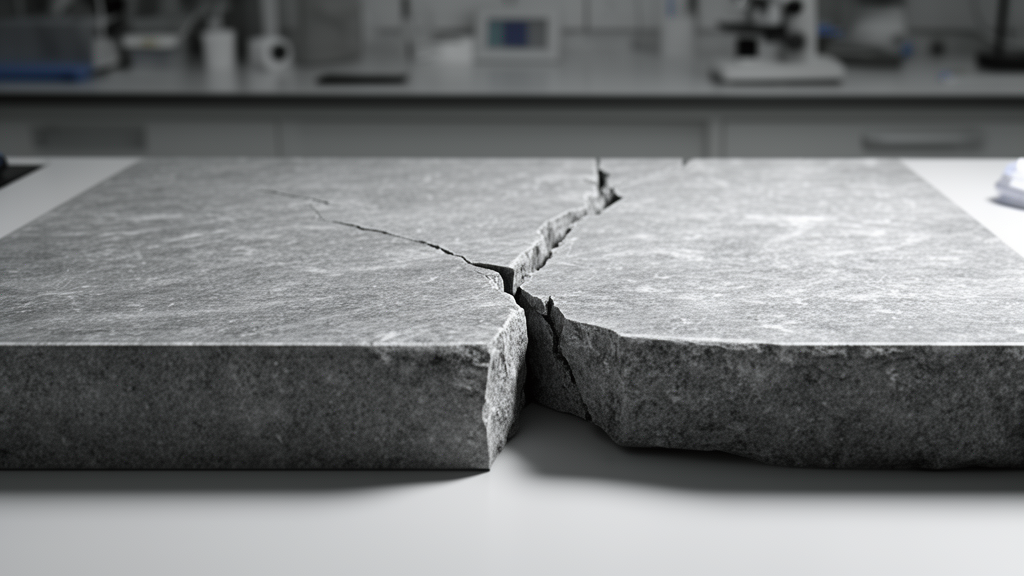
Researchers report that a calcite-based composite built around a traditional building stone known as kufeki or musselstone, dubbed “Sinan’s Stone,” can close deep surface scratches within 6 to 8 seconds without any added repair material. The finding, published in npj Heritage Science, describes a form of autogenous healing in which the damaged area repairs itself through mechanisms inherent to the material.
Autogenous healing is a self-repair process in which cracks or damaged zones are sealed without introducing external substances. In cementitious structures, this kind of crack repair arises partly from physical, mechanical, and chemical mechanisms acting together. The study set out to demonstrate effective and rapid autogenous healing using various microscopy techniques to observe the process directly.
The composite developed by the team combines cement, polyvinyl alcohol (PVA), chitosan, water, and other organic and inorganic additives. Its defining ingredient is finely ground and homogenized kufeki-musselstone powder, with particle sizes of 20 to 25 microns, which serves as the calcite component of the mixture.
When the researchers observed the composites under microscopy, healing began rapidly. Closure started at the bottom of a scratch or groove and progressed upward, gradually filling the damaged region. The complete process was recorded within 6 to 8 seconds, a speed the authors characterize as rapid self-healing.
The calcite-rich stone provides the calcium carbonate base that the composite’s other components bind and modify, forming the main composition developed in the research.
According to the authors, these novel composites are designed for potential use in restoring and repairing historical artifacts and other structures.
The study is a laboratory demonstration of healing behavior observed through microscopy, and the reported times and closure patterns apply to the scratches and grooves examined in the experiments. The published version is an early-release, peer-reviewed accepted article that remains subject to further editorial edits before the final Version of Record.
By pairing a heritage building stone with modern polymer and biopolymer additives, the work points toward restoration materials in which repair is built into the composite itself.
Subject of Research: Self-healing calcite-based composite materials for restoration of historical structures
Article Title: Calcite-based composite structure of Sinan stone for self-healing
Article References: Çetin, G., Ozbek, S., & Baykara, T. (2026). Calcite-based composite structure of Sinan stone for self-healing. npj Heritage Science. https://doi.org/10.1038/s40494-026-03079-1
Image Credits: AI Generated
DOI: 10.1038/s40494-026-03079-1
Keywords: autogenous healing, calcite, kufeki stone, Sinan's Stone, composite materials, self-healing, cementitious materials, polyvinyl alcohol, chitosan, heritage conservation, microscopy, npj Heritage Science
Cite Scienmag News
Courtney Benton. (October 26, 2026). Sinan stone composite heals its own cracks within seconds. Scienmag. https://scienmag.com/sinan-stone-composite-heals-its-own-cracks-within-seconds/
Courtney Benton. "Sinan stone composite heals its own cracks within seconds." Scienmag, 26 October 2026, https://scienmag.com/sinan-stone-composite-heals-its-own-cracks-within-seconds/. Accessed 26 October 2026.
Courtney Benton. "Sinan stone composite heals its own cracks within seconds." Scienmag. October 26, 2026. https://scienmag.com/sinan-stone-composite-heals-its-own-cracks-within-seconds/


