


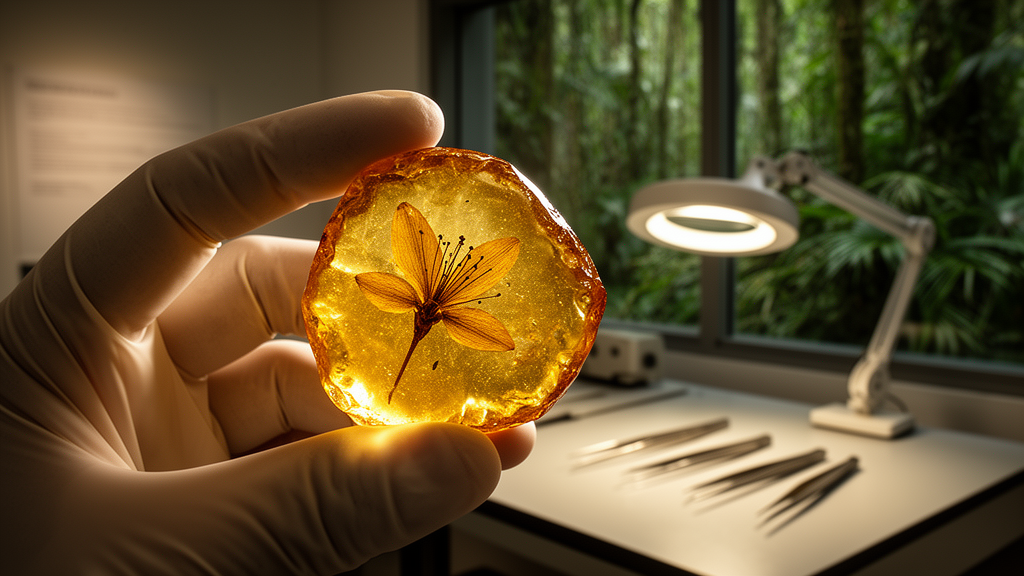
A tiny flower preserved for nearly 15 million years in amber from southeastern China has been identified as the first unambiguous fossil flower of the genus Cryptocarya, a widespread group of tropical trees that today includes relatives of cinnamon and avocado. The specimen, encased in Middle Miocene amber from the Zhangpu deposit in Fujian Province, was studied with synchrotron X-ray microtomography, a non-destructive imaging technique that allowed researchers to peer inside the amber and reconstruct the flower’s delicate reproductive structures in three dimensions without cutting into the fossil. The discovery, reported in the journal Fossil Record, confirms the presence of Cryptocarya in the Miocene Zhangpu flora, which had previously only been suggested by fossil fruits that could not be firmly assigned to the genus.
The amber piece, catalogued as specimen PB21525 and housed at the Nanjing Institute of Geology and Palaeontology of the Chinese Academy of Sciences, comes from the middle part of the Fotan Group in Zhangpu County. Radiometric dating of associated basaltic layers using the argon-40/argon-39 method constrains the deposit to between 14.8 plus or minus 0.6 and 14.7 plus or minus 0.4 million years ago, corresponding to the Langhian stage of the Middle Miocene. The amber itself derives from tropical Dipterocarpaceae trees, as shown by its terpenoid chemistry and by fossilized winged fruits of that family found in the same layers. Alongside the flower, the amber piece also trapped two Tetramorium ants, five Carebara ants, one springtail, two non-biting midges and wood fragments, offering a small window into the forest floor community of the time.
Because amber is notoriously difficult to examine without damaging the inclusion, the team prepared the specimen carefully. The flower was separated from other inclusions using a sawing machine, and the amber was then ground and polished with progressively finer wet silicon polishing papers to create even surfaces parallel to the fossil. Light microscopy combined 65 individual photographs into a single sharp composite image using focus stacking software. The decisive step, however, came at the P05 beamline of the PETRA III storage ring at DESY in Hamburg, where synchrotron-radiation-based X-ray microtomography produced a reconstructed volume with an effective voxel size of 0.91 micrometres. A total of 3501 projections were recorded at a photon energy of 18 kiloelectronvolts, and phase retrieval and filtered back projection were used to build the three-dimensional model.
The virtual reconstruction revealed a flower 3.11 millimetres long and 1.66 millimetres wide, bisexual and radially symmetrical, with six tepals, nine fertile stamens and three staminodes arranged in six trimerous, alternating whorls around the gynoecium. The flower is perigynous, meaning its cup-shaped hypanthium, 1.71 millimetres long, entirely encloses the superior ovary and the lowest third of the style. The position of the perianth organs, forming a narrow opening, and the apical flaps still covering the pollen sacs suggest the flower was caught at a late pre-anthetic stage or in the early, female phase of anthesis. The gynoecium consists of a single carpel with a slender ovary containing one apical pendulous ovule, and the whole flower is densely covered with appressed, simple, acute hairs except on the inner hypanthium, the anthers and the gynoecium.
Several features proved decisive for the identification. Like all members of the laurel family, Lauraceae, the fossil has valvate anthers that open by apical flaps and a unicarpellate, unilocular ovary with a single apical ovule. Within the family, the combination of six tepals, nine fully fertile stamens and a deep hypanthium completely surrounding the ovary matches the extant genus Cryptocarya. The anthers are bilocular, with septal remains visible in some pollen sacs, a condition thought to have arisen either through reduction of pollen sacs or through lateral fusion of pollen sac pairs, the latter being a shared derived character of the larger Cryptocarya group of genera, which also includes Beilschmiedia and Endiandra.
Two unusual characters stood out during the comparison with living plants. In most Lauraceae, the paired staminal glands are attached to the filament bases of the third stamen whorl, but in the fossil the glands are free from the filaments and inserted toward the distal end of the floral cup, a condition also seen in some extant Cryptocarya species from Australia and South America. Even more striking, the filaments of the third stamen whorl are fused with those of the staminode whorl, forming a short staminal tube that projects beyond the rim of the hypanthium. The researchers observed the same tube in herbarium flowers of Cryptocarya vulgaris from Australia, which they scanned with conventional micro-CT at the Museum für Naturkunde in Berlin, along with flowers of four species from New Caledonia and one from Vanuatu. To their knowledge, such a staminal tube formed only by the third and fourth androecial whorls has never before been pictured or described in Lauraceae.
The comparison also revealed that the tube appears more pronounced in less mature flowers, suggesting it may be only a temporary feature of early floral development in some Cryptocarya species. This developmental plasticity means that flowers at different stages can look superficially quite different, complicating comparisons with classic descriptions of fully developed flowers in the botanical literature. The authors argue that these morphological variations must be taken into account in future studies of the genus, and they note that X-ray-based methods are a valuable tool for examining extant herbarium specimens non-invasively, in contrast to the destructive microtome sectioning traditionally used in botany.
Because Cryptocarya flowers vary considerably and the fossil lacks features distinguishing any particular living species, and because leaves or fruits would be needed to settle a species-level identification, the team refrained from naming a new fossil species and assigned the inclusion simply to Cryptocarya sp. This caution reflects a broader problem in lauraceous palaeobotany. The family has a vast fossil record, but it consists mostly of leaves, which are notoriously difficult to assign even to the genus level because key features are widespread across both extinct and extant taxa. For example, the supposedly diagnostic butterfly-shaped cuticular ledges of Australian Cryptocarya also occur in other South American laurel genera. Reproductive structures such as flowers and fruits carry far more diagnostic detail, yet they are rarely preserved in sedimentary rocks, and the family’s pollen fossilizes poorly, leaving no pollen record for Cryptocarya at all.
The fossil record of the genus itself is sparse. Molecular clock estimates suggest Cryptocarya diverged around 90 plus or minus 20 million years ago, probably of Gondwanan origin, but fossils with affinities to the genus are known only from the Cenozoic, beginning with possible Eocene leaves from Australia and North America. Putative leaves and fruits have since been reported from New Zealand, New Caledonia and China, and a Pleistocene wood fossil from Asia was recently assigned to the genus. The Zhangpu flower is now the first fossil flower of Cryptocarya anywhere in the world and the first Cenozoic lauraceous flower known from Asia, confirming the genus in the Miocene of China and providing new insight into its floral morphology in the geological past.
The find also carries broader ecological significance. The Zhangpu amber deposit preserves a highly diverse megathermal rainforest, with arthropod inclusions from more than 250 families and plant megafossils from about 24 families, dominated by pantropical groups such as Dipterocarpaceae, Leguminosae, Lauraceae and Clusiaceae. The palaeoclimate and fossil taxa resemble today’s Southeast Asian tropical rainforests, indicating that the Zhangpu amber forest was a megathermal seasonal rainforest during the Mid-Miocene Climatic Optimum. Notably, the modern members of these families show only slight morphological differences from their Miocene counterparts, pointing to long-term morphological stasis in the plant community. Cryptocarya remains an important canopy and subcanopy element of evergreen broad-leaved forests in southern China today, so its presence in the Zhangpu amber forest fits neatly with existing palaeoclimatic and palaeoenvironmental interpretations, and the amber-encased flower stands as a vivid testament to how little some tropical lineages have changed over nearly 15 million years.
Subject of Research: First fossil flower of Cryptocarya from Miocene amber in China, identified by X-ray microtomography
Article Title: First flower inclusion and fossil evidence of Cryptocarya ( Laurales , Lauraceae ) from Miocene amber of Zhangpu (China)
Article References: Beurel, S., Bachelier, J. B., Munzinger, J., Shao, F., Hammel, J. U., Shi, G., & Sadowski, E.-M. (2024). First flower inclusion and fossil evidence of Cryptocarya (Laurales, Lauraceae) from Miocene amber of Zhangpu (China). Fossil Record, 27(1), 1-11. https://doi.org/10.3897/fr.27.109621
Image Credits: AI Generated
DOI: 10.3897/fr.27.109621
Keywords: Cryptocarya, Lauraceae, amber fossil, Zhangpu, Miocene, X-ray microtomography, palaeobotany, fossil flower, China, tropical rainforest, morphological stasis, Middle Miocene
Cite Scienmag News
Gavin Prescott. (October 26, 2026). Fossil Flower Trapped in Miocene Amber Reveals Cryptocarya in Ancient Chinese Rainforest. Scienmag. https://scienmag.com/fossil-flower-trapped-in-miocene-amber-reveals-cryptocarya-in-ancient-chinese-rainforest/
Gavin Prescott. "Fossil Flower Trapped in Miocene Amber Reveals Cryptocarya in Ancient Chinese Rainforest." Scienmag, 26 October 2026, https://scienmag.com/fossil-flower-trapped-in-miocene-amber-reveals-cryptocarya-in-ancient-chinese-rainforest/. Accessed 26 October 2026.
Gavin Prescott. "Fossil Flower Trapped in Miocene Amber Reveals Cryptocarya in Ancient Chinese Rainforest." Scienmag. October 26, 2026. https://scienmag.com/fossil-flower-trapped-in-miocene-amber-reveals-cryptocarya-in-ancient-chinese-rainforest/


