


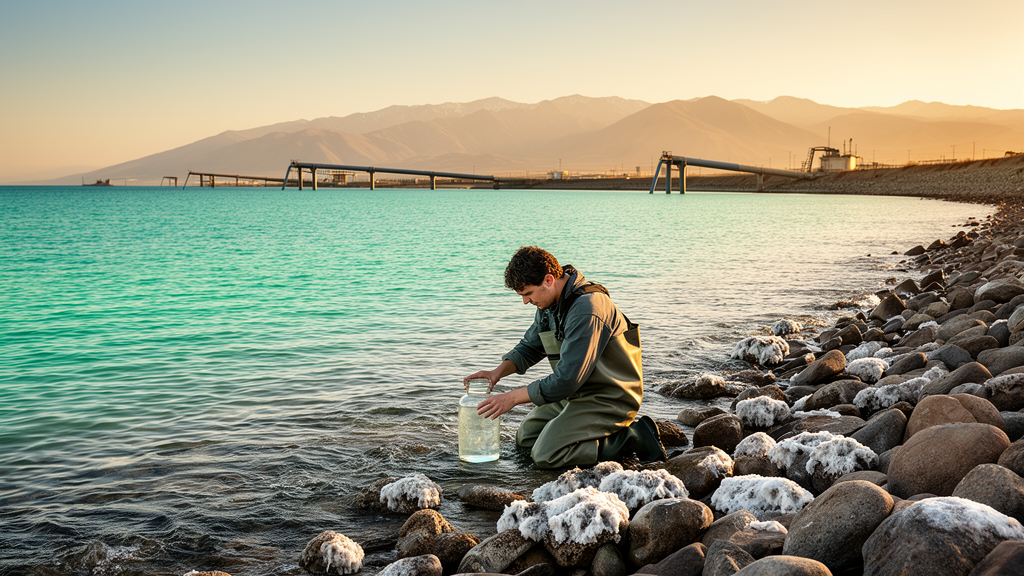
Seawater desalination is expanding rapidly across arid coastlines, and a new study from Flamenco Bay in northern Chile shows that the hypersaline brine these plants discharge leaves a detectable fingerprint in marine photosynthetic communities even where standard water-quality measurements look close to normal. The research, published in Environmental Geochemistry and Health, combined physicochemical profiling, pigment measurements, 18S rRNA metabarcoding and diversity metrics to survey the biological gradient around a brine outfall.
The chemical signal was sharply localized. At the discharge point, salinity reached 41.75 ± 3.36 PSU, compared with 33.71 ± 0.44 PSU at the reference station, a strong near-field anomaly. Yet the biological differences told a broader story: shifts in the photosynthetic assemblage extended over a wider area than the salinity anomaly itself, suggesting that community structure responds across a larger spatial scale than conventional monitoring captures.
Genus richness remained remarkably stable across stations, ranging from 9 to 11 genera, but Shannon diversity dropped at impacted stations to values of 1.06 to 1.09, against 1.87 at the reference site. The composition of the assemblages also changed character. Near-field stations were dominated by Myzozoa, particularly the dinoflagellate genus Karlodinium, while the reference station supported a more balanced mix of Ochrophyta, Myzozoa, Chlorophyta, Cryptophyta and Haptophyta.
Statistical analysis reinforced the pattern. Bray–Curtis dissimilarity indicated that differences among stations were driven mainly by changes in relative sequence abundance rather than by wholesale taxonomic replacement, meaning the same broad groups persisted but in very different proportions. PERMANOVA confirmed significant differences in community composition among stations (pseudo-F = 1.99, p = 0.018), and principal coordinates ordination showed discharge-influenced stations clustering separately from the reference site.
Perhaps the most consequential finding came from the Integrated Response Index, which identified the discharge point as showing the strongest deviation but also flagged biological differences at 500 meters from the outfall despite low physicochemical deviation there. In other words, community-level differences may remain detectable where salinity and related variables already approach reference conditions, so physicochemical monitoring alone may not fully capture the spatial variation in community structure around desalination outfalls.
The authors note important caveats. Future studies integrating high-resolution hydrodynamics with replicated temporal sampling would be needed to distinguish brine-driven effects from natural spatial variability, strengthening the bioindicator value of these community-level metrics. The study represents a single spatial gradient survey, so its conclusions are about detectable spatial patterns rather than long-term ecological change.
Nevertheless, the work carries practical weight for a region where desalination is a growing pillar of water supply. If eukaryotic photosynthetic communities respond to brine discharge over broader areas than salinity probes can resolve, metabarcoding-based diversity metrics could serve as sensitive complements to routine physicochemical monitoring, helping regulators judge the true footprint of outfalls along Chile’s hyperarid coast and beyond.
Subject of Research: Effects of desalination brine discharge on marine photosynthetic microbial communities in northern Chile
Article Title: Photosynthetic community restructuring along a desalination brine-discharge gradient in northern Chile
Article References: Cruces, E., Rojas-Lillo, Y., Oses, R., & Bonnail, E. (2026). Photosynthetic community restructuring along a desalination brine-discharge gradient in northern Chile. Environmental Geochemistry and Health, 48(16), Article 666. https://doi.org/10.1007/s10653-026-03568-z
Image Credits: AI Generated
DOI: 10.1007/s10653-026-03568-z
Keywords: desalination, brine discharge, northern Chile, metabarcoding, Shannon diversity, Myzozoa, Karlodinium, salinity, bioindicators, marine ecology, Flamenco Bay, PERMANOVA
Cite Scienmag News
Morgan Morrow. (October 26, 2026). Desalination Brine Reshapes Microbial Communities in Chilean Bay. Scienmag. https://scienmag.com/desalination-brine-reshapes-microbial-communities-in-chilean-bay/
Morgan Morrow. "Desalination Brine Reshapes Microbial Communities in Chilean Bay." Scienmag, 26 October 2026, https://scienmag.com/desalination-brine-reshapes-microbial-communities-in-chilean-bay/. Accessed 26 October 2026.
Morgan Morrow. "Desalination Brine Reshapes Microbial Communities in Chilean Bay." Scienmag. October 26, 2026. https://scienmag.com/desalination-brine-reshapes-microbial-communities-in-chilean-bay/


