


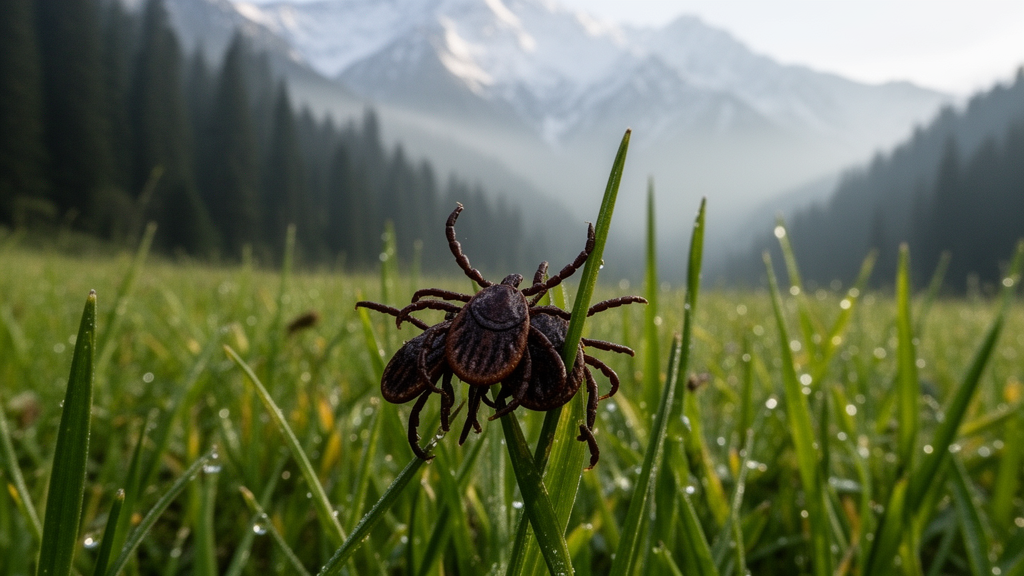
A cross-sectional survey of livestock across eight districts of the Kashmir Valley in India has detected DNA from the tick-borne protozoan parasites Babesia and Theileria in ticks collected from cattle, sheep and goats, according to a study published in Acta Parasitologica. The work provides molecular and phylogenetic baseline data for piroplasm infections in ticks in this high-altitude region, where such data had previously been limited.
The research team examined 4,965 domestic ruminants for tick infestation and found 1,800 animals carrying ticks, an overall infestation rate of 36.27 percent. Collected ticks were identified morphologically and then screened for parasite DNA using a genus-specific PCR assay targeting the 18S rRNA gene. Positive amplicons were sequenced and placed into phylogenetic trees to infer which parasite species were circulating.
Of the 1,800 ticks examined, the genus Haemaphysalis dominated, accounting for 1,529 ticks, or 84.0 percent of the collection. Rhipicephalus made up 171 ticks (9.5 percent) and the soft tick genus Ornithodoros 100 ticks (5.5 percent). This composition indicates that Haemaphysalis species were the predominant ticks parasitizing livestock in the valley during the survey.
Molecular screening revealed low but detectable parasite prevalence. Babesia DNA was found in 19 of 1,800 ticks, a positivity rate of 1.06 percent, while Theileria DNA was detected in 10 of 1,800 ticks, or 0.56 percent. Babesia-positive ticks came from cattle (3 of 720; 0.42 percent), sheep (14 of 720; 1.94 percent) and goats (2 of 360; 0.56 percent). Theileria DNA appeared in ticks from cattle (5 of 720; 0.69 percent) and goats (5 of 360; 1.39 percent), but not in ticks collected from sheep.
Sex of the tick mattered for Babesia detection. Female ticks showed significantly higher positivity than males, with 13 of 648 females (2.01 percent) testing positive compared with 3 of 792 males (0.38 percent), a difference the authors report as statistically significant with P = 0.004. Tick infestation of livestock peaked during the summer months of the survey period.
Phylogenetic analysis of the sequenced 18S rRNA fragments placed the Kashmir Babesia sequences within the clade containing Babesia bovis reference sequences, while the Theileria sequences clustered with sequences related to Theileria cf. luwenshuni. The authors note that Haemaphysalis was the predominant tick genus associated with the detected piroplasmid infections.
The study is a cross-sectional survey of ticks rather than a demonstration of disease in the animals themselves. Detecting parasite DNA in a tick does not by itself establish that the tick was infectious in the epidemiological sense or that the sampled livestock were clinically affected, and the overall PCR positivity rates were low. The 18S rRNA marker used for screening is also relatively conserved, which limits the resolution with which closely related piroplasm species can be distinguished.
Despite these limitations, the researchers describe the results as baseline data for piroplasm surveillance in the Kashmir Valley and call for further characterization of the detected parasites using higher-resolution molecular markers. Because ticks are major vectors of hemoprotozoan parasites that cause substantial morbidity and economic losses in livestock, knowing which parasite sequences and tick genera co-occur in a region is a practical starting point for targeted monitoring.
The study, led by Altaf Hussain Khan and colleagues, was published online in Acta Parasitologica on 26 October 2026 as volume 71, article number 245. Its combination of large-scale tick collection, molecular screening and phylogenetic profiling documents which piroplasm sequences were circulating in ticks infesting livestock in the Kashmir Valley at the time of the survey.
Subject of Research: Molecular detection and phylogenetic analysis of Babesia and Theileria in ticks infesting livestock in the Kashmir Valley, India
Article Title: Phylogenetic Profiling and Molecular Detection of Babesia and Theileria spp. in Ticks Infesting Livestock Across Kashmir Valley, India
Article References: Khan, A. H., Jadhav, I., Fomda, B. A., Qadri, U., Allaie, I. M., Nisar, Q., Rather, T. B., & Mir, Y. (2026). Phylogenetic Profiling and Molecular Detection of Babesia and Theileria spp. in Ticks Infesting Livestock Across Kashmir Valley, India. Acta Parasitologica, 71(6), Article 245. https://doi.org/10.1007/s11686-026-01427-6
Image Credits: AI Generated
DOI: 10.1007/s11686-026-01427-6
Keywords: Babesia, Theileria, ticks, Haemaphysalis, livestock, Kashmir Valley, 18S rRNA PCR, phylogenetics, piroplasms, India, surveillance, Phylogenetic
Cite Scienmag News
Drew Townsend. (October 26, 2026). Ticks in Kashmir Valley Carry Babesia bovis and Theileria Sequences, Survey Finds. Scienmag. https://scienmag.com/ticks-in-kashmir-valley-carry-babesia-bovis-and-theileria-sequences-survey-finds/
Drew Townsend. "Ticks in Kashmir Valley Carry Babesia bovis and Theileria Sequences, Survey Finds." Scienmag, 26 October 2026, https://scienmag.com/ticks-in-kashmir-valley-carry-babesia-bovis-and-theileria-sequences-survey-finds/. Accessed 26 October 2026.
Drew Townsend. "Ticks in Kashmir Valley Carry Babesia bovis and Theileria Sequences, Survey Finds." Scienmag. October 26, 2026. https://scienmag.com/ticks-in-kashmir-valley-carry-babesia-bovis-and-theileria-sequences-survey-finds/


