

Monday, October 26, 2026
Science
No Result
View All Result
  • Login
  • HOME
  • SCIENCE NEWS
  • CONTACT US
  • HOME
  • SCIENCE NEWS
  • CONTACT US
No Result
View All Result
Scienmag
No Result
View All Result
Home Science News Cancer

LPS boosts gallbladder cancer cell migration and invasion via NF-κB–CXCR4 axis

October 26, 2026
in Cancer
Nathaniel Bowman
By Nathaniel Bowman Scienmag Editorial Profile - Precision Oncology
Reading Time: 3 mins read
0
LPS boosts gallbladder cancer cell migration and invasion via NF-κB–CXCR4 axis

LPS boosts gallbladder cancer cell migration and invasion via NF-κB–CXCR4 axis

65
SHARES
587
VIEWS
Share on FacebookShare on Twitter
ADVERTISEMENT

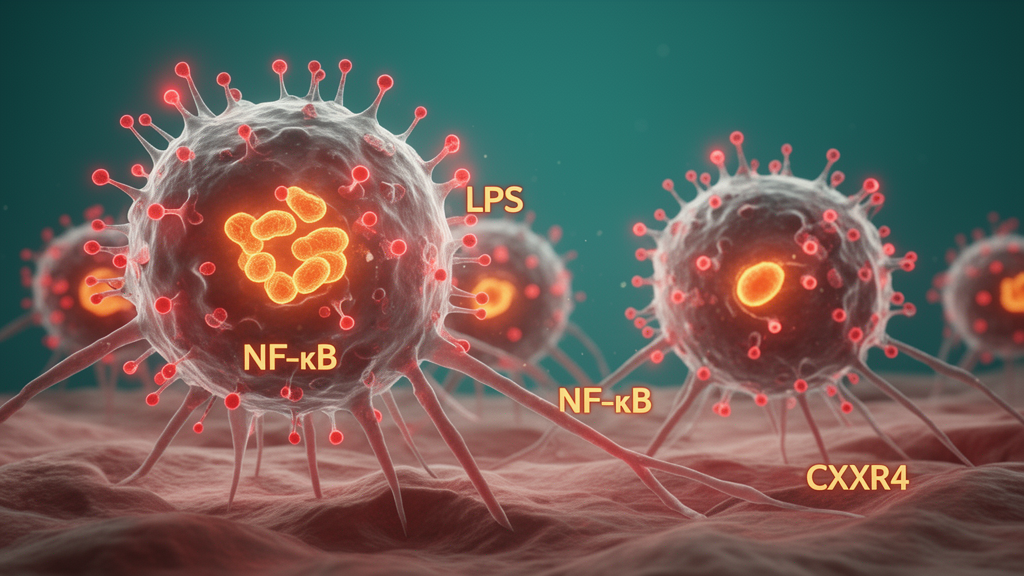
A new laboratory study reports that lipopolysaccharide (LPS), an inflammatory stimulus increasingly implicated in inflammation-related disease processes, can increase the migratory and invasive behavior of gallbladder cancer cells in culture. The work, published in Medical Oncology, also identifies a signaling route through which this happens: LPS appears to boost the activity of the transcription factor NF-κB, which then binds the promoter of the gene encoding CXCR4, a chemokine receptor that is markedly overexpressed in multiple malignancies, including gallbladder cancer. The authors propose this LPS/NF-κB/CXCR4 axis as a potential mechanistic link between chronic biliary inflammation and tumor progression, while stressing that the findings come from cell-based experiments and require further in vivo studies and clinical validation.

The evidence began in patient samples. Using a chromogenic Tachypleus amebocyte lysate assay, the researchers quantified LPS concentrations in bile from gallbladder cancer patients and found that elevated levels correlated with more advanced pT stage, a measure of how far the primary tumor has grown. Notably, LPS concentrations were positively associated with CXCR4 expression, which the team assessed using immunohistochemistry, quantitative real-time PCR, and luciferase reporter assays.

This set of complementary methods allowed the investigators to examine CXCR4 at the protein, mRNA, and promoter-activity levels rather than relying on a single readout. In vitro experiments then tested what LPS does to gallbladder cancer cells directly. When cells were stimulated with LPS, their migratory and invasive capacities increased robustly.

The study reports that this increase in motility was mediated by the upregulation of CXCR4 expression, meaning that when LPS raised CXCR4 levels, the cells became better at moving and invading through their surroundings in the culture system. Mechanistically, the researchers showed that NF-κB, a transcription factor central to inflammatory signaling, binds to the CXCR4 promoter to drive its expression, and that LPS potentiated this transcriptional activation. In other words, LPS did not simply raise CXCR4 levels as a side effect; it appeared to strengthen the NF-κB-driven transcription of the CXCR4 gene.

The authors frame these results as revealing a novel LPS/NF-κB/CXCR4 signaling axis that may contribute to the aggressive phenotype of gallbladder cancer in vitro. They are careful about scope: the correlation between biliary LPS and advanced pT stage is an association in patient samples, the migration and invasion findings are confined to cultured cells, and the paper explicitly states that further in vivo studies and clinical validation are warranted. No clinical recommendations follow from this work at this stage, and the findings should not be read as evidence that LPS exposure causes cancer progression in patients.

What the study does provide is a defined molecular pathway that connects a bacterial inflammatory stimulus to a pro-metastatic phenotype in gallbladder cancer cells, along with patient-sample data linking bile LPS levels to both tumor stage and CXCR4 expression. For now, the contribution is mechanistic: a candidate route by which inflammation-associated signals may promote the invasive behavior of this cancer in the laboratory.

Subject of Research: LPS-induced, NF-κB-mediated upregulation of CXCR4 promoting gallbladder cancer cell migration and invasion in vitro

Article Title: Lipopolysaccharide increases cell migration and invasion via NF-κB-mediated upregulation of CXCR4 in gallbladder cancer

Article References: Lin, B., Hong, H., & Zhang, Y. (2026). Lipopolysaccharide increases cell migration and invasion via NF-κB-mediated upregulation of CXCR4 in gallbladder cancer. Medical Oncology, 43(11), Article 359. https://doi.org/10.1007/s12032-026-03488-z

Image Credits: AI Generated

DOI: 10.1007/s12032-026-03488-z

Keywords: gallbladder cancer, lipopolysaccharide, CXCR4, NF-κB, cell migration, cell invasion, biliary inflammation, Medical Oncology, increases, cell, migration, invasion

Cite Scienmag News

Nathaniel Bowman. (October 26, 2026). LPS boosts gallbladder cancer cell migration and invasion via NF-κB–CXCR4 axis. Scienmag. https://scienmag.com/lps-boosts-gallbladder-cancer-cell-migration-and-invasion-via-nf-%ce%bab-cxcr4-axis/


Nathaniel Bowman. "LPS boosts gallbladder cancer cell migration and invasion via NF-κB–CXCR4 axis." Scienmag, 26 October 2026, https://scienmag.com/lps-boosts-gallbladder-cancer-cell-migration-and-invasion-via-nf-%ce%bab-cxcr4-axis/. Accessed 26 October 2026.

Nathaniel Bowman. "LPS boosts gallbladder cancer cell migration and invasion via NF-κB–CXCR4 axis." Scienmag. October 26, 2026. https://scienmag.com/lps-boosts-gallbladder-cancer-cell-migration-and-invasion-via-nf-%ce%bab-cxcr4-axis/

Tags: bile LPS levels in cancer patientsbiliary inflammationcellcell invasioncell migrationcell migration and invasion mechanismschemokine receptor in malignanciesCXCR4CXCR4 overexpression in cancerGallbladder cancerin vitro studies of gallbladder cancerincreasesinflammation and tumor progressioninvasionlipopolysaccharideLPS-induced cell migrationmechanistic link between inflammation and cancerMedical OncologymigrationNF-κBNF-κB signaling pathwaypotential therapeutic targets for gallbladder cancerrole of chronic biliary inflammation in tumor development
Share26Tweet16
Previous Post

Native long reads reveal dimeric plasmid and fragmented prophages in Wolbachia

Next Post

Ticks in Kashmir Valley Carry Babesia bovis and Theileria Sequences, Survey Finds

Related Posts

Endothelial p16 expression marks a favorable-prognosis subgroup of clear cell renal cell carcinoma
Cancer

Endothelial p16 expression marks a favorable-prognosis subgroup of clear cell renal cell carcinoma

October 26, 2026
Review Reframes MAD Genes as a Coordinated Genome Stability Axis in Cancer
Cancer

Review Reframes MAD Genes as a Coordinated Genome Stability Axis in Cancer

October 26, 2026
Single-cell tumour phylogenetics
Cancer

Single-cell tumour phylogenetics

October 26, 2026
Beta-1 blocker use linked to higher mortality in immune checkpoint inhibitor patients
Cancer

Beta-1 blocker use linked to higher mortality in immune checkpoint inhibitor patients

October 26, 2026
PTN-Secreting Glioblastoma Subclone Rebuilds the Immune Niche to Seed Distant Recurrence
Cancer

PTN-Secreting Glioblastoma Subclone Rebuilds the Immune Niche to Seed Distant Recurrence

October 26, 2026
Pericyte Snai1 Drives Pathological Retinal Angiogenesis Through Extracellular Matrix Remodelling
Cancer

Pericyte Snai1 Drives Pathological Retinal Angiogenesis Through Extracellular Matrix Remodelling

October 26, 2026
Next Post
Ticks in Kashmir Valley Carry Babesia bovis and Theileria Sequences, Survey Finds

Ticks in Kashmir Valley Carry Babesia bovis and Theileria Sequences, Survey Finds

  • Mothers who receive childcare support from maternal grandparents show more optimized

    Mothers who receive childcare support from maternal grandparents show more parental warmth, finds NTU Singapore study

    27656 shares
    Share 11059 Tweet 6912
  • University of Seville Breaks 120-Year-Old Mystery, Revises a Key Einstein Concept

    1061 shares
    Share 424 Tweet 265
  • Bee body mass, pathogens and local climate influence heat tolerance

    682 shares
    Share 273 Tweet 171
  • Researchers record first-ever images and data of a shark experiencing a boat strike

    546 shares
    Share 218 Tweet 137
  • Groundbreaking Clinical Trial Reveals Lubiprostone Enhances Kidney Function

    531 shares
    Share 212 Tweet 133
Science

Embark on a thrilling journey of discovery with Scienmag.com—your ultimate source for cutting-edge breakthroughs. Immerse yourself in a world where curiosity knows no limits and tomorrow’s possibilities become today’s reality!

RECENT NEWS

  • Ticks in Kashmir Valley Carry Babesia bovis and Theileria Sequences, Survey Finds
  • LPS boosts gallbladder cancer cell migration and invasion via NF-κB–CXCR4 axis
  • Native long reads reveal dimeric plasmid and fragmented prophages in Wolbachia
  • High-Altitude Tibetan Study Maps Hyperuricemia Risk Across Elevation Gradients

Categories

  • Agriculture
  • Anthropology
  • Archaeology
  • Athmospheric
  • Biology
  • Biotechnology
  • Blog
  • Bussines
  • Cancer
  • Chemistry
  • Climate
  • Earth Science
  • Editorial Policy
  • Marine
  • Mathematics
  • Medicine
  • Pediatry
  • Policy
  • Psychology & Psychiatry
  • Science Education
  • Science News
  • Social Science
  • Space
  • Technology and Engineering

Subscribe to Blog via Email

Enter your email address to subscribe to this blog and receive notifications of new posts by email.

Join 5,151 other subscribers

© 2025 Scienmag - Science Magazine

Welcome Back!

Login to your account below

Forgotten Password?

Retrieve your password

Please enter your username or email address to reset your password.

Log In
No Result
View All Result
  • HOME
  • SCIENCE NEWS
  • CONTACT US

© 2025 Scienmag - Science Magazine

Discover more from Science

Subscribe now to keep reading and get access to the full archive.

Continue reading