


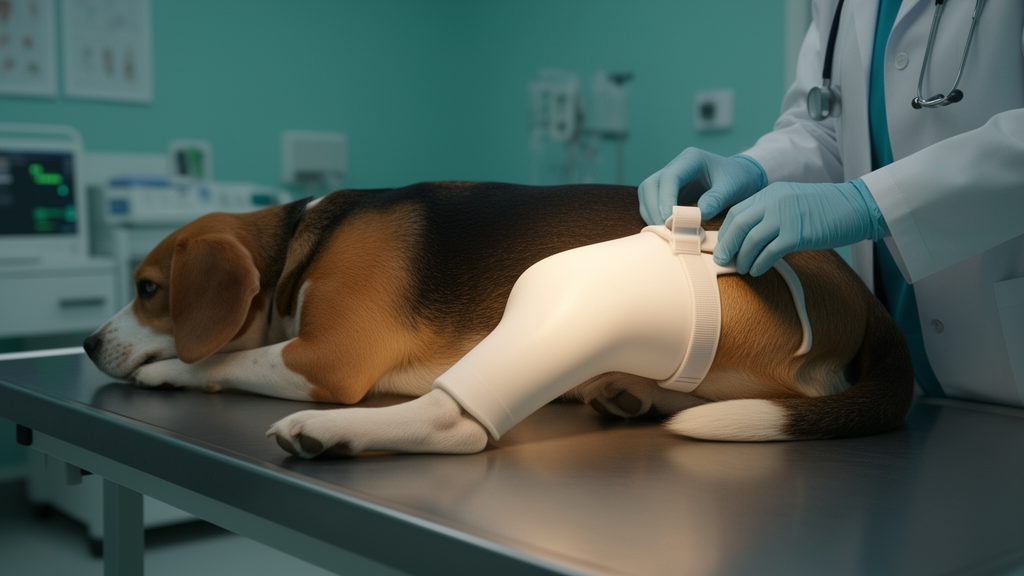
A personalized knee splint produced by three-dimensional printing was associated with better short-term function in beagles with experimentally induced knee osteoarthritis, according to a study from South China Agricultural University published in Frontiers in Veterinary Science. The device, fabricated from polylactic acid and shaped to an individual dog’s limb, was tested both on its own and alongside nonsteroidal anti-inflammatory drugs (NSAIDs) in a monosodium iodoacetate-induced model of the disease.
The study’s starting point was that canine knee osteoarthritis involves pain, inflammation, altered joint loading, and restricted motor function, and that NSAIDs do not directly correct abnormal joint mechanics. The researchers therefore evaluated a mechanical intervention intended to complement drug therapy: a custom splint designed for each animal and printed in polylactic acid.
Twelve beagles were assigned to four groups of three animals each: an osteoarthritis group receiving no continued treatment, a splint-only group, an NSAID-only group, and a combined group receiving both NSAIDs and splinting. With only three dogs per group, the study is explicitly preliminary in scale.
In the living animals, the researchers tracked static hindlimb weight-bearing symmetry, knee joint range of motion, and clinical scoring instruments: the Liverpool Osteoarthritis in Dogs score, the Canine Brief Pain Inventory, and the Canine Orthopedic Index pain and function scores. Together these measures capture how evenly a dog distributes load between limbs, how freely the knee moves, and how pain and function are scored over the study period.
Alongside the animal work, the team performed finite element analysis using representative healthy and osteoarthritic knee models as descriptive, model-based mechanical support. In the osteoarthritic model, adding the splint reduced several model-predicted mechanical indices, including peak stress, equivalent elastic strain, femoral condylar contact pressure, and total cartilage deformation. The simulations also showed that the splint remained below the yield threshold of polylactic acid under simulated loading, meaning the material was not predicted to permanently deform under the simulated conditions. These mechanical findings are model estimates rather than measurements taken inside the joints of the treated dogs.
The in vivo results followed a consistent direction. Dogs treated with the splint alone showed better short-term functional outcomes than animals receiving no continued treatment, while the combined NSAID-plus-splint group displayed the greatest overall improvement in weight-bearing symmetry, range of motion, and clinical pain and function scores.
The authors are careful about what the combined result does and does not show. Because no formal interaction analysis was performed, the stronger performance of the combination group should be interpreted as broader short-term functional benefit rather than statistical evidence that the splint and the drugs interact. The small group size and the chemically induced model, which differs from the spontaneous disease seen in pet dogs, further limit how far the conclusions can be generalized.
Even so, the findings outline a division of labor in osteoarthritis management as tested here. NSAIDs addressed the inflammatory and painful components of the disease in the treated animals, while the personalized splint was associated with improved functional outcomes and, in the finite element models, with reduced predicted contact pressure on the femoral condyles and cartilage. The confirmation that printed polylactic acid stayed within its predicted elastic range under simulated loading addresses a basic mechanical question for this type of orthosis.
For now, the study stands as an early proof of concept rather than a treatment recommendation. The authors describe personalized three-dimensional printed splinting as a potential mechanical adjunct to NSAID therapy for canine knee osteoarthritis, a framing that matches the preliminary nature of the evidence from twelve dogs with chemically induced disease.
Subject of Research: A personalized three-dimensional printed knee splint for mechanical mitigation of canine knee osteoarthritis and adjunctive nonsteroidal anti-inflammatory drug therapy
Article Title: A personalized three-dimensional printed knee splint for mechanical mitigation of canine knee osteoarthritis and adjunctive nonsteroidal anti-inflammatory drug therapy
Article References: Li, X.-T., Xiong, Z.-H., Ye, J.-M., Qiu, W.-T., Sun, J.-F., Gu, J.-L., Yue-Yin, Ou, Z.-L., & Li, S.-C. (2026). A personalized three-dimensional printed knee splint for mechanical mitigation of canine knee osteoarthritis and adjunctive nonsteroidal anti-inflammatory drug therapy. Frontiers in Veterinary Science, 13, Article 1938731. https://doi.org/10.3389/fvets.2026.1938731
Image Credits: AI Generated
DOI: 10.3389/fvets.2026.1938731
Keywords: 3D printing, canine osteoarthritis, knee splint, polylactic acid, NSAIDs, finite element analysis, monosodium iodoacetate, beagle model, veterinary orthopedics, joint loading, pain scores, weight-bearing symmetry
Cite Scienmag News
William Thompson. (October 26, 2026). Personalized 3D-Printed Knee Splint Shows Short-Term Benefit in Beagle Osteoarthritis Study. Scienmag. https://scienmag.com/personalized-3d-printed-knee-splint-shows-short-term-benefit-in-beagle-osteoarthritis-study/
William Thompson. "Personalized 3D-Printed Knee Splint Shows Short-Term Benefit in Beagle Osteoarthritis Study." Scienmag, 26 October 2026, https://scienmag.com/personalized-3d-printed-knee-splint-shows-short-term-benefit-in-beagle-osteoarthritis-study/. Accessed 26 October 2026.
William Thompson. "Personalized 3D-Printed Knee Splint Shows Short-Term Benefit in Beagle Osteoarthritis Study." Scienmag. October 26, 2026. https://scienmag.com/personalized-3d-printed-knee-splint-shows-short-term-benefit-in-beagle-osteoarthritis-study/


