

Monday, October 26, 2026
Science
No Result
View All Result
  • Login
  • HOME
  • SCIENCE NEWS
  • CONTACT US
  • HOME
  • SCIENCE NEWS
  • CONTACT US
No Result
View All Result
Scienmag
No Result
View All Result
Home Science News Biology

First fully marine amphibian relative discovered in 237-million-year-old Chinese rocks

October 26, 2026
in Biology
Gavin Prescott
By Gavin Prescott Scienmag Editorial Profile - Ecology and Ecosystem Dynamics
Reading Time: 3 mins read
0
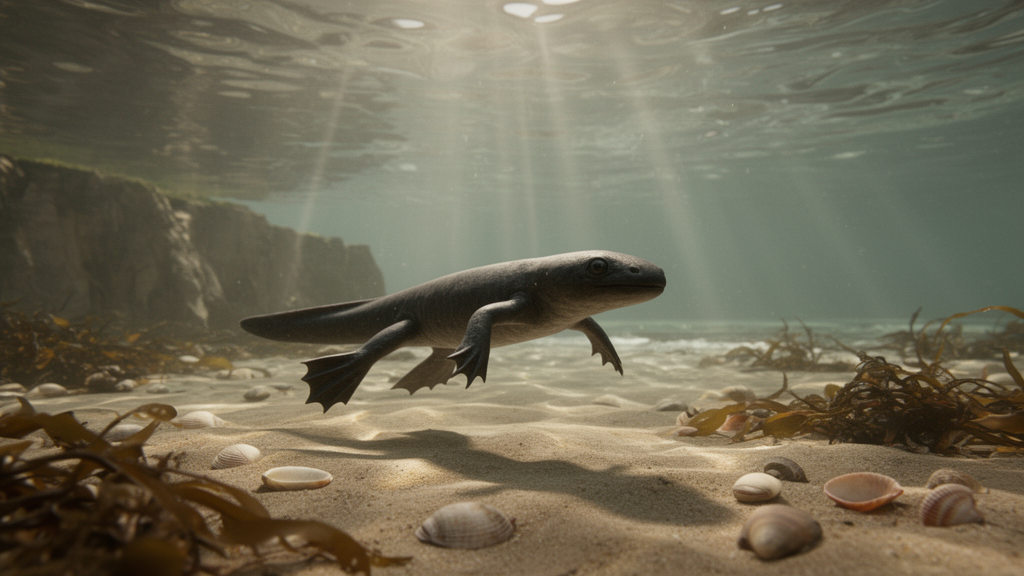
First fully marine amphibian relative discovered in 237-million-year-old Chinese rocks

First fully marine amphibian relative discovered in 237-million-year-old Chinese rocks

65
SHARES
587
VIEWS
Share on FacebookShare on Twitter
ADVERTISEMENT

Palaeontologists have identified the first known fully marine member of the amphibian stem lineage, a new species named Gerrothorax maritimus, based on two nearly complete skeletons from Late Triassic rocks of southern China dated to roughly 237 million years ago. The discovery, published in Nature Ecology & Evolution, fills a conspicuous gap in the record of vertebrate life at sea: mammals, reptiles and birds all include species that can survive entirely on marine food and water, but no amphibian, living or extinct, had previously been shown to do so. The researchers attribute this absence to a fundamental constraint of amphibian biology.

Most amphibians have permeable skins that exchange water, gases and salts with their surroundings, which makes them intolerant of seawater. Gerrothorax maritimus, however, descended from a lineage characterised by complete body armour, a covering that would have restricted such skin-based exchanges. According to the authors, this armour plating probably enforced reliance on other organs, namely the gills and the gut, which are more capable of becoming tolerant of salt, and thereby probably prepared the lineage for life in fully marine regimes.

The evidence for a marine lifestyle comes from two independent lines of support. First, the skeletons were found articulated, meaning the animals were buried intact rather than as scattered remains, at a location far from land, making post-mortem transport from freshwater habitats unlikely. Second, the strontium isotope record associated with the specimens indicates that the animals lived in fully marine conditions rather than in brackish or freshwater settings near the coast.

Together, these indicators point to an animal that did not merely visit the sea but lived and died in it. Its new species therefore extends the known ecological range of the amphibian total group into an environment that its living relatives never colonised. The find adds to a long pattern in Earth history, in which land vertebrates repeatedly returned to the sea with varying degrees of adaptation, from partial use of marine resources to complete independence from the land.

The two nearly complete specimens, designated as the holotype GMG 1119 and the paratype GMG 35, preserve enough anatomical detail to establish the species and to place it within the evolutionary sequence of marine adaptations traced by the authors along the group's phylogeny. For the evolution of marine adaptation, the study proposes a specific pathway: rather than gradual physiological tuning of the skin, the decisive step was the loss of skin-based exchange functions through full armouring, which shifted the burden of water, gas and salt regulation to organs that could evolve salt tolerance. This mechanism, the authors suggest, explains how a stem amphibian achieved a lifestyle that no crown amphibian has managed.

The discovery also reframes how biologists think about the limits of amphibian evolution. The barrier that kept crown amphibians out of the open sea was not an unbreakable physiological rule but a trait that could be lost, and its loss opened a route to salt tolerance through entirely different organs. Gerrothorax maritimus thus stands as a rare example of a morphological feature that closed one door to survival while opening another, allowing an armoured stem amphibian to make a living in an environment its living relatives have never entered.

Subject of Research: A fully marine stem amphibian from the Late Triassic of China

Article Title: A fully marine stem amphibian from the Late Triassic of China

Article References: Diao, L., Motani, R., Jiang, D.-Y., Hao, J., & Wang, S. (2026). A fully marine stem amphibian from the Late Triassic of China. Nature Ecology & Evolution. https://doi.org/10.1038/s41559-026-03209-9

Image Credits: AI Generated

DOI: 10.1038/s41559-026-03209-9

Keywords: Gerrothorax maritimus, stem amphibian, marine adaptation, Late Triassic, Carnian, South China, palaeontology, strontium isotopes, body armour, vertebrate evolution, fully, marine

Cite Scienmag News

Gavin Prescott. (October 26, 2026). First fully marine amphibian relative discovered in 237-million-year-old Chinese rocks. Scienmag. https://scienmag.com/first-fully-marine-amphibian-relative-discovered-in-237-million-year-old-chinese-rocks/


Gavin Prescott. "First fully marine amphibian relative discovered in 237-million-year-old Chinese rocks." Scienmag, 26 October 2026, https://scienmag.com/first-fully-marine-amphibian-relative-discovered-in-237-million-year-old-chinese-rocks/. Accessed 26 October 2026.

Gavin Prescott. "First fully marine amphibian relative discovered in 237-million-year-old Chinese rocks." Scienmag. October 26, 2026. https://scienmag.com/first-fully-marine-amphibian-relative-discovered-in-237-million-year-old-chinese-rocks/

Tags: amphibian fossil record in Chinaamphibian skin permeability and salt toleranceancient marine life 237 million years agobody armourCarnianfullyfully marine amphibian speciesGerrothorax maritimusGerrothorax maritimus discoverygill and gut functions in marine amphibiansLate Triassicmarinemarine adaptationmarine adaptation in early amphibiansmarine amphibian evolutionpalaeontologyrole of body armor in marine adaptationsignificance of marine amphibians in evolutionary historySouth Chinastem amphibianstrontium isotopesTriassic marine vertebratesvertebrate evolutionvertebrate transition to marine habitats
Share26Tweet16
Previous Post

Survey maps how machine learning can run on encrypted data

Next Post

Conservation Genomists Call Time on the Vague Term Hybrid Swarm

Related Posts

Early Pyrethroid Resistance Detected in Dengue Mosquitoes from Southern India
Biology

Early Pyrethroid Resistance Detected in Dengue Mosquitoes from Southern India

October 26, 2026
Conservation Genomists Call Time on the Vague Term Hybrid Swarm
Biology

Conservation Genomists Call Time on the Vague Term Hybrid Swarm

October 26, 2026
Missing Wuhan-Strain Imprinting Leaves Children Vulnerable to Omicron BA.3.2.2
Biology

Missing Wuhan-Strain Imprinting Leaves Children Vulnerable to Omicron BA.3.2.2

October 26, 2026
Continuous mass photometry tracks single biomolecules for hours
Biology

Continuous mass photometry tracks single biomolecules for hours

October 26, 2026
Losing β-Catenin in the Liver Protects Mice From Toxic Bile Acid Injury
Biology

Losing β-Catenin in the Liver Protects Mice From Toxic Bile Acid Injury

October 26, 2026
Hidden Blood Factory Discovered at the Border Between Mother and Embryo
Biology

Hidden Blood Factory Discovered at the Border Between Mother and Embryo

October 26, 2026
Next Post
Conservation Genomists Call Time on the Vague Term Hybrid Swarm

Conservation Genomists Call Time on the Vague Term Hybrid Swarm

  • Mothers who receive childcare support from maternal grandparents show more optimized

    Mothers who receive childcare support from maternal grandparents show more parental warmth, finds NTU Singapore study

    27656 shares
    Share 11059 Tweet 6912
  • University of Seville Breaks 120-Year-Old Mystery, Revises a Key Einstein Concept

    1061 shares
    Share 424 Tweet 265
  • Bee body mass, pathogens and local climate influence heat tolerance

    682 shares
    Share 273 Tweet 171
  • Researchers record first-ever images and data of a shark experiencing a boat strike

    546 shares
    Share 218 Tweet 137
  • Groundbreaking Clinical Trial Reveals Lubiprostone Enhances Kidney Function

    531 shares
    Share 212 Tweet 133
Science

Embark on a thrilling journey of discovery with Scienmag.com—your ultimate source for cutting-edge breakthroughs. Immerse yourself in a world where curiosity knows no limits and tomorrow’s possibilities become today’s reality!

RECENT NEWS

  • Flood rebuilding in Europe could drive emissions up tenfold by 2080
  • Imperfect but plentiful training data improves prediction of software user satisfaction
  • Dye trace reveals treated wastewater reaches Grand Canyon spring in months
  • Early Pyrethroid Resistance Detected in Dengue Mosquitoes from Southern India

Categories

  • Agriculture
  • Anthropology
  • Archaeology
  • Athmospheric
  • Biology
  • Biotechnology
  • Blog
  • Bussines
  • Cancer
  • Chemistry
  • Climate
  • Earth Science
  • Editorial Policy
  • Marine
  • Mathematics
  • Medicine
  • Pediatry
  • Policy
  • Psychology & Psychiatry
  • Science Education
  • Science News
  • Social Science
  • Space
  • Technology and Engineering

Subscribe to Blog via Email

Enter your email address to subscribe to this blog and receive notifications of new posts by email.

Join 5,151 other subscribers

© 2025 Scienmag - Science Magazine

Welcome Back!

Login to your account below

Forgotten Password?

Retrieve your password

Please enter your username or email address to reset your password.

Log In
No Result
View All Result
  • HOME
  • SCIENCE NEWS
  • CONTACT US

© 2025 Scienmag - Science Magazine

Discover more from Science

Subscribe now to keep reading and get access to the full archive.

Continue reading