

Monday, October 26, 2026
Science
No Result
View All Result
  • Login
  • HOME
  • SCIENCE NEWS
  • CONTACT US
  • HOME
  • SCIENCE NEWS
  • CONTACT US
No Result
View All Result
Scienmag
No Result
View All Result
Home Science News Space

Plasma Flows May Drive Solar Active Region Formation

October 26, 2026
in Space
Grant Pearson
By Grant Pearson Scienmag Editorial Profile - Observational Astronomy
Reading Time: 2 mins read
0
Plasma Flows May Drive Solar Active Region Formation

Plasma Flows May Drive Solar Active Region Formation

65
SHARES
587
VIEWS
Share on FacebookShare on Twitter
ADVERTISEMENT

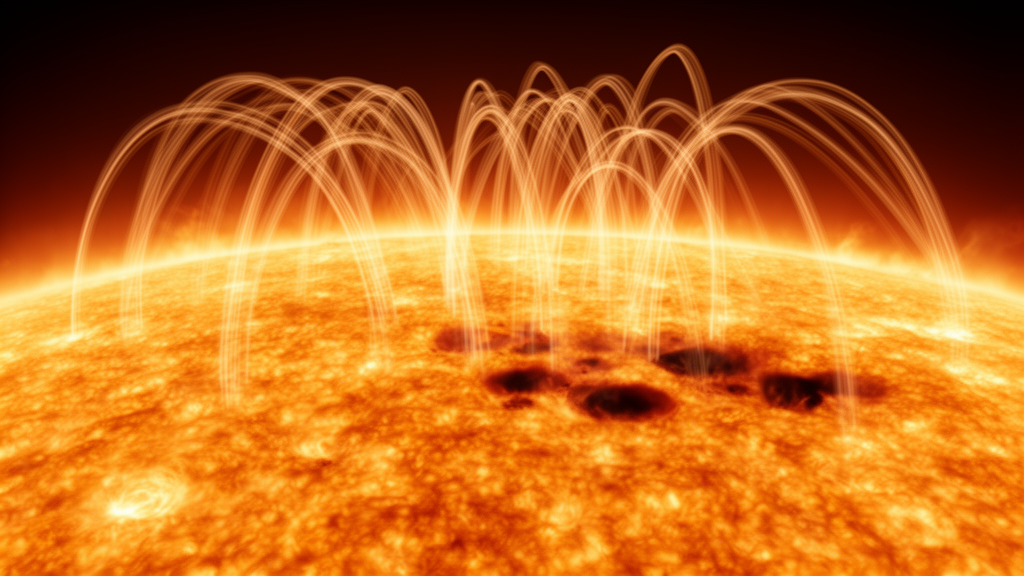
The research analyzes the early evolutionary stages of active regions to address a fundamental question in heliophysics: whether magnetic structures or fluid motions are the dominant drivers of solar activity. The findings challenge the popular rising flux-tube model, which posits that twisted loops of strong magnetic field emerge from the Sun's interior to create these features. The investigation utilized optical images and full-vector magnetic field maps obtained by the Helioseismic and Magnetic Imager (HMI) aboard the Solar Dynamics Observatory.

By applying local correlation tracking to photospheric brightness elements, the authors constructed detailed maps of fluid-particle tracks. These maps allowed for a direct comparison between the observed magnetic configurations and the underlying plasma dynamics during the initial development of three distinct active regions. The popular rising-tube model suggests that an Omega-shaped loop of strong magnetic field rises through the subphotospheric layers.

If this model were correct, the emerging magnetic field would inevitably disrupt the surrounding supergranulation pattern. However, the data from this study indicate that the supergranulation pattern remains intact during the emergence of the active regions. This observation confirms a conclusion first made by Bumba and Howard in the mid-1960s, which stated that the supergranulation pattern is not destroyed by the emerging magnetic field of the developing active region.

The researchers found no signs of spreading flows on scales comparable to the size of the entire active region. The study notes that such disruption would be inevitable if a loop of the strong-magnetic-field flux tube rose through the subphotospheric layers. Instead, the authors conclude that plasma flows appear to be determinant with respect to magnetic fields.

Furthermore, the study revealed various forms of dissymmetry between the leading and trailing parts of the active regions. These asymmetries were observed during the analysis of the developing regions. The researchers also examined a well-developed sunspot group to investigate the timing of magnetic twist development.

They found that the twist of the magnetic configuration may develop much later than the group starts growing. The authors argue that the observed preservation of supergranulation and the delayed development of magnetic twist are incompatible with the idea of a rising flux tube. The preservation of supergranulation patterns and the delayed development of magnetic twist are key observations that challenge existing models.

Subject of Research: The role of plasma flows versus magnetic fields in the formation of solar active regions

Article Title: Solar Photospheric Flows and the Origin of Active Regions

Article References: Getling, A. V. (2026). Solar Photospheric Flows and the Origin of Active Regions. Solar Physics, 301(10), 162. https://doi.org/10.1007/s11207-026-02762-7

Image Credits: AI Generated

DOI: 10.1007/s11207-026-02762-7

Keywords: solar physics, active regions, plasma flows, magnetic fields, sunspots, supergranulation, Solar Dynamics Observatory, heliophysics, flux-tube model, photospheric dynamics, Solar, Photospheric

Cite Scienmag News

Grant Pearson. (October 26, 2026). Plasma Flows May Drive Solar Active Region Formation. Scienmag. https://scienmag.com/plasma-flows-may-drive-solar-active-region-formation/

Grant Pearson. "Plasma Flows May Drive Solar Active Region Formation." Scienmag, 26 October 2026, https://scienmag.com/plasma-flows-may-drive-solar-active-region-formation/. Accessed 26 October 2026.

Grant Pearson. "Plasma Flows May Drive Solar Active Region Formation." Scienmag. October 26, 2026. https://scienmag.com/plasma-flows-may-drive-solar-active-region-formation/


Tags: active region evolutionactive regionsflux-tube modelHeliophysicshelioseismologylocal correlation trackingmagnetic field emergencemagnetic fieldsmagnetic flux tubesPhotosphericphotospheric dynamicsplasma flowsplasma flows in the sunsolarsolar active region formationSolar Dynamics Observatorysolar interior versus surface processessolar magnetic activitysolar physicssunspot developmentsunspotssupergranulationsupergranulation patterns
Share26Tweet16
Previous Post

Bone Retouchers Dominate Neanderthal Tool Research, Study Finds

Next Post

Continuous mass photometry tracks single biomolecules for hours

Related Posts

Stellar collisions may have been common when the universe was young
Space

Stellar collisions may have been common when the universe was young

October 26, 2026
FCC-hh Projected to Probe B-L Symmetry at 50 TeV
Space

FCC-hh Projected to Probe B-L Symmetry at 50 TeV

October 26, 2026
Consumer Video Yields Quantitative Framework for Eclipse Shadow Bands
Space

Consumer Video Yields Quantitative Framework for Eclipse Shadow Bands

October 26, 2026
Collapsing Stars May Power Gamma-Ray Bursts While Erasing Black Hole Singularities
Space

Collapsing Stars May Power Gamma-Ray Bursts While Erasing Black Hole Singularities

October 25, 2026
Galaxy Clusters Reveal Hints of Cosmic Anisotropy, but the Universe Refuses to Break Its Symmetry Just Yet
Space

Galaxy Clusters Reveal Hints of Cosmic Anisotropy, but the Universe Refuses to Break Its Symmetry Just Yet

October 25, 2026
New Black Hole Model Keeps Curvature Below the Planck Scale Everywhere
Space

New Black Hole Model Keeps Curvature Below the Planck Scale Everywhere

October 25, 2026
Next Post
Continuous mass photometry tracks single biomolecules for hours

Continuous mass photometry tracks single biomolecules for hours

  • Mothers who receive childcare support from maternal grandparents show more optimized

    Mothers who receive childcare support from maternal grandparents show more parental warmth, finds NTU Singapore study

    27656 shares
    Share 11059 Tweet 6912
  • University of Seville Breaks 120-Year-Old Mystery, Revises a Key Einstein Concept

    1061 shares
    Share 424 Tweet 265
  • Bee body mass, pathogens and local climate influence heat tolerance

    682 shares
    Share 273 Tweet 171
  • Researchers record first-ever images and data of a shark experiencing a boat strike

    546 shares
    Share 218 Tweet 137
  • Groundbreaking Clinical Trial Reveals Lubiprostone Enhances Kidney Function

    531 shares
    Share 212 Tweet 133
Science

Embark on a thrilling journey of discovery with Scienmag.com—your ultimate source for cutting-edge breakthroughs. Immerse yourself in a world where curiosity knows no limits and tomorrow’s possibilities become today’s reality!

RECENT NEWS

  • Female genital schistosomiasis remains institutionally invisible in South Africa’s health policy
  • Continuous mass photometry tracks single biomolecules for hours
  • Plasma Flows May Drive Solar Active Region Formation
  • Bone Retouchers Dominate Neanderthal Tool Research, Study Finds

Categories

  • Agriculture
  • Anthropology
  • Archaeology
  • Athmospheric
  • Biology
  • Biotechnology
  • Blog
  • Bussines
  • Cancer
  • Chemistry
  • Climate
  • Earth Science
  • Editorial Policy
  • Marine
  • Mathematics
  • Medicine
  • Pediatry
  • Policy
  • Psychology & Psychiatry
  • Science Education
  • Science News
  • Social Science
  • Space
  • Technology and Engineering

Subscribe to Blog via Email

Enter your email address to subscribe to this blog and receive notifications of new posts by email.

Join 5,151 other subscribers

© 2025 Scienmag - Science Magazine

Welcome Back!

Login to your account below

Forgotten Password?

Retrieve your password

Please enter your username or email address to reset your password.

Log In
No Result
View All Result
  • HOME
  • SCIENCE NEWS
  • CONTACT US

© 2025 Scienmag - Science Magazine

Discover more from Science

Subscribe now to keep reading and get access to the full archive.

Continue reading