

Monday, October 26, 2026
Science
No Result
View All Result
  • Login
  • HOME
  • SCIENCE NEWS
  • CONTACT US
  • HOME
  • SCIENCE NEWS
  • CONTACT US
No Result
View All Result
Scienmag
No Result
View All Result
Home Science News Space

Consumer Video Yields Quantitative Framework for Eclipse Shadow Bands

October 26, 2026
in Space
Grant Pearson
By Grant Pearson Scienmag Editorial Profile - Observational Astronomy
Reading Time: 2 mins read
0
Consumer Video Yields Quantitative Framework for Eclipse Shadow Bands

Consumer Video Yields Quantitative Framework for Eclipse Shadow Bands

65
SHARES
587
VIEWS
Share on FacebookShare on Twitter
ADVERTISEMENT

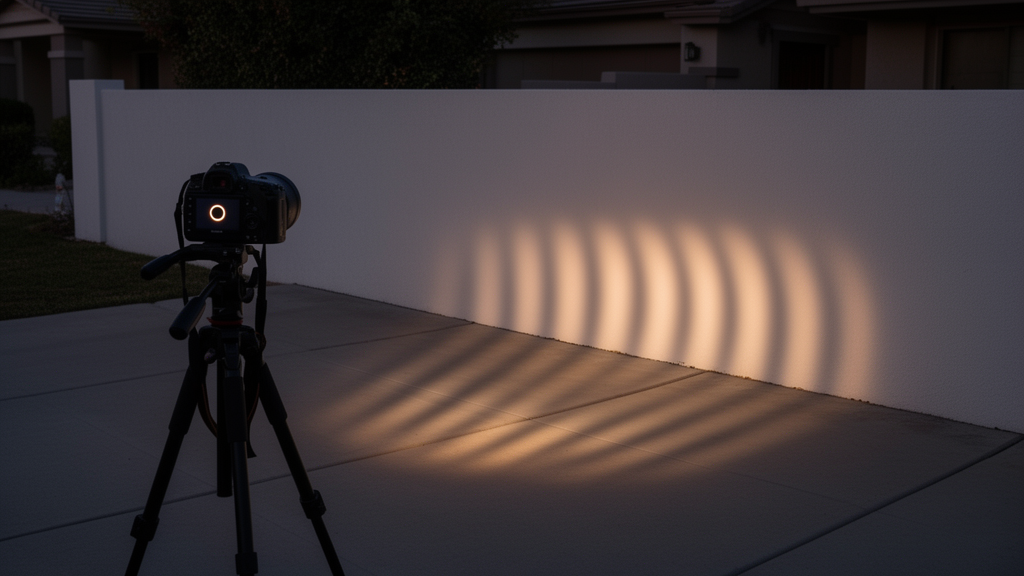
Eclipse shadow bands, the faint rippling patterns of light and dark that can sweep across the ground near solar eclipse totality, can now be measured quantitatively from ordinary video. A study published in Experimental Astronomy by Joseph Conti presents a reusable image-processing framework that turns ground-based video recordings captured with consumer-grade cameras into quantitative characterizations of these transient patterns. The method quantifies band prominence, orientation, separation, velocity, and power spectral density.

Applied to two eclipse datasets, the framework detected statistically significant shadow band activity during eclipse windows consistent with atmospheric scintillation theory. The analysis went beyond simple detection. It identified statistically significant shadow bands persisting for more than 10 minutes after third contact, the moment (C3) when totality ends, under conditions of high partial solar obscuration. It also documented temporal rotation of shadow band orientation over the course of an event.

The analysis further identified simultaneous shadow band modes with distinct orientations and velocities, indicating that multiple band patterns with different geometries and motions can coexist in the same recordings.

The persistence of shadow bands well after C3, under high partial solar obscuration, provides observational evidence supporting the hypothesis that, under favorable atmospheric conditions, shadow bands may also occur outside the path of totality, in regions experiencing only a partial eclipse.

The study is a methods paper, and its claims rest on the two eclipse datasets analyzed rather than a broad survey of events. The abstract does not report the geographic locations, camera configurations, or atmospheric conditions of the recordings, and the statistical significance statements apply to the detected band activity within the analyzed windows.

Nevertheless, the results demonstrate that consumer-grade video recordings can support quantitative characterization of detailed and dynamic shadow band behavior. The author positions the framework as a reusable tool for future observational and atmospheric studies of the phenomenon.

For now, the framework stands as a validated pipeline for extracting band prominence, geometry, motion, and spectral content from video, and as evidence that shadow band activity can be measured systematically with widely available equipment.

Subject of Research: Quantitative image-processing analysis of eclipse shadow bands using consumer-grade video recordings

Article Title: A quantitative image-processing framework for eclipse shadow band analysis

Article References: Conti, J. (2026). A quantitative image-processing framework for eclipse shadow band analysis. Experimental Astronomy, 62(3), Article 25. https://doi.org/10.1007/s10686-026-10086-4

Image Credits: AI Generated

DOI: 10.1007/s10686-026-10086-4

Keywords: eclipse shadow bands, image processing, atmospheric scintillation, solar eclipse, totality, third contact, consumer cameras, power spectral density, partial eclipse, Experimental Astronomy, quantitative, image-processing

Cite Scienmag News

Grant Pearson. (October 26, 2026). Consumer Video Yields Quantitative Framework for Eclipse Shadow Bands. Scienmag. https://scienmag.com/consumer-video-yields-quantitative-framework-for-eclipse-shadow-bands/

Grant Pearson. "Consumer Video Yields Quantitative Framework for Eclipse Shadow Bands." Scienmag, 26 October 2026, https://scienmag.com/consumer-video-yields-quantitative-framework-for-eclipse-shadow-bands/. Accessed 26 October 2026.

Grant Pearson. "Consumer Video Yields Quantitative Framework for Eclipse Shadow Bands." Scienmag. October 26, 2026. https://scienmag.com/consumer-video-yields-quantitative-framework-for-eclipse-shadow-bands/


Tags: atmospheric scintillationatmospheric scintillation and eclipse shadow bandsconsumer camerasconsumer video eclipse shadow band measurementeclipse shadow band velocity and spectral densityeclipse shadow bandsExperimental Astronomyground-based video analysis of eclipse phenomenaimage processingimage processing framework for eclipse patternsmultiple shadow band modes during solar eclipseobservational evidence for eclipse shadow band theoriespartial eclipsepersistence of shadow bands post-totalitypower spectral densityQuantitativequantitative analysis of eclipse shadow bandsshadow band prominence and orientation analysissolar eclipsesolar eclipse shadow bandstemporal rotation of eclipse shadow bandsthird contacttotality
Share26Tweet16
Previous Post

AI drug recommendations favor famous brands, adding millions in costs

Next Post

Witnesses, models and mud reveal Chile’s 1989 glacial flood was vastly underestimated

Related Posts

Collapsing Stars May Power Gamma-Ray Bursts While Erasing Black Hole Singularities
Space

Collapsing Stars May Power Gamma-Ray Bursts While Erasing Black Hole Singularities

October 25, 2026
Galaxy Clusters Reveal Hints of Cosmic Anisotropy, but the Universe Refuses to Break Its Symmetry Just Yet
Space

Galaxy Clusters Reveal Hints of Cosmic Anisotropy, but the Universe Refuses to Break Its Symmetry Just Yet

October 25, 2026
New Black Hole Model Keeps Curvature Below the Planck Scale Everywhere
Space

New Black Hole Model Keeps Curvature Below the Planck Scale Everywhere

October 25, 2026
Energy extraction processes and thermodynamics in rotating Weyl conformal black holes
Space

Energy extraction processes and thermodynamics in rotating Weyl conformal black holes

October 25, 2026
Two atoms, three spacetimes: when cosmic expansion, acceleration and heat tell the same story
Space

Two atoms, three spacetimes: when cosmic expansion, acceleration and heat tell the same story

October 25, 2026
Probing the sensitivity of dark energy dynamics to equation of state parametrization flexibility
Space

Probing the sensitivity of dark energy dynamics to equation of state parametrization flexibility

October 25, 2026
Next Post
Witnesses, models and mud reveal Chile’s 1989 glacial flood was vastly underestimated

Witnesses, models and mud reveal Chile's 1989 glacial flood was vastly underestimated

  • Mothers who receive childcare support from maternal grandparents show more optimized

    Mothers who receive childcare support from maternal grandparents show more parental warmth, finds NTU Singapore study

    27656 shares
    Share 11059 Tweet 6912
  • University of Seville Breaks 120-Year-Old Mystery, Revises a Key Einstein Concept

    1061 shares
    Share 424 Tweet 265
  • Bee body mass, pathogens and local climate influence heat tolerance

    682 shares
    Share 273 Tweet 171
  • Researchers record first-ever images and data of a shark experiencing a boat strike

    546 shares
    Share 218 Tweet 137
  • Groundbreaking Clinical Trial Reveals Lubiprostone Enhances Kidney Function

    531 shares
    Share 212 Tweet 133
Science

Embark on a thrilling journey of discovery with Scienmag.com—your ultimate source for cutting-edge breakthroughs. Immerse yourself in a world where curiosity knows no limits and tomorrow’s possibilities become today’s reality!

RECENT NEWS

  • Cave bear cub skeletons reveal cubs grew faster than brown bears and died mostly before their first hibernation
  • Zinc oxide nanoparticles boost antibiotics against resistant bacteria, review finds
  • Cryptic amplifier hosts: the overlooked bridge species in bat virus spillover
  • Witnesses, models and mud reveal Chile’s 1989 glacial flood was vastly underestimated

Categories

  • Agriculture
  • Anthropology
  • Archaeology
  • Athmospheric
  • Biology
  • Biotechnology
  • Blog
  • Bussines
  • Cancer
  • Chemistry
  • Climate
  • Earth Science
  • Editorial Policy
  • Marine
  • Mathematics
  • Medicine
  • Pediatry
  • Policy
  • Psychology & Psychiatry
  • Science Education
  • Science News
  • Social Science
  • Space
  • Technology and Engineering

Subscribe to Blog via Email

Enter your email address to subscribe to this blog and receive notifications of new posts by email.

Join 5,151 other subscribers

© 2025 Scienmag - Science Magazine

Welcome Back!

Login to your account below

Forgotten Password?

Retrieve your password

Please enter your username or email address to reset your password.

Log In
No Result
View All Result
  • HOME
  • SCIENCE NEWS
  • CONTACT US

© 2025 Scienmag - Science Magazine

Discover more from Science

Subscribe now to keep reading and get access to the full archive.

Continue reading