


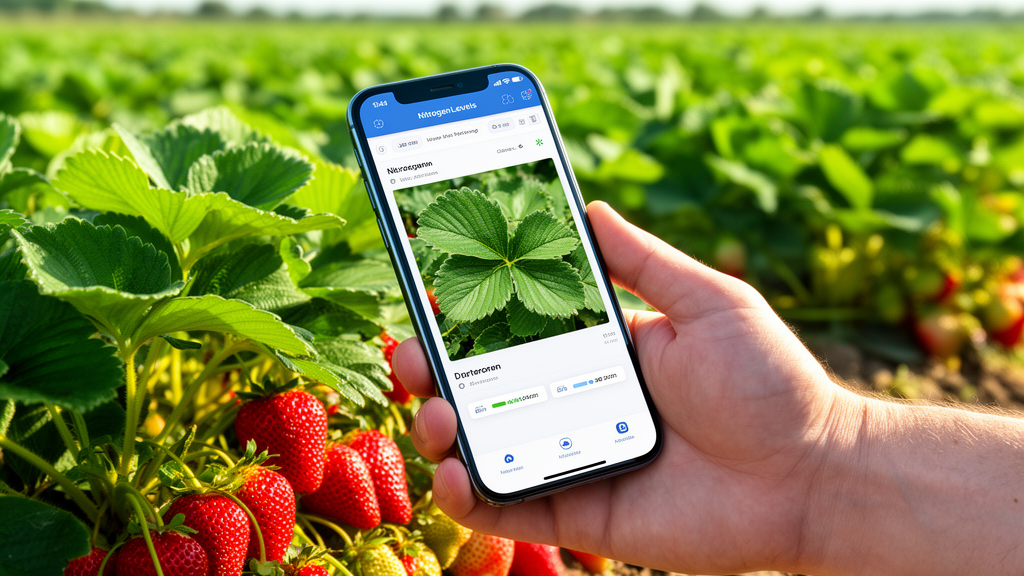
A strawberry field on the misty hills of Meghalaya, India, has become the testing ground for an unusual kind of farmhand: a smartphone application that looks at leaf photographs, decides how hungry each plant is for nitrogen, and then tells a drip fertigation system exactly how long to run. The system, developed by researchers at the ICAR Research Complex for North Eastern Hill Region in Umiam, was evaluated across an entire growing season on the cultivar Sweet Sensation, and its harvest numbers came back remarkably close to those of a conventional, fixed nitrogen schedule. The work, published in Results in Engineering, does not claim that artificial intelligence outperformed traditional fertilization. What it demonstrates is something arguably more important for the future of smallholder farming: that a complete chain running from a phone camera to a quantitative fertilizer decision can be executed in real fields, not just in the laboratory.
Nitrogen sits at the heart of strawberry production. It is a fundamental component of chlorophyll, the pigment that captures light energy for photosynthesis, and it is indispensable for building the amino acids and proteins that drive plant growth. Getting the dose right, however, is a balancing act. Too little nitrogen stunts growth and depresses yield, while too much pushes plants into lush vegetative growth at the expense of fruit set and sweetness, and the surplus can leak into groundwater and degrade soil. Traditional assessment methods, such as the Kjeldahl chemical digestion of leaf samples, are accurate but slow, equipment-intensive and unsuited to rapid, repeated checks. Handheld chlorophyll meters offer a faster, non-destructive proxy, but their readings depend on which leaf is measured and where, and they require crop-specific calibration. Spectroscopy and satellite imagery can cover broader areas but demand sensors, radiometric correction and technical expertise that many small farmers simply do not have.
The research team’s answer was to build on their earlier nitrogen-prediction work and close the loop between diagnosis and action. First, they calibrated a SPAD-502 chlorophyll meter against Kjeldahl-determined leaf nitrogen using thirty plant samples, producing a regression with an R-squared of 0.89. This relationship converted the meter readings attached to each leaf photograph into estimated nitrogen percentages, which were then binned into eight classes spanning less than 2.25 percent up to more than 3.75 percent, with 0.25-percentage-point intervals between the interior classes. In total, roughly 3,400 leaf images were captured between 45 and 100 days after transplanting, and 3,000 passed quality screening and were organized into the class structure used for model development.
The prediction engine is a multi-image convolutional neural network with a distinctive input design: rather than judging a single leaf, it processes five leaf images from the same plant as one sample, producing one plant-level nitrogen prediction. Each of the five images flows through its own parallel branch of six convolutional layers with max-pooling, and Squeeze-and-Excitation modules are inserted after the early pooling stages. These modules work by squeezing feature maps into channel-wise statistics through global average pooling, then learning adaptive scaling factors that emphasize informative features and suppress irrelevant ones. The five branches are concatenated into a final SoftMax output layer that assigns the plant to one of the eight nitrogen classes. The model was trained end-to-end on the field dataset without pre-trained weights, using the Adam optimizer, categorical cross-entropy loss, and dropout layers to guard against overfitting.
Because the fertigation decision is ultimately binary — does this plant need additional nitrogen or not — the researchers evaluated the network on seventy-five entirely independent plants by grouping classes C1 through C7 as below the adopted upper operational reference and therefore requiring intervention, with class C8 treated as not requiring more. On this operational criterion, the system achieved an accuracy of 78.67 percent, a precision of 75.5 percent, a recall of 93.0 percent and an F1-score of 83.4 percent. The high recall means that forty of the forty-three plants genuinely needing intervention were correctly flagged, with only three missed. The lower precision reflects thirteen false alarms among plants that did not need more nitrogen. The authors caution that these figures describe the binary intervention decision, not performance across the eight individual classes, and that the fine 0.25-percent class intervals make the classification task harder than broader nutrient-deficiency categories used in many prior studies.
The trained model was then converted to TensorFlow Lite and embedded in an Android application named NitroMate. Mobile deployment cost little: the on-device version reached an operational accuracy of 77.05 percent, only 1.62 percentage points below the base model, and processed a five-image plant-level input in roughly two seconds. The app’s workflow is deliberately simple. A grower photographs leaves from ten to twelve plants per terrace, and the app averages their predicted nitrogen concentrations into a terrace-level estimate. The user then enters the drip emitter discharge rate, the crop growth stage, and the urea concentration in the irrigation water. Behind the scenes, the app calculates the nitrogen deficit per plant from the difference between a fixed 4.0 percent operational reference — the upper endpoint of published strawberry tissue-nitrogen sufficiency ranges — and the predicted concentration, scaled by plant dry biomass measured at five growth stages. That deficit is converted into a urea requirement assuming 46 percent nitrogen content and 90 percent nitrogen use efficiency, then into a water volume and finally a fertigation duration in minutes.
The field trial compared three treatments across nine terraces: AI-guided fertigation on T1 through T3, a pre-defined seasonal schedule of 80 kilograms of nitrogen per hectare on T4 through T6, and a no-nitrogen control on T7 through T9. Fertigation ran once weekly for ten events, with smartphone images captured immediately before each AI-guided application so that recommendations responded to the current plant status. The dynamic nature of the system was evident in the numbers: predicted plant nitrogen ranged from 2.30 to 3.22 percent, estimated deficits from 0.07 to 0.35 grams per plant, urea requirements from 0.18 to 0.85 grams per plant, and model-derived fertigation durations from 10.60 to 50.00 minutes. The prescriptions varied among terraces and across successive events, showing that the system did not apply a constant dose.
The harvest results told a story of near-parity. Area-normalized cumulative yield averaged 20,744.60 kilograms per hectare under the AI-guided treatment against 20,909.45 kilograms per hectare under the pre-defined schedule — a numerical difference of just 0.79 percent — while the no-nitrogen control produced 17,477.42 kilograms per hectare. Mean fruit weights were similarly close, at 24.30 grams under AI guidance versus 24.62 grams under the fixed schedule, with the control pooled at 21.94 grams. Statistical analysis, however, demands careful reading. One-way ANOVA of yield showed no significant treatment effect, and Tukey’s HSD found no significant pairwise differences. The authors stress that the trial was not designed as an equivalence or non-inferiority study, that treatments were assigned to contiguous terrace groups on a slope rather than randomized, and that a sensitivity analysis indicated the design would only detect very large effects. The similarity in yields is therefore a numerical observation, not statistical proof of parity.
Where the AI-guided strategy clearly fell short was fertilizer productivity. Because the algorithm recalculated the nitrogen deficit from current plant status at every event without subtracting previously applied fertilizer, and because it anchored everything to the fixed 4.0 percent reference, the area-weighted seasonal nitrogen application reached 282.47 kilograms per hectare — more than three and a half times the pre-defined rate. Fruit yield per unit of applied fertilizer nitrogen was consequently 73.44 kilograms per kilogram under AI guidance versus 261.83 kilograms per kilogram under the fixed schedule. The researchers identify this recommendation component, rather than the sensing component, as the critical next target for calibration. They also note that long-term soil effects, nitrogen losses, economic returns and environmental benefits were not measured, and that validation across multiple seasons, locations and cultivars is required before broader deployment. Even so, the study establishes a proof of concept that could matter enormously for small terraced fields where dedicated spectral sensors, GPS-guided machinery and satellite analytics are impractical. A farmer with an ordinary Android phone, a gravity-fed drip system and row-level flow valves can now run a plant-responsive nitrogen program.
Subject of Research: A smartphone-based deep learning decision support system that predicts strawberry plant nitrogen status from leaf images and generates quantitative fertigation recommendations evaluated under field conditions
Article Title: Smart fertigation: A deep learning-based hand-held decision support system for plant-responsive nitrogen management in strawberry production
Article References: Singh, N., Ajaykumar, K., Sahu, A., Thangavel, R., Verma, V. K., Choudhury, B. U., & Kadirvel, G. (2026). Smart fertigation: A deep learning-based hand-held decision support system for plant-responsive nitrogen management in strawberry production. Results in Engineering, 32, Article 113646. https://doi.org/10.1016/j.rineng.2026.113646
Image Credits: AI Generated
DOI: 10.1016/j.rineng.2026.113646
Keywords: strawberry, nitrogen management, fertigation, deep learning, convolutional neural network, smartphone app, precision agriculture, drip irrigation, Squeeze-and-Excitation, plant sensing, urea, field trial
Cite Scienmag News
Blake Davidson. (October 26, 2026). Smartphone AI app guides strawberry nitrogen fertigation from leaf photos alone. Scienmag. https://scienmag.com/smartphone-ai-app-guides-strawberry-nitrogen-fertigation-from-leaf-photos-alone/
Blake Davidson. "Smartphone AI app guides strawberry nitrogen fertigation from leaf photos alone." Scienmag, 26 October 2026, https://scienmag.com/smartphone-ai-app-guides-strawberry-nitrogen-fertigation-from-leaf-photos-alone/. Accessed 26 October 2026.
Blake Davidson. "Smartphone AI app guides strawberry nitrogen fertigation from leaf photos alone." Scienmag. October 26, 2026. https://scienmag.com/smartphone-ai-app-guides-strawberry-nitrogen-fertigation-from-leaf-photos-alone/


